
Related videos:
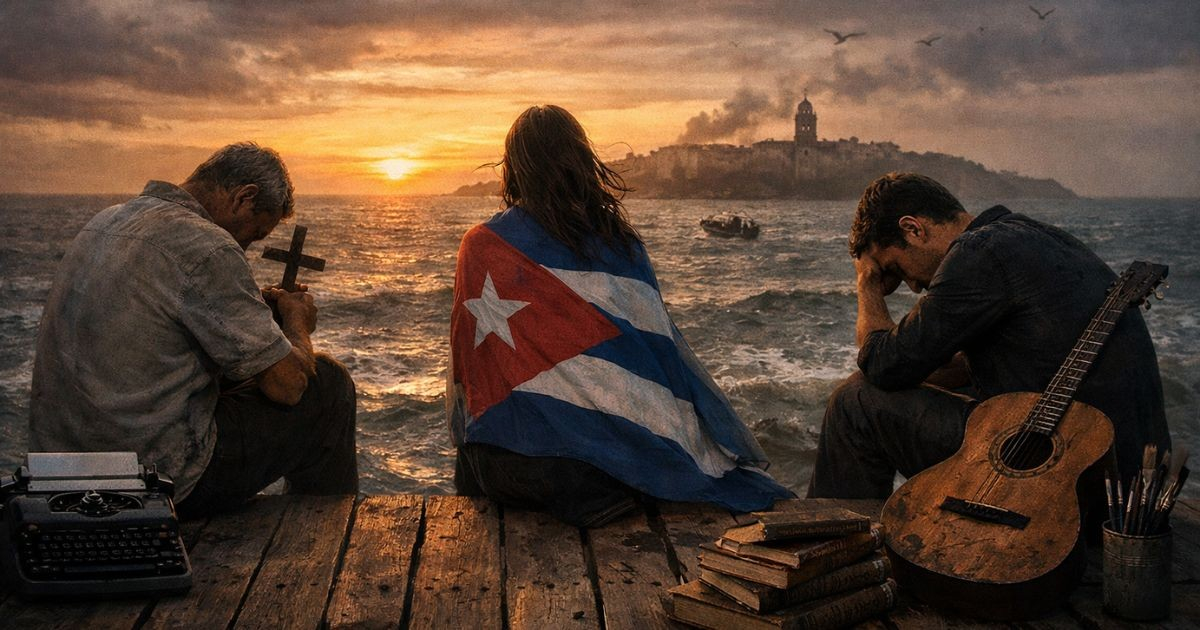
The Washington D.C. Bible Museum will host the August 21 upcoming conference "Coastline and the Cross," a free event—both in-person and virtual—dedicated to the art and literature of the Cuban Christian community in exile, organized by journalist and writer Yoe Suárez as part of the 250th anniversary of the independence of the United States.
The event, announced by Suárez on his social media, will bring together five exiled Cuban writers and artists who will explore, from their direct experience, the social impact of limited freedom on the island, with a special emphasis on religious freedom. The program will run from 1:00 p.m. to 5:45 p.m. EDT in the Conference Room of the Fellowship Initiative, 5R Floor of the museum.
"I am honored to organize this event for exiled Cuban authors alongside the Museum of the Bible in Washington DC, in the 250th year of the United States," wrote Suárez when announcing the meeting. "We will talk about that wound called Cuba, about the challenges and the courage of those who dare to express themselves, associate, believe, and create under socialist tyranny," he detailed.
The five speakers are: Yaiset Matos, Oscander Rodríguez Frómeta, Yoaxis Marcheco, Mauricio Vega, and Suárez himself, each with a history characterized by resistance and repression within Cuba.
Suárez (Havana, 1990), journalist and documentary filmmaker, will present a lecture based on his eight years of research reflected in Hoz y Cruz, a 828-page work, winner of the Manuel Márquez Sterling 2025 Non-Fiction Literature Award and published in June 2026. Suárez was interrogated and harassed on multiple occasions by State Security and went into exile in 2022.
His research asserts that the Cuban evangelical community "became the most important force of civil society against Castro's policies between 2018 and 2022," gathering approximately 180,000 signatures against the regime's new Constitution, one of the largest independent initiatives on the island in six decades.
Mauricio Vega (Havana, 1986), founder of the independent publication Supervivo and the art festival Festivo in Cuba, will address survival in Cuban visual arts. His lecture begins with Fidel Castro's famous phrase: "Within the revolution, everything; against the revolution, nothing," to examine how the regime attempted to control or suppress all forms of independent creativity and faith. Marcheco denounced in March 2026 the detention of a 16-year-old teenager, son of an evangelical pastor, accused of sabotage following protests in Morón, Ciego de Ávila.
Oscander Rodríguez Frómeta (Maisí, Guantánamo, 1978), former CBN correspondent in Cuba from 2011 to 2018, will present how evangelical journalists built communication networks—from DVD recordings to digital platforms—to document realities that official media silence, providing "a window to the outside for a society long kept isolated."
Yaiset Matos, journalist graduated from the University of Havana will discuss the evangelistic campaign "Power to Transform" from 2017 in Havana, which was subject to surveillance and interruptions by State Security. Her conference examines how Decree 349 and Decree-Law 370 impact religious and creative life on the island.
Yoaxis Marcheco (Mayarí, 1973), journalist and co-founder of the Patmos Institute for the defense of religious freedom, will finally share a reflection on the young Cuban evangelical influencers who use digital platforms to address social and political issues despite the risks and repression, and who have become a powerful voice of protest in the country.
The Cuban dictatorial power has continued for decades a pattern of surveillance and repression against religious communities that do not align with its directives. This has been systematically denounced by believers in Cuba and other countries.
The colloquium is free of charge but requires prior registration. Interested parties can consult the program and register on the Museum of the Bible's website, where the option for virtual attendance is also available.
Filed under: