
Related videos:
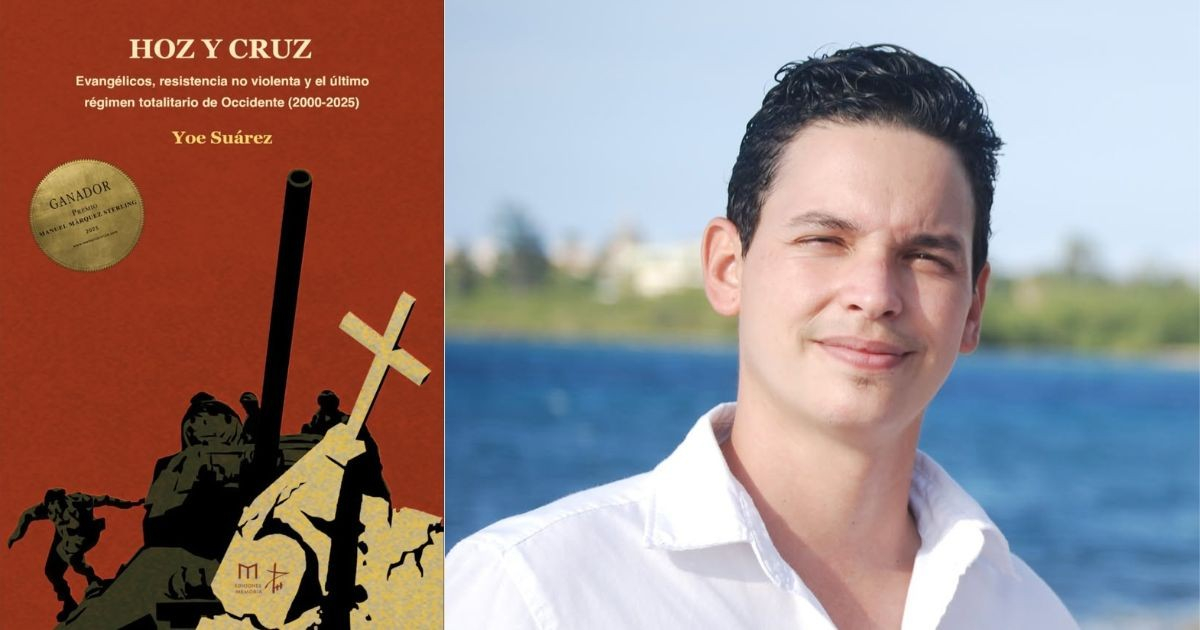
The publishing houses Ediciones Memoria and Ediciones Homagno released this week the volume "Hoz y Cruz: Evangelicals, Nonviolent Resistance, and the Last Totalitarian Regime of the West (2000-2025)", a work by Cuban journalist and writer Yoe Suárez, who is in exile in the United States. The book explores a quarter-century of nonviolent civic struggle by the evangelical community in Cuba against the Castro regime; it is available on Amazon and other digital platforms.
The extensive book, spanning 828 pages, is the result of eight years of research that began in 2018 and was marked by arrests, surveillance, censorship, internet outages, and the author's exile in September 2022. The work won the Manuel Márquez Sterling 2025 Non-Fiction Literature Prize, a significant recognition of Cuban literature in exile.
“I began writing Hoz y Cruz in 2018, without knowing that I was writing it,” recalls Suárez in an interview with journalist Diane Hernández for Voz Media, and he explains that the idea emerged while observing how the widespread access to mobile internet and the process of constitutional reform by the regime were transforming the participation of Cuban civil society.
In that context, multiple social actors emerged, but Suárez argues that evangelicals held a unique position: "They stood out for their mobilization capacity, distinctiveness in the political spectrum, and impact."
According to the book, dozens of evangelical churches led a national campaign against the new Constitution promoted by the regime, which included the collection of approximately 180,000 signatures, one of the largest independent initiatives recorded in Cuba in the last six decades.
One of the main conceptual contributions of the work is the formulation of the Evangelical Civic Movement (MoCE), which Suárez defines as "the peaceful, sustained, and massive articulation of demands and actions, more or less coordinated, by the vast majority of the evangelical community in response to Castroist policies between 2018 and 2022," the interview states.
The author places the symbolic beginning of that movement on June 28, 2018, when the main evangelical churches released a statement against the government’s draft constitution, noting that its impact transcended the boundaries of the churches: “The MoCE energized the public sphere in a unique way.”
The book also highlights episodes that are practically unknown to newer generations: the peaceful recovery of the Baptist temple in Yaguajay, the "Life and Freedom" fast led by doctor Oscar Elías Biscet in 1999 to draw international attention to political prisoners, and the protest of approximately one thousand evangelicals outside the Provincial Court of Camagüey in support of political prisoner Orson Vila.
Suárez also denounces a double standard in the media treatment of religious resistance: "It seemed that if it was a political perspective supporting the left or progressivism, then the Church’s voice was indeed welcomed; but if it was a conservative, counter-revolutionary, or freedom-oriented viewpoint, then it was not convenient for that segment of the citizenry to speak."
The work is published in a context of documented and increasing religious repression. The Cuban Observatory of Human Rights recorded at least 873 violations of religious freedom in Cuba during 2025, and the U.S. Commission on International Religious Freedom placed Cuba in its most severe category in 2026 for "serious and ongoing violations."
The author refers to how the history of evangelical resistance connects with the "new generation of Christian content creators and influencers who are actively participating in the public debate in Cuba." Among these critical voices against the dictatorship are Anna Bensi (Anna Sofía Benítez Silvente) and Iván Daniel Calás, who have faced systematic harassment and mistreatment from the regime's repressive forces.
For Yoe Suárez, ignoring phenomena such as the MoCE leads to an incomplete understanding of the recent history of the island, including the social outbreak of July 11, 2021: "Each group that emerged into activism during the period contributed to the root of the 11J outbreak."
The journalist, who had already published "Leviathan. Cuban Political Police and Socialist Terror" —winner of the 2021 Ilíada Journalism Award— summarizes the spirit of his new work with a powerful statement: "The battle in the future Cuba will not be the reconstruction of buildings, but of the soul of the nation."
Filed under: