
Related videos:
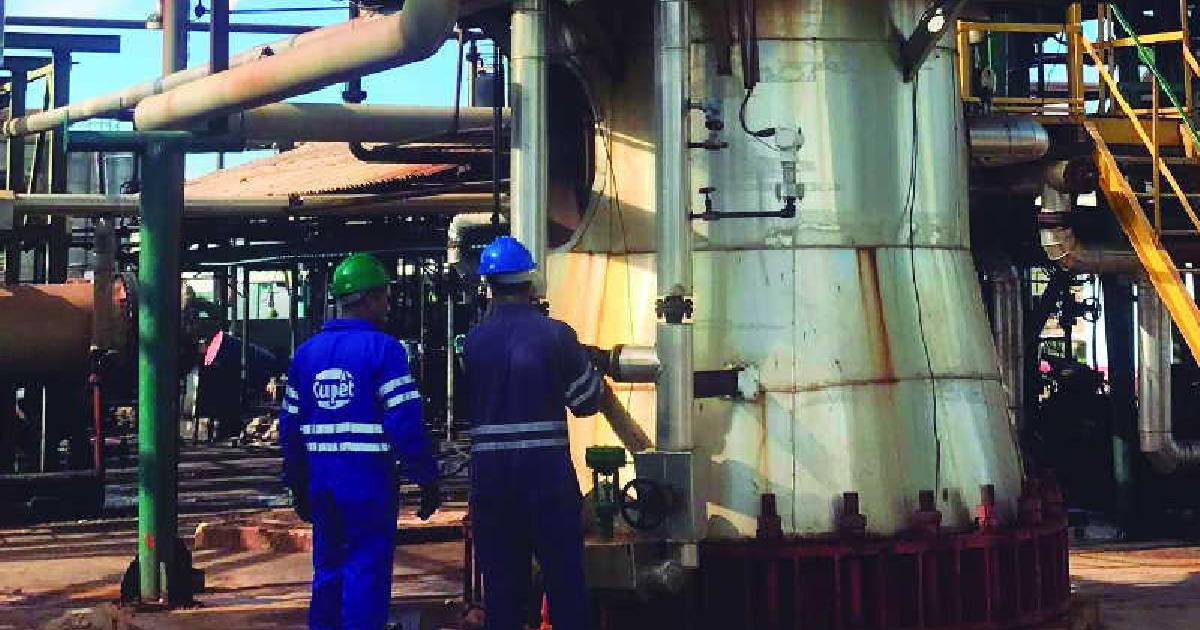
The Sergio Soto refinery in Cabaiguán, located in the province of Sancti Spíritus, continues its production using the crude oil residues accumulated at the bottom of the tanks of the Cienfuegos refinery and the Nico López refinery in Havana, the latter of which has been shut down since February due to a fire.
The strategy, confirmed this Saturday by Yudith Rodríguez, director of Accounting and Finance of the plant, reveals the level of precariousness to which the Cuban oil industry has reached amid the worst energy crisis the island has experienced in decades.
"We are collecting all the crude oil that remained in the tank foundations of the Cienfuegos refinery, Nico López refinery in Havana, which is currently inactive. All those foundations are coming here with a somewhat raw refining process, because they are already foundations with tanks at high levels of sulfur and viscosity," declared Rodríguez to the station Radio Sancti Spíritus.
The raw material that arrives in Cabaiguán is of low quality; the waste shows a high concentration of sulfur and elevated viscosity, which necessitates a refining process that the workers themselves acknowledge as inadequate.
The failure to meet the production plan is severe. The refinery was expected to inject 73,000 tons, but to date, it has only processed 14,000. Nonetheless, the director stated that the plant remains profitable and operates at 76% capacity thanks to diversified production.
"With only 14,000 tons injected out of a plan of 73,000, we managed to maintain profitability. We are not at full compliance, but we are at 76% with diversified productions, along with other production alternatives," Rodríguez specified.
The plant operates in direct coordination with the Ministry of Energy and Mines (Minem) and, according to the directive, with "the highest leadership of the country."
Since January, the secondary sanctions imposed by the Trump administration through Executive Order 14380 have reduced Cuban oil imports by 80% to 90%.
Venezuela cut its supply of between 25,000 and 35,000 subsidized barrels per day following the capture of former president Nicolás Maduro, and Mexico suspended its shipments.
Cuba produces only between 30,000 and 40,000 barrels of crude oil daily, which covers just 40% of a demand that ranges between 90,000 and 110,000 barrels per day.
The only recent relief was the Russian donation of 730,000 barrels, the derivatives of which began to be distributed on April 19, covering barely one-third of the national demand for a month.
The Nico López refinery was shut down on February 13, following a fire in a storage area for unused additives, which exacerbated the country's refining capacity issues.
The Cienfuegos plant, with a capacity of 150,000 barrels per day, was inactive for about four months before being reactivated with Russian crude oil.
Sergio Soto has been processing national crude since 2010 and increased its capacity from 400 to 600 tons daily in 2026, with plans to reach 1,000 tons daily.
Their products include naphtha, kerosene, gasoline, diesel, fuel oil, and asphaltic liquid, although the refining of Cuban crude oil faces structural limitations due to the high sulfur content and acidity of the national raw material.
The ruler Miguel Díaz-Canel summarized the extent of the collapse in April with a phrase that circulated widely: "There is almost no fuel."
Filed under: