
Related videos:
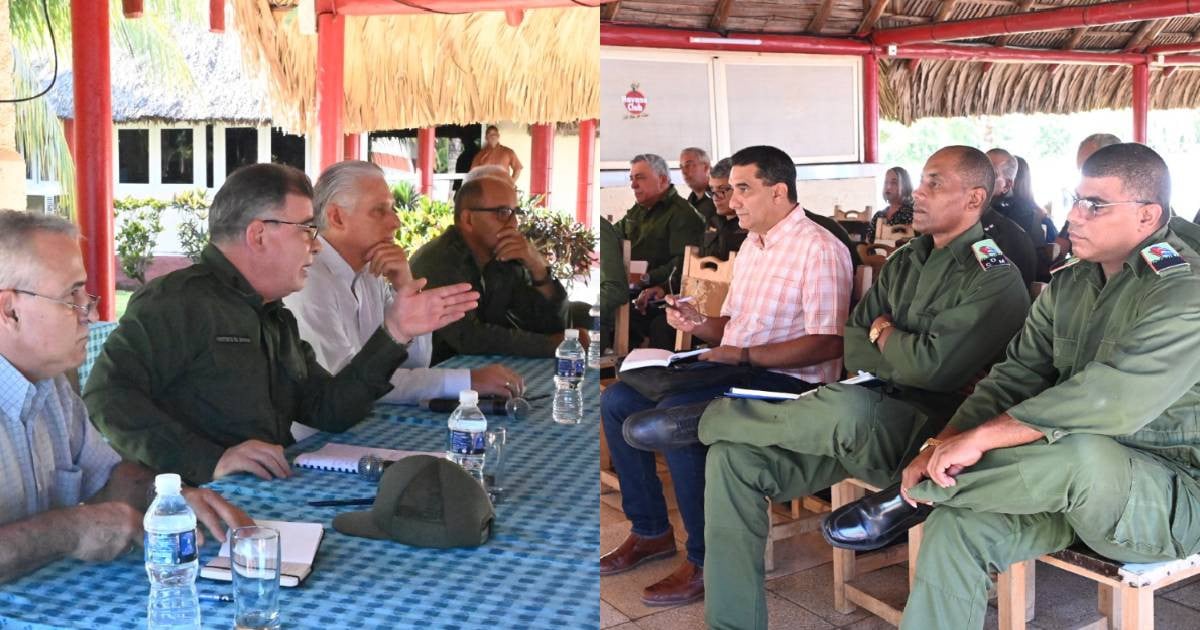
The president Miguel Díaz-Canel visited the Wajay Defense Zone this Saturday, located in the Boyeros municipality of the capital, to assess the integration of the Internal Order Groups into the territorial defense structures of the Cuban regime, which the government presented as a key step "to prevent and confront exceptional situations."
The visit, led by Díaz-Canel in his capacity as President of the National Defense Council, brought together three members of the Political Bureau: the Minister of the Interior, Army General Lázaro Alberto Álvarez Casas; the First Deputy Minister of the Revolutionary Armed Forces and Chief of the General Staff, Army General Roberto Legrá Sotolongo; and the Secretary of the Council of Ministers, Division General José Amado Ricardo Guerra, as noted in a report from the Presidency's portal this Sunday.
The Interior Order Groups are units of the Ministry of the Interior (Minint) that combine regular troops, Territorial Troops Militias, Production and Defense Brigades, and Minint forces with the civilian population, with missions related to internal order, security, and defense under a unified plan.
Díaz-Canel described the work of these groups as "a coherent, precise, firm, and creative response that has attended to the details," and asserted that their incorporation into defense areas, which are territorially equivalent to the popular councils, can provide cohesion and better functioning to each jurisdiction.
The official also stated that "organizational resources are not lacking, and we can always consider different solutions tailored to the characteristics of each location."
The visit is part of the Year of Preparation for Defense, declared by the regime for 2026 and inaugurated on January 12 with ceremonies in the three territorial armies, during which Saturdays were designated as permanent military training days for civilians.
The most recent meeting with high-ranking officials from the Cuban military establishments is part of a series of territorial control initiatives launched in recent months, such as the My Neighborhood for the Fatherland program, formally introduced in May and projected across more than 12,000 constituencies; the Community Youth Network, launched in April; and the reinforcement of the CDR as structures of "defense and combativeness" in every neighborhood.
The regime justifies this mobilization as a response to alleged threats from the government of President Donald Trump, which have escalated following the capture of former president Nicolás Maduro by U.S. forces in January.
However, the real context is far from the official discourse. According to a report in May from Cubalex, Cuba is experiencing a "de facto exceptionalism", with 31 documented events of security, defense, and repression just in March, which represents a 240% increase compared to February, of which 61% corresponded to repression or direct control over the population.
All of this is happening while the island endures daily blackouts lasting more than 20 hours, a chronic shortage of food and medicine, and a contraction of the GDP by 23% since 2019, a reality that the regime's militaristic apparatus cannot hide with territorial defense exercises.
Cubalex concludes that the regime is effectively implementing measures typical of a state of emergency "without it being formally declared or subjected to legal controls," representing the most extensive territorial control since the reactivation of the warlike discourse at the beginning of 2026.
Filed under: