
Related videos:
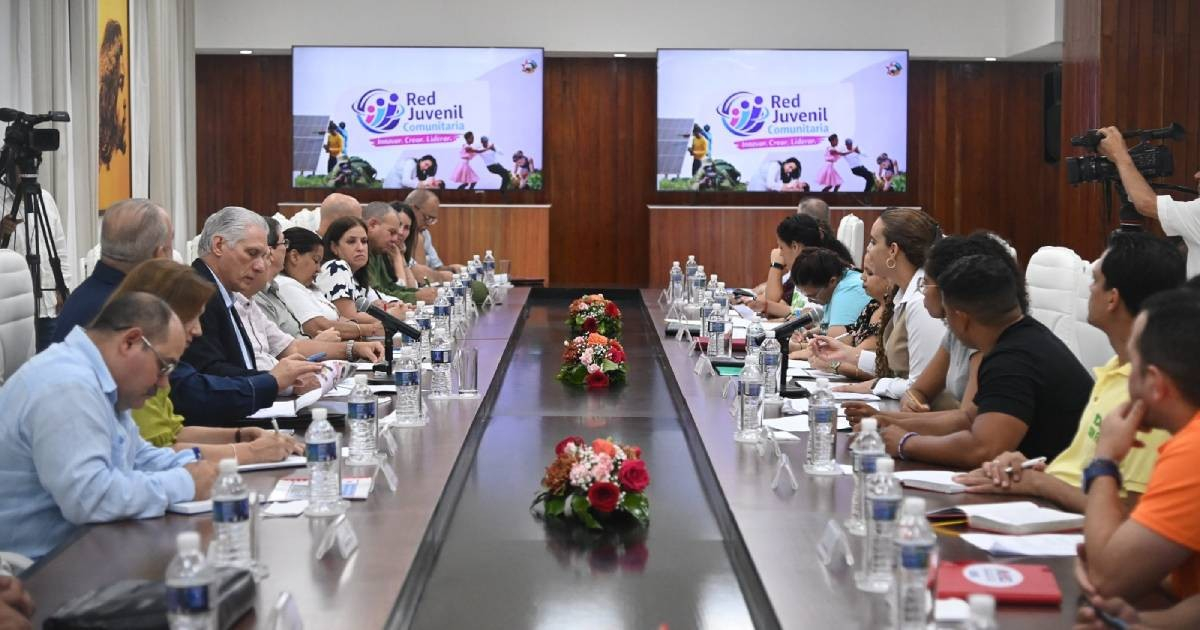
The Cuban regime introduced the so-called "Community Youth Network," an initiative announced by Prime Minister Manuel Marrero Cruz on his official X account and also led by the appointed ruler Miguel Díaz-Canel, with the participation of members of the Young Communist League (UJC) and student organizations.
The formal meeting on Wednesday has its origins in a previous gathering held on March 27 in the Protocol Room of Laguito, in Havana, according to the official broadcaster Radio Rebelde, where Díaz-Canel referred to the project as a "mega project" and urged the selected youth to "fight" for the Revolution under the slogan producing is resisting, and creating is overcoming.
In his message on X, Marrero Cruz described the network as an opportunity to engage and contribute, at the local level, in defense, production, social communication, ideological training, and cultural development.
The official language reveals the political nature of the initiative: far from being a spontaneous movement, the network will be supervised and executed by the entire state apparatus.
The prime minister himself was clear on the matter: "The ministries will not be support entities; they must participate, just like the governors and the administrative authorities of the municipalities," and he called to "mobilize the entire youth population to ensure that all projects are implemented."
The network structure is organized into seven projects under the slogan "Innovate, Create, Lead," arranged in brigades by strategic axes at the levels of the popular council, municipality, and province.
Among the most revealing projects is "Safe Youth Zone," aimed at preparing for defense through youth patrols monitoring community infrastructures, and "Youth Awareness," focused on fostering "love and defense of the homeland" and building the so-called "new man" in the face of "ideological warfare."
The "Código Joven" project goes further: it transforms youth communication into "a weapon for ideological battle," activating "digital youth hives" in provinces and municipalities to generate content and "debunk fake news against Cuba."
Meyvis Estévez Echevarría, the first secretary of the UJC, defined the network as "the organizational framework of youth in a territory that, organized into brigades around strategic axes, carries out actions in defense, production, communication, ideological training, culture, and solidarity."
The launch occurs at a time of deep legitimacy crisis for the regime among young Cubans. The UJC lost over 200,000 members between 2007 and 2024, decreasing from 609,000 to 415,000 affiliates, a decline of 32% mainly attributed to mass emigration and ideological disillusionment.
Some 800,000 young Cubans are disconnected from work and education, while Cuba experiences blackouts lasting up to 20 and 40 hours, hyperinflation, and chronic shortages of food and medicine.
The network will start gradually, with Old Havana as the starting point, in a context where Díaz-Canel has already set the tone for what lies ahead: "We already have the ideas, now the battle begins."
Filed under: