
Related videos:
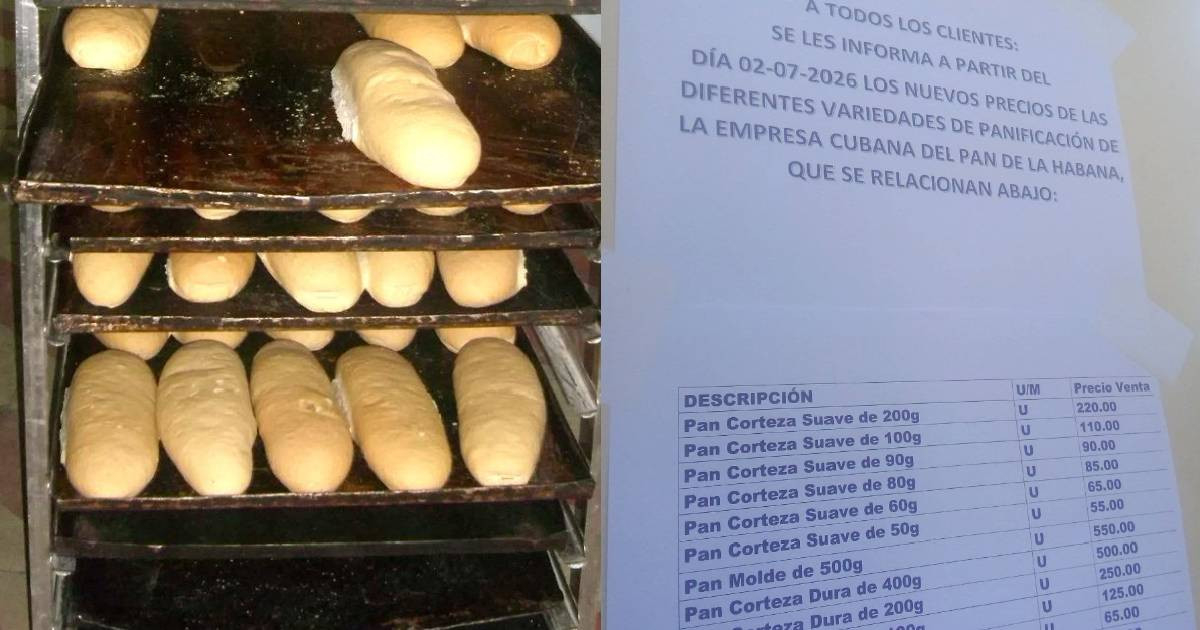
The engineer and private entrepreneur Yulieta Hernández Díaz shared this Sunday on Facebook a photograph of an official notice posted in establishments of the Cuban Bread Company of Havana, announcing that, starting July 2, new prices for all types of baked goods came into effect, with no public explanation regarding the reasons for the measure or a transition period.
According to the document, the 200-gram soft crust bread has gone up to 220 Cuban pesos, while the 100-gram version is priced at 110 pesos.
The 500-gram loaf of bread was set at 550 pesos, and the 400-gram crusty bread at 500 pesos. The 40-gram small cake, one of the most affordable options, is now sold for 40 pesos.
Hernández assured that he initially thought the notice was fake. "I saw this on social media... I thought it was fake, but it's not," he wrote. Although he reiterated that he believes the state should not be involved in bread production, he questioned how the decision was implemented.
"These measures, without prior explanation, after decades of state-run bread production and amid the current polycrisis, are incomprehensible. The least that should have been done was to explain the decision. Then, there should have been a defined transition: to tender or lease the bakeries with transparency, without discretion. The scheme should not have been changed overnight, nor should prices have been raised without clear information," he stated.
The businesswoman stated that the State should focus on ensuring the importation of wheat and the production and distribution of flour, rather than maintaining control over the entire production chain.
In his opinion, this would allow private producers to be supplied with lower logistical costs and greater stability in the supply.
He also warned about the social consequences of the increase in a context marked by blackouts, shortages, and the deterioration of purchasing power.
"We are on vacation, with the kids at home. Many mothers have no options to feed them or keep them entertained, without electricity to preserve food or cook. A loaf of bread, in that context, can be the meal for a child or an elderly person," she wrote.
Hernández concluded that the issue lies not only in the economic adjustment but in the way it is applied: "There are ways to implement this type of decision without the impact being so chaotic."
The increase directly impacts the income of Cubans. The new minimum wage, set at 3,210 pesos, came into effect on July 1, although workers will not start receiving it until August. With that amount, a worker could only purchase around 14 loaves of 200 grams each per month.
Retirees face an even more challenging situation, with a minimum pension of 3,056 pesos, while economists estimate that meeting basic needs requires about 96,000 pesos per month.
The publication sparked numerous reactions of outrage on social media. Among the comments, several users criticized the government for implementing price increases without providing solutions for the shortages or explaining the reasons behind their decisions.
Others recalled the closure or intervention of private bakeries that previously offered a greater variety of products and prices.
A mother of eight children in Matanzas reported on February 18 that she had paid 200 pesos for each loaf of soft bread. In Villa Clara, since February, the regulated bread is only distributed to those under 13 years old and over 65.
The increase comes amidst the worsening supply of flour in the country. In May, Ciego de Ávila received only 32 tons of flour, enough for two days of rationed bread for more than 430,000 residents.
Cuba needs around 20,000 tons monthly to ensure bread for the ration book, while its wheat mills remain idle or operate at minimum capacity.
In 2025, national bread production dropped by 100,900 tons and 17 companies in the food sector closed with losses of 364 million pesos.
Filed under: