
Related videos:
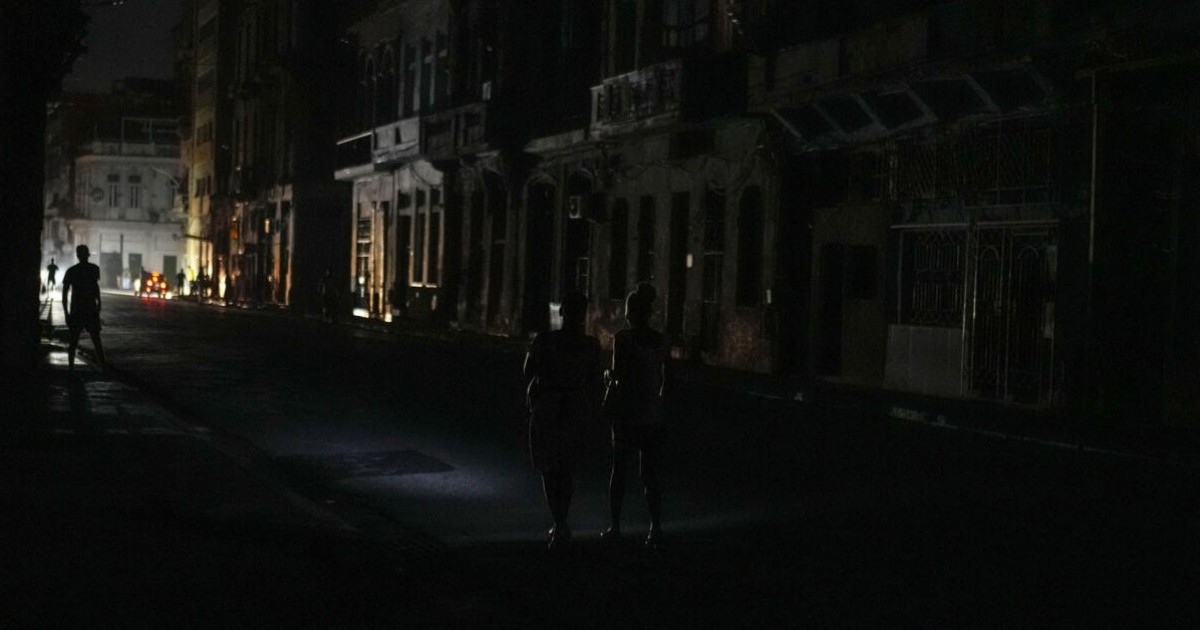
Cuba is facing another day of extreme electrical crisis this Sunday, which could surpass the worst record in its history.
According to the report from the Unión Eléctrica, the projected deficit for the nighttime peak hours reaches 2,200 MW, with a forecasted impact of 2,230 MW, resulting from a mere availability of 1,000 MW against an expected demand of 3,100 MW.
If the forecast holds true, this Sunday would surpass the record of 2,208 MW recorded on June 25, the most devastating figure in the country's recent electrical history.
On Saturday, the system was already operating at its limit: the service was affected for 24 hours, with a maximum impact of 2,201 MW at 10:00 PM that hit all provinces without exception.
The capital did not escape the collapse.
The Havana Electric Company confirmed that on Saturday, the service was interrupted for 24 hours in the city, with a maximum impact of 605 MW at 11:00 PM. "It was not possible to restore the service," the entity warned, noting that at the end of its report, there were still 448 MW affected.
The picture of breakdowns that explains the disaster is extensive.
Two units of the Máximo Gómez thermoelectric plant in Mariel, the Antonio Guiteras in Matanzas, another unit of the Diez de Octubre thermoelectric plant in Nuevitas, and one of the Lidio Ramón Pérez in Felton (Holguín) are out of service
In addition, there are maintenance blocks at the Máximo Gómez, Ernesto Guevara (Santa Cruz), Antonio Maceo (Santiago de Cuba), and Diez de Octubre plants, which further reduces the available capacity.
Distributed generation also provides no relief: 106 power plants remain out of service due to a lack of fuel, along with the Patana de Regla, the Patana de Melones, the Central Fuel in Mariel, and the Central Fuel in Moa.
The 54 photovoltaic solar parks generated 4,679 MWh on Saturday with a peak power of 709 MW, but their contribution becomes negligible during peak demand hours at night, when the crisis intensifies.
The root of the problem is structural, and the regime has been ignoring it for years.
The CTE Antonio Guiteras, out of service for 48 hours has been in operation for over 38 years without major maintenance since 2010 and has experienced 17 outages this year alone.
The director of the UNE, Román Pérez Castañeda, acknowledged that a permanent repair is necessary, but he admitted that "the country's situation still does not allow it."
The Minister of Energy and Mines, Vicente de la O Levy, promised that the capital maintenance would be completed by the end of 2025. He postponed it in December, citing a "temporary issue," and reiterated the announcement in April without setting a specific date.
The fuel deficit worsens the situation. Cuba needs between 90,000 and 110,000 barrels of oil daily to sustain its electrical system, but it only produces 40,000. The interruption of Venezuelan supplies since January, which provided around 35,000 barrels per day, has deepened the collapse without the regime finding a real solution.
The desperation of the population has surpassed fear. In June, 107 protests were recorded in Cuba, led by Havana, featuring people banging pots and pans, blocking streets, and shouting "Freedom!" in neighborhoods of the capital and other provinces.
The regime has responded with a police presence, arrests, and internet blackouts.
Activists called for massive daily pot-banging protests at 5:00 PM and 9:00 PM until July 11, demanding the release of political prisoners and the relinquishment of power by the regime, as Cuba faces what could be the worst blackout in its history.
Filed under: