
Related videos:
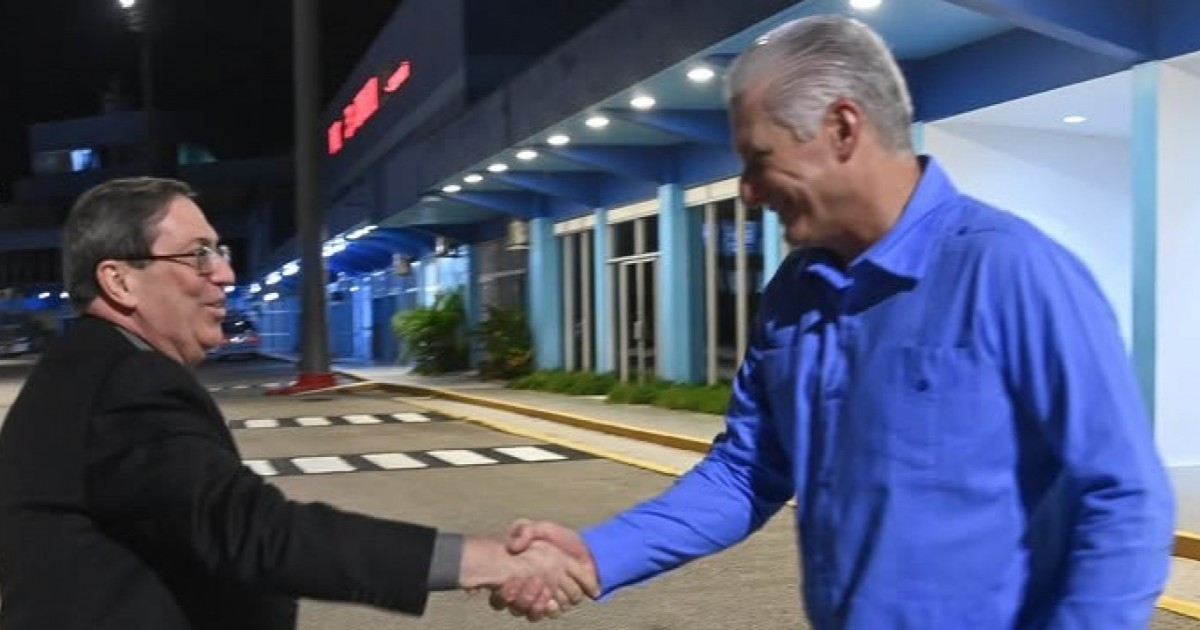
Miguel Díaz-Canel welcomed Foreign Minister Bruno Rodríguez Parrilla early this morning at José Martí International Airport upon his return from New York.
The leader posted on Facebook that Cuba achieved a "decisive VICTORY at the UN General Assembly," following the extraordinary session on Tuesday, July 7, regarding the U.S. embargo.
"It demonstrated the overwhelming support of the world for Cuba in its struggle against the genocidal blockade imposed by the United States government," he wrote.
What the regime celebrates as a triumph was, in reality, the approval of a debate with 136 votes in favor, nine against, and 30 abstentions, a vote that neither lifts nor modifies the embargo, but merely authorized a six-hour discussion session costing $168,000.
The result is significantly weaker than that obtained in the annual vote in October 2025, when Cuba received 165 favorable votes.
The abstentions doubled, increasing from 12 to 30, reflecting the partial effect of the intense diplomatic campaign led by Washington, which, according to a leaked cable from Secretary of State Marco Rubio, instructed embassies around the world to block the debate.
The U.S. Ambassador Mike Waltz did not overlook the cost figure. "With that money, thousands of Cuban children could have been fed instead of financing another propaganda spectacle for the regime," he wrote on his social media the following day.
Waltz also accused the military conglomerate GAESA of managing a trust fund of 18 billion dollars without those resources reaching the population.
During the session, Ambassador Jeffrey Bartos directly asked if the more than 800 political prisoners had electricity in their cells, referring to the third total collapse of the Cuban electrical system so far in 2026, which began on July 6 and left 9.6 million people without power.
"That is the true embargo on Cuba," Bartos asserted. "It is the embargo that the regime imposes on its own people: on freedom of expression, faith, entrepreneurial initiative, dissent, political rights, and hope, and now, quite literally, on light."
The European Union also did not support the regime's narrative. Its ambassador to the UN, Stavros Lambrinidis, demanded urgent political and economic reforms and the release of all those arbitrarily detained.
"The serious situation of the Cuban people is not solely due to the embargo," he stated, adding that the EU regrets Cuba's stance on Russia's war in Ukraine, describing it as incompatible with the principles of the UN Charter.
The context in which the debate took place further intensifies the contrast with the official narrative: Cuba has accumulated 1,281 political prisoners according to data from the European Parliament, which just three weeks before the debate approved individual sanctions against Díaz-Canel and leaders of GAESA. ECLAC projects a contraction of the Cuban GDP of 6.5% in 2026, the worst in the entire region.
Waltz concluded his remarks with a direct appeal to the countries present: "Stand with the Cuban people, do not side with the regime that has devastated that country. You cannot do both at the same time. The time has come to make a decision."
Filed under: