
Related videos:
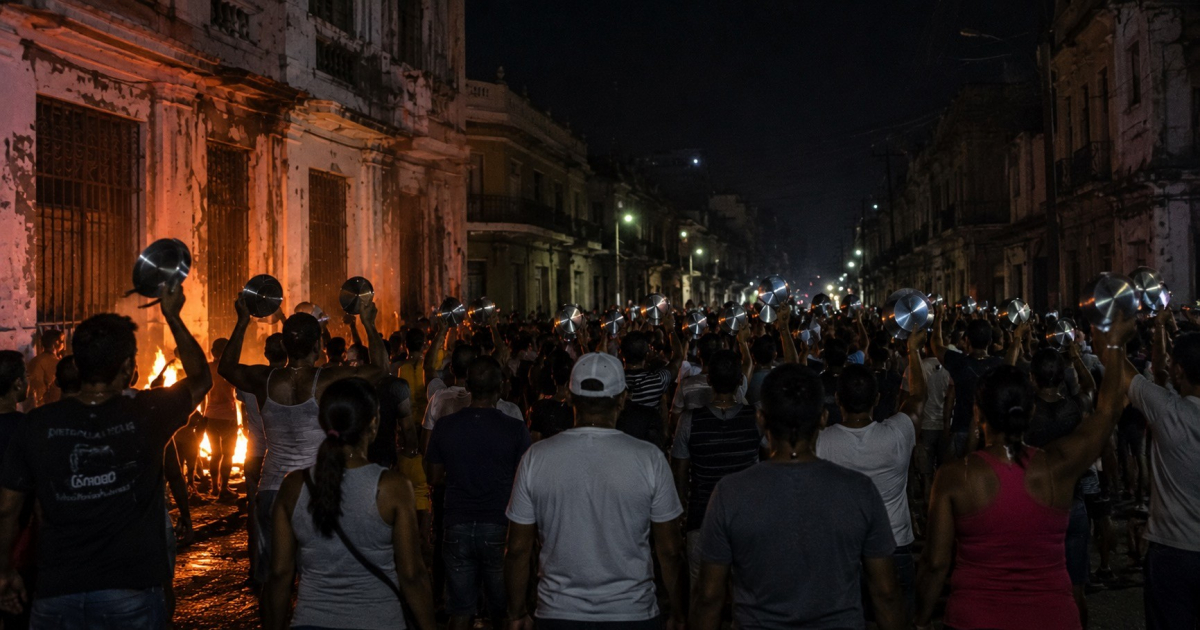
Every night, the Cuban spoons sound hungry as they clash against the hollow background of empty pots. The thunderous clamor has been spreading more and more throughout all of Cuba.
What started with bold individuals alone has transformed into a concert of rebellion reaching more and more municipalities or towns across the country. Those who are more fearful make their pots resonate from the intimacy of their homes, but an increasing number of bold citizens are taking to the streets, fully aware that they may face beatings or arrest by the repressive police, yet determined to assert their rightful claims.
There is something in the sound of these metal rings that terrifies tyrants. Once in our history, it was Carlos Manuel de Céspedes who made the majestic bell of his plantation, La Demajagua, resound, announcing the freedom of his slaves and calling them to rise up against the brutal Spanish colonialism. Those calls of forged bronze marked a milestone in the achievement of our independence. It was the consciousness of the burgeoning Cuban nation that summoned its finest sons to expel from power those who undermined their dream of sovereignty and independence.
It seems that there are echoes that shake the dictatorship: the ringing of church bells calling the congregation for the spiritual strengthening of its parishioners and the clang of pots and pans urging citizens to take to the streets and demand their rights.
Today, there are echoes from the streets and homes of Cuba calling us to stand up for a change in the system that has oppressed and degraded us as a people and as human beings for almost 70 years. Yes, some may see them as inconsequential echoes of pots and pans, but in reality, they are drums urging us to overcome our fears and rise up against our tyrant, while signaling that the end of that tyranny is fast approaching.
Ironically, those who do not doubt the determination of the Cubans are the enforcers of the dictatorship, who have been hearing citizens pass the word to participate in a national protest featuring pot banging on July 11, 2026, the same day as the fifth anniversary of that great peaceful social explosion of 2021. The call is also to begin rehearsing the Human Chain of Freedom, which consists of linking arms when the protesters gather in the streets, thereby creating barriers that make it more difficult for the repressors to break up the demonstrations.
The fear that Cubans will take to the streets en masse and become the sovereign internal force that dethrones those in power is so great that for days now, the informants of Castro and Díaz-Canel have been running an intimidating and morbid campaign in which they arrest conscientious citizens and brutally beat them. Then, in an act of unspeakable depravity, they strip them, take photographs of them without clothes, and leave them abandoned miles from their homes without money or a phone. More than one has been threatened with receiving “a bullet in the head” if they continue to call for participation in the cooking pot protests and the human chain. The victims of these atrocities have names and have reported these abuses in recent hours.
But instead of being intimidated, Cubans are increasingly realizing that while freedom can be very expensive at times, slavery is far more costly.
On one of those darkest nights in Havana, the lifelong tyrant of Cuba (take your pick, for even this duo of misfortune has afflicted Cuba) weighed down by the increasingly near clangor of pots and pans, will, in fright, open the window of his brightly lit room in his comfortable little palace and looking into the darkness will cry out with the frenetic voice of a scared tyrant anticipating his end: "For whom do the pots and pans clang?" And from the depths of that darkness, into which the rogue has plunged his country, a chorus of dignified voices will surely sound to the tyrant as those of Saylí Navarro, Annita Bensi, Félix Navarro, and many others responding by paraphrasing the legendary phrase of the English poet John Donne: "Do not ask for whom the [pots and pans clang, tyrant]; they clang for you."
Filed under:
Opinion article: Las declaraciones y opiniones expresadas en este artículo son de exclusiva responsabilidad de su autor y no representan necesariamente el punto de vista de CiberCuba.