
Related videos:
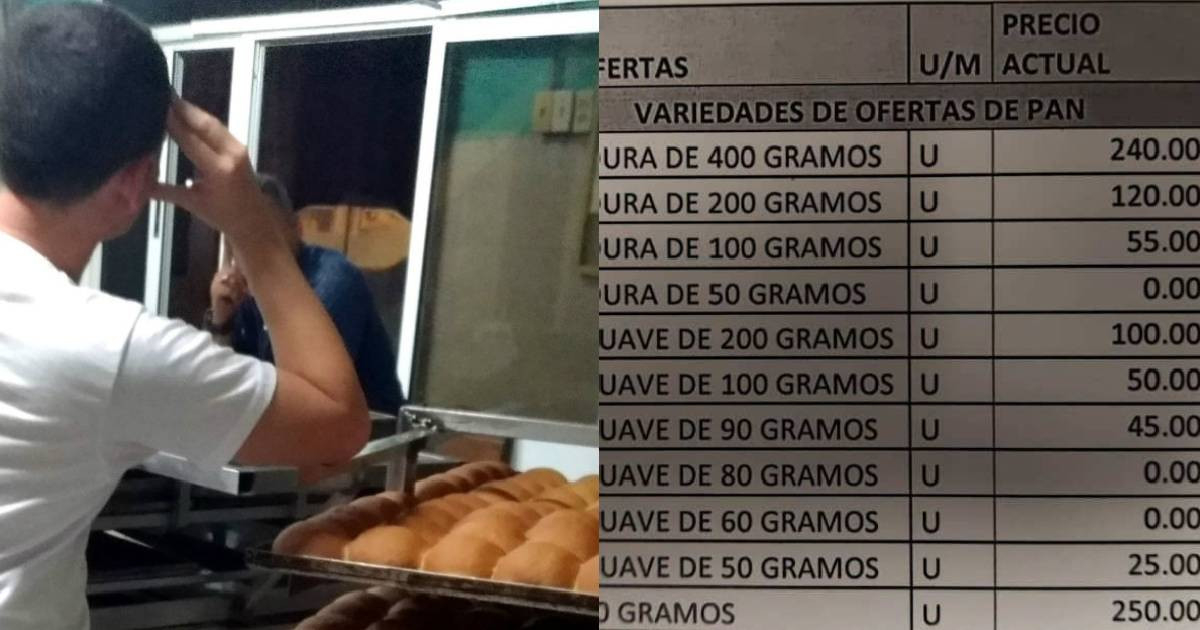
A week after bakeries in Havana began charging significantly higher prices for bread, the Municipal Assembly of the People's Power in Centro Habana published the new prices on Friday, amid criticism from citizens who claim that salaries barely allow them to purchase a few units each month.
The post on the Facebook page of the governmental entity that officially confirmed the new bread prices triggered an avalanche of comments from outraged Cubans about the impact that the increase will have on a population already affected by inflation and the loss of purchasing power.
The discontent was not solely directed at the price increase but also at the delay with which authorities communicated the measure. The new prices began to take effect on July 2 and only more than a week later were they officially published, when many consumers had already encountered the surprise at the bakeries.
"The poor elderly people arrived with their bags to buy their bread for 120 and found out it cost 250; of course, they had to leave with their bags empty," lamented a user, who questioned why the notice came when the price increase had been in effect for days.
One of the most shared comments summarized the impact of the measure on the income of Cubans: "So, the salary is enough for six loaves of hard crust bread weighing 400 grams. We are moving forward with increased resistance."
The situation of retirees was one of the main concerns expressed by citizens. "What retired person will be able to buy a loaf of bread? Or what worker, living on their meager salary, will be able to buy daily bread for their children's snacks? Truly, what is felt is impotence," wrote another internet user.
A mother described the new price of bread as "astronomical" and recalled that it was one of the few foods that many families could still afford for their children's breakfast. "It was the only thing we could buy to give our kids for breakfast," she noted.
Other users directly blamed the State for the rising costs. "In that price lies all the state inefficiency," wrote one commentator, while another summarized the vicious cycle that Cubans are experiencing: "The first to raise prices is the State. What’s the point of slightly increasing wages if prices continue to rise every day?"
Irony also shaped a significant part of the reactions. "Always thinking of the people," commented one user. Another wrote: "Just think, it could be worse... they could have priced it in USD, but out of consideration for the people, they didn't."
A third person added, "Before we bought little due to the poor quality of the bread; now we will be able to buy less because of how expensive it is. I would get paid eight loaves of bread a month. This is the country of the unheard of."
The Cuban Bread Company has effectively doubled the price of several of its products in Havana. The 400-gram crusty bread increased from 240 to 500 Cuban pesos, a rise of 108%, while the 200-gram bread went up from 120 to 250 pesos, and the 500-gram sliced bread rose from 250 to 550 pesos.
With the new minimum wage of 3,210 pesos, effective from July 1, although it will be paid in August, a worker can only purchase about six units of the 400-gram hard crust bread per month.
Retirees, whose minimum pension amounts to 3,056 pesos, are facing an even more critical situation.
The increase comes amid the deterioration of the state bread production system. In 2025, national production fell by 100,900 tons and 17 companies in the sector closed with losses amounting to 364 million pesos, while more and more Cubans are turning to making bread at home due to the constant increase in prices and the loss of access to a food considered basic.
Filed under: