Related videos:
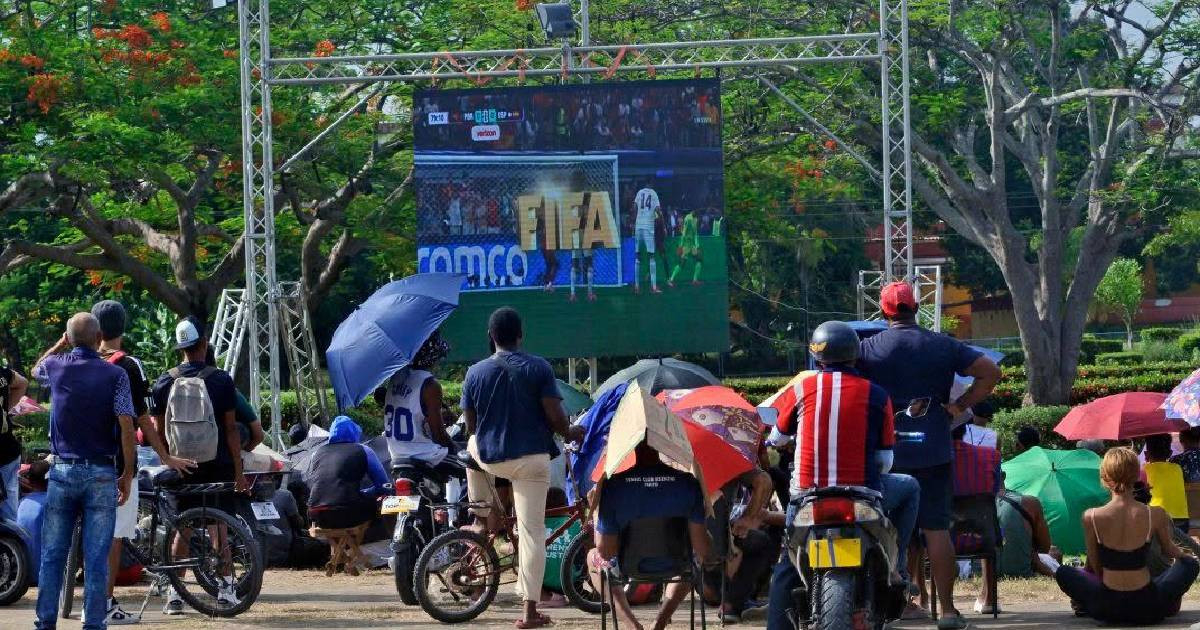
Due to the inability to guarantee electricity in homes, the authorities in Guantánamo have set up more than 60 audiovisual viewing centers in public squares and spaces across the province as part of the summer program "Summer with My People" and as a "solution" to the energy crisis that leaves Cubans without power for nearly the entire day.
"These centers emerge as an alternative in response to the country's electricity situation—due to the fuel blockade imposed by the United States government—to facilitate access to television and other audiovisual content of interest for the people," declared Richard Cruz Alcedo, sports director of the region, as quoted by the official newspaper Venceremos.
Among the state-enabled spaces are the Plaza de la Revolución Mariana Grajales and the multipurpose hall Rafael Castiello; among the non-state venues are La Majagua and the Huambo cinema, he specified.
The busiest center is located in Plaza de la Revolución, which operates thanks to the collaboration of the mipyme Marcapaso, the Electric Company, Etecsa, the Sports Directorate, and the provincial government.
The programming includes the World Cup, the upcoming Central American and Caribbean Games, the prime-time news, Cuban films, and animated shows.
The initiative is neither new nor spontaneous. In October 2025, the First Deputy Prime Minister Inés María Chapman proposedtaking televisions to the streets connected to generators so that neighbors could watch the government's directives during power outages.
In December of that same year, while neighborhoods in Havana protested power outages lasting more than 10 hours, the government projected films on giant screens in Vedado during the Latin American New Film Festival.
Guantánamo has been one of the provinces most affected by the energy crisis. In April, its residents held pot-banging protests, denouncing that they only received electricity for 45 minutes to one hour a day.
In June, a failure in the 110 kV line connecting the province to Santiago de Cuba left residents without electricity for up to 33 hours, with eight malfunctioning transformers and no spare parts available.
The national context is one of historical collapse. On Friday, Cuba experienced its fourth total blackout of the year when the National Electric System went offline at 4:30 PM.
This Sunday, the Electric Union announced that the system has been interconnected throughout the Cuban territory at 6:30 in the morning, although without a guarantee of stable supply for households.
While the regime turns plazas into collective television rooms, the government's response to the crisis has been limited to rhetoric. The ruler Miguel Díaz-Canel called to "better organize" the blackouts, and the Minister of Energy and Mines Vicente De la O Levy stated after the most recent collapse of the SEN that "nobody gives up here," without announcing any structural measures to increase electricity generation.
Filed under: