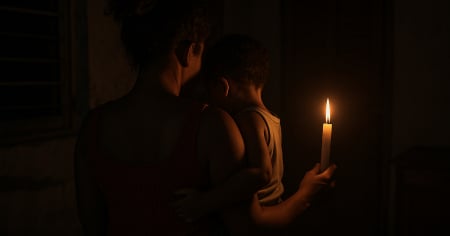
Amid the prolonged blackouts affecting all of Cuba, Vice Prime Minister Inés María Chapman proposed a unique "solution" to keep the population informed: bringing a television outside and connecting it to a generator so that neighbors can watch the government's guidance during the power outages.
The idea was presented in a report broadcast by Cuban Television (TVC), where the leader emphasized the importance of social communication in times of crisis, although she did not mention any real solutions to eliminate the ongoing power outages.
"Due to the energy deficit, there are people who cannot watch television, but look, the place where the electronic group is located can provide a television for people to watch," he said, in what was intended to be an example of community initiative but comes off as mockery of the people.
The proposal was made in the context of a working session on the coordination between the hydraulic system and the Electric Union, in which Chapman requested to strengthen ties between both sectors and "find solutions" to the concerns of the people.
However, his suggestion to improvise community televisions during the energy crisis stole the spotlight in the debate on social media, where many users criticized the "ingenious" solution.
During the meeting, the director of the Electric Union, Alfredo López Valdés, acknowledged that the country is facing a critical situation regarding water supply and electricity generation, with areas requiring between 4 and 24 hours of service to ensure water availability.
In Havana, the deficit exceeds 2,000 liters per second, impacting more than 233,000 residents with total or partial outages.
While the government tries to "coordinate actions" between electricity and water, the Deputy Prime Minister urged the mobilization of delegates, presidents of popular councils, CDR, the Federation, and mass organizations to "explain to the population" the current situation, even in places without electricity.
In a context where millions of Cubans live with power outages, long lines, intermittent water supply, and scarce food, the idea of watching television on the street with a generator running seems more like a metaphor—and even a mockery—than a real solution.
What remains unclear in the official's remarks is whether they would take attendance by list and monitor the number of people who will collectively watch the speeches, the Round Table, and the various informative segments of TVC.
Meanwhile, the government continues to appeal to "unity" and "direct communication" as responses to a crisis that worsens with each hour of blackouts.
What is unclear is whether the community television will also include the promise that the power will be restored before the next speech.
Frequently Asked Questions about the Energy Crisis in Cuba
What was the Cuban government's proposal to inform the population during power outages?
The First Deputy Prime Minister Inés María Chapman suggested bringing a television out to the street and connecting it to a generator so that the neighbors could watch the government's guidelines during power outages. This proposal was criticized for its lack of realism and effectiveness amidst the energy crisis.
What is the current situation of the Cuban electrical system?
The Cuban electric system is facing a significant collapse, with power outages exceeding 20 hours a day in several areas. The lack of investment in energy infrastructure and the shortage of fuel worsen the situation, pushing it beyond a mere deficit in electrical generation.
What measures has the Cuban government adopted to address the energy crisis?
The Cuban government has attempted to implement measures such as rotating blackouts and urging the population to conserve energy. However, these actions have not succeeded in alleviating the crisis, and the system remains unable to provide a stable electricity supply due to obsolescence and lack of resources.
How has the Cuban population reacted to the proposal of the community television?
The reaction from the population has been one of criticism and mockery, viewing the proposal as a metaphor for the government's disconnection from the reality faced by citizens. The suggestion was seen as a joke in a context where basic needs are not being met.
Filed under: