Related videos:
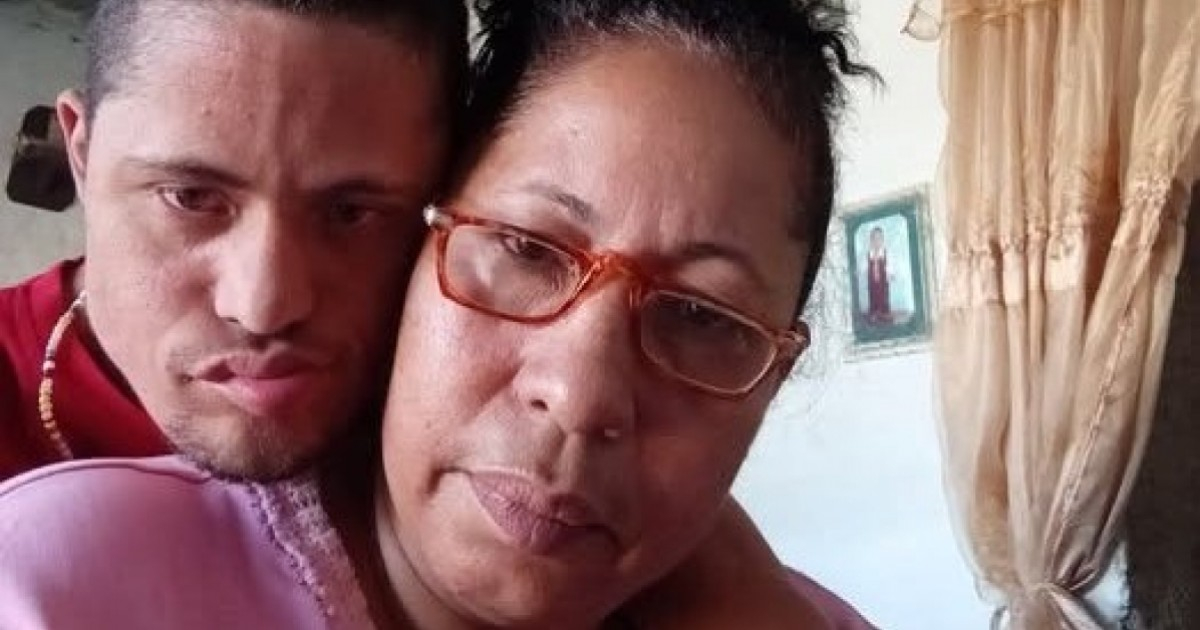
Arisleydis Hernández, a 55-year-old resident of Placetas, Villa Clara, issued a heartbreaking call for help on Facebook directed to the international Red Cross, human rights organizations, and "the World," denouncing the complete abandonment by the Cuban state towards her and her 32-year-old son, who has Down syndrome and several serious illnesses.
"Here in Cuba, those who need to listen to me do not, they suffer from selective deafness and blindness," wrote Arisleydis, whose situation has become a symbol of the collapse of the social protection system on the Island.
The clinical picture of the young man is devastating: cardiac patient with a "hollow heart," asthmatic, with only one functioning lung and one kidney, epileptic, and with a bleeding ulcer that could cause him to vomit blood at any moment.
To support both, the regime assigned them 2,900 pesos monthly as social assistance, an amount even lower than the official minimum pension, which was increased to 3,056 pesos in September 2025. Although analysts point out that this amount should be at least 10,000 pesos just to cover food.
"For this government, I am a social assistance recipient who has to support myself and my son with a ridiculous salary of 2,900 pesos. Please... without electricity, with prices through the roof," she stated.
Arisleydis suffers from epilepsy, among other illnesses, which prevents her from leaving her home.
Despite her case being officially categorized as "vulnerable," her social worker has never visited her. She called the social workers' office, the Government, and the Party in Placetas, but no one answered the phone.
"Please, world! Listen to the muffled cry of a mother and do not turn away," Arisleydis wrote. She concluded with a phrase that transcends her personal story: "It's not just my cry, it's the cry of a people in agony."
This is not the first time this mother has raised her voice. In June, her report about more than 63 consecutive hours without electricity shocked hundreds of Cubans: without power, her son cannot blend his food or sleep.
On that occasion, he also rejected the official argument of the embargo: "And then there's 'resistance', which is all the fault of the 'blockade'. Please, nonsense, no."
Your new publication arrives at the worst energy moment for the Island. Cuba experienced its fourth total blackout of the year on July 10, with a record deficit of 2,341 MW recorded on July 8 and only 935 MW available against a demand of 3,100 MW.
The regime itself acknowledged in March that the budget "is not extensive" and does not allow for caring for all vulnerable individuals.
In the face of the collapse, the regime announced in June that it would force private and state enterprises to fund the social assistance system, implicitly acknowledging that the State can no longer sustain it.
The case of Arisleydis is not isolated.
In April, relatives of six children in Pinar del Río who rely on electricity for feeding or breathing pleaded for portable power stations.
In January, a campaign sought generators for three seriously ill girls, including a two-year-old with spinal muscular atrophy who is dependent on a permanent mechanical ventilator.
Filed under: