Related videos:
On the fifth anniversary of the social upheaval of July 11, 2021, sociologist Cecilia Bobes published in Rialta an analysis of the legacy of the protests that shook Cuba five years ago, presenting a thesis that goes beyond the usual question of whether a similar event can happen again.
Bobes, a doctor in Sociology from El Colegio de México and a research professor at the Latin American Faculty of Social Sciences (FLACSO), argues that the main effect of July 11 was not quantitative but qualitative. "The primary legacy of July 11 is related to the transformation of the conditions under which protest becomes conceivable, practicable, and socially legitimate in contemporary Cuba," writes the author of the volume Protests in Cuba. Beyond July 11.
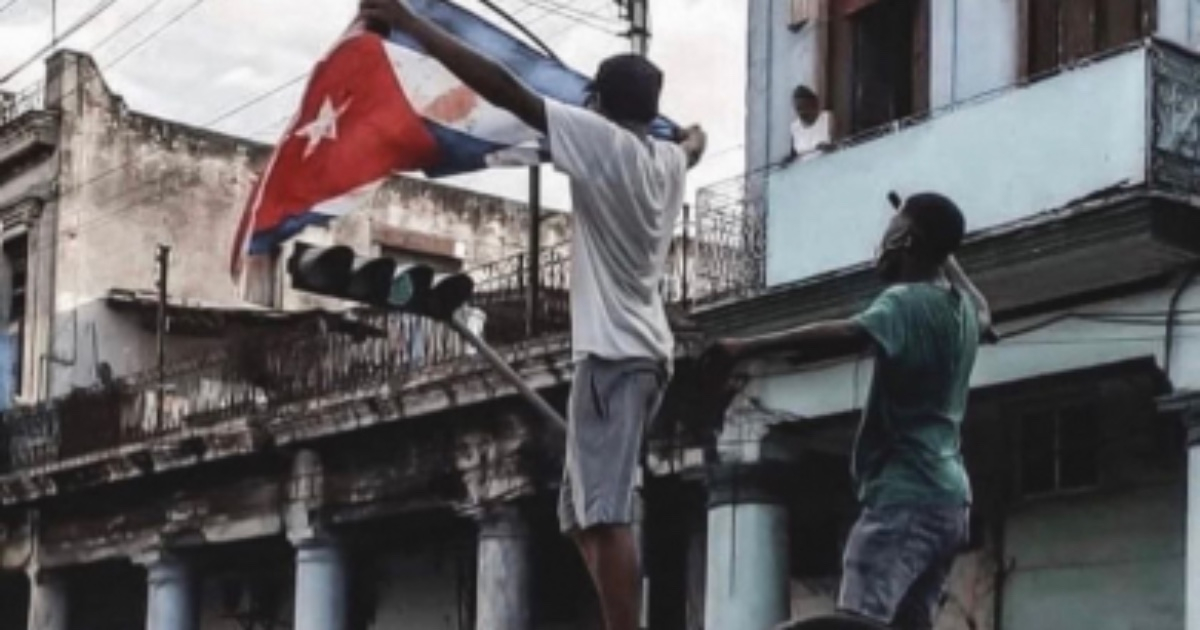
The researcher describes the 11J as the most significant social mobilization event that has occurred in Cuba since 1959: thousands of people took to the streets simultaneously in dozens of locations, driven by blackouts, the scarcity of food and medicine, and a buildup of daily grievances. What distinguished that day was its massiveness, its territorial reach, and its socially diverse nature: it was not an action led by organized activists, but a spontaneous eruption that involved ordinary citizens from all over the country.
One of the most significant changes that Bobes identifies after 11J is the shift in the main actor. "After July 2021, one of the most significant changes in protest is that its main actor is no longer the activist, but rather the prominence of the people or the ordinary citizen," he points out. Since then, those who take to the streets are women, neighbors, families, young people, retirees, and workers who would have previously hardly recognized themselves as participants in a collective action.
The sociologist documents with her own data an irregular but upward evolution: 102 protest events in 2021, 177 in 2022, a sharp drop to 40 in 2023—attributed to repression, exhaustion, and mass emigration—recovery to 121 in 2024, a decrease to 82 in 2025, and an unprecedented burst in 2026 with about 380 events recorded up to the date of the article, a figure that the author herself warns should be interpreted as an underreporting.
The protests of 2026 include episodes of high intensity. In March, protesters in Morón, Ciego de Ávila, took their mobilization to the headquarters of the Communist Party in one of the most violent episodes recorded. In neighborhoods of Havana such as Regla, Guanabo, La Lisa, and San Miguel del Padrón, protests featuring pot-banging, barricades, and bonfires have been replicated. Bobes interprets these acts not as organized violence, but as an expression of the erosion of institutional mediation and the perception that there are no effective channels to address demands.
Another central element of the analysis is the increasing politicization of the demands. Protests that begin over issues such as electricity, water, or food end up accompanied by slogans like "Freedom," "Homeland and Life," "Down with Díaz-Canel," or "We are not afraid." Bobes points out a fact that directly contradicts the regime's narrative: "There has not been a single protest where demonstrators request the lifting of the blockade or direct their demands against the government of the United States. On the contrary, the demands overwhelmingly focus on the national authorities."
This context of growing protest coexists with sustained repression. According to the organization Justicia 11J, 338 individuals remain incarcerated solely for their participation in the 2021 protests and were explicitly excluded from the April 2026 pardon that freed 2,010 inmates. Prisoners Defenders reports a total of 1,306 political prisoners in Cuba as of June 2026, a historical record.
Bobes also analyzes the factors that hinder a new explosion of the magnitude of 11J: the exemplifying repression, the massive emigration that depletes communities of young populations, and the regime's use of the threat of external intervention as a cohesion argument. The researcher describes the current situation as an "exclusive governance," a management of the crisis with little inclusion of autonomous social actors and limited institutional mediation capabilities.
"This transformation does not guarantee sustained organization, political openness, or democratic transition. However, it does indicate that something has changed in the social experience of disagreement. That change may seem intangible, but it likely constitutes one of the most significant social transformations to have occurred in Cuba since 1959,” concludes Bobes.
Filed under: