
Related videos:
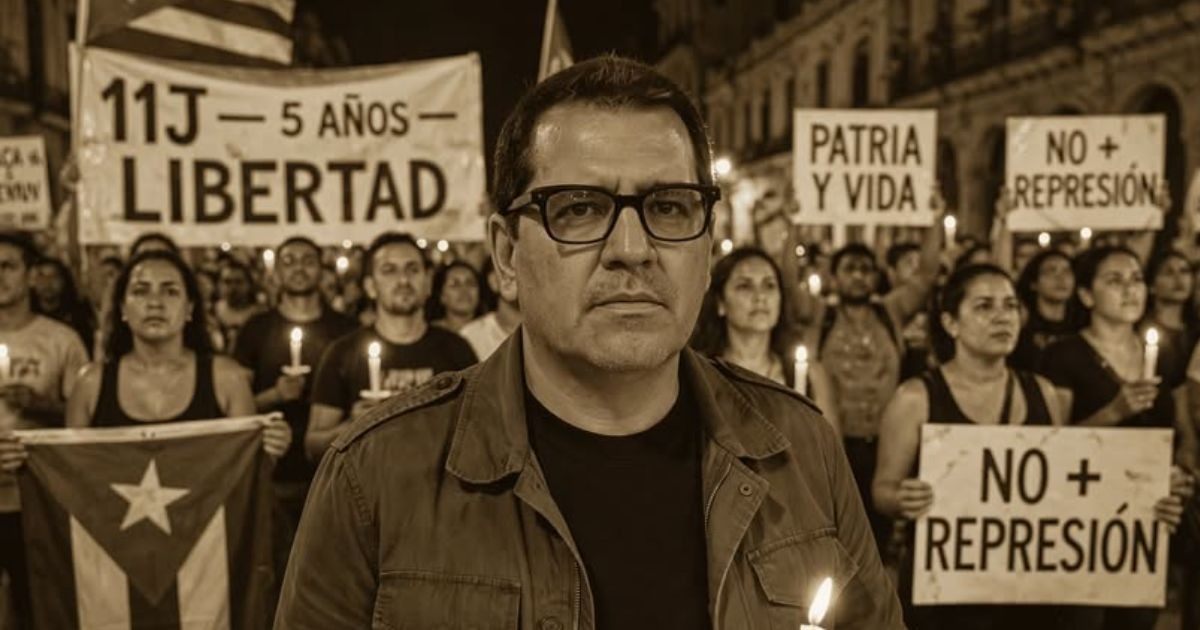
The Cuban political scientist and historian Armando Chaguaceda published this Saturday, on the fifth anniversary of the protests of July 11, 2021, a personal reflection on Facebook in which he recalls the impact of those historic demonstrations and their legacy in the collective consciousness of the Cuban people.
Chaguaceda, a resident of Mexico and one of the most recognized critical voices of the Cuban intellectual community in exile, wrote from what he himself describes as a deep personal mourning, referring to the forced separation from loved ones as a direct consequence of his ideas and activism.
"Five years ago, when I learned from a call with my friend and colleague Eloy Viera that thousands of people were taking to the streets to protest across Cuba, I was far from knowing many things," wrote the political scientist, recalling the exact moment he learned about the social outbreak.
Among the things he could not imagine at the time, Chaguaceda bluntly enumerates: "That several thousand of those people would spend all these years in prisons for exercising their right to have rights"; that the regime "would increasingly reveal its unpopular despotism in a cruel and massive way, combining repression and neglect over the tired and impoverished majority"; and that the crisis would deepen, "casting millions of his fellow citizens into misery and migration."
Despite the weight of that balance, the author identifies in his text two "irrefutable truths" that he claims he chooses to highlight above pain and despair.
The first, which he defines as "external" because it does not belong to him, is the gradual transformation experienced by the consciousness of the Cuban people: "One who, pushed to the limit, begins to discover—overcoming their fears, their inertia, their deceptions, and their miseries—the value of raising their voice against those who trample upon them."
The second truth is personal: "The way all this tearing and distance that affects me today has not turned into a paralyzing trauma or a deceptive tendency towards forgetfulness. Because today I feel Cuba more than I did five years ago," writes Chaguaceda.
The political scientist also sent an implicit message to the Cuban diaspora, noting that there is much to be done, "especially in that part of the nation that lives outside of Cuban borders, under infinitely more advantageous conditions than those of our people on the island," although he announced that he would elaborate on these thoughts in the coming days.
The fifth anniversary of 11J is commemorated in a context of unprecedented crisis in Cuba: blackouts lasting up to 25 hours a day, a projected GDP contraction between 6.5% and 15% —the worst in Latin America according to CEPAL— the informal dollar skyrocketing to 670 Cuban pesos compared to 435 in December 2025, and a massive migratory exodus that has emptied entire communities.
The repression that followed July 11th has not eased. According to the organization Justicia 11J, more than 300 people directly linked to those protests remain imprisoned, out of a total of more than 1200 political prisoners in Cuba. An emblematic case is that of Luis Manuel Otero Alcántara, leader of the San Isidro Movement, whose five-year sentence expired on July 9th but who has been missing since agents of State Security removed him from Guanajay prison without notifying his family.
Abroad, the Cuban diaspora organized commemorative events. The organization Cuban Freedom March called for a march in Miami under the slogan "Actions, not words," while U.S. Senator Tom Cotton demanded the regime release all political prisoners before the anniversary.
Chaguaceda concluded his publication with a quote from the British writer William Morris—taken from A Dream of John Ball, published in 1886—that encapsulates the spirit of resistance he believes defines these past five years: “Men fight and lose the battle, and what they fought for becomes reality despite their defeat; and, when it arrives, it turns out not to be what they intended, and other men have to fight for what they intended under a different name.” The final words of his text were: “We continue…. Homeland and Life. Long live a Free Cuba.”
Filed under: