Related videos:
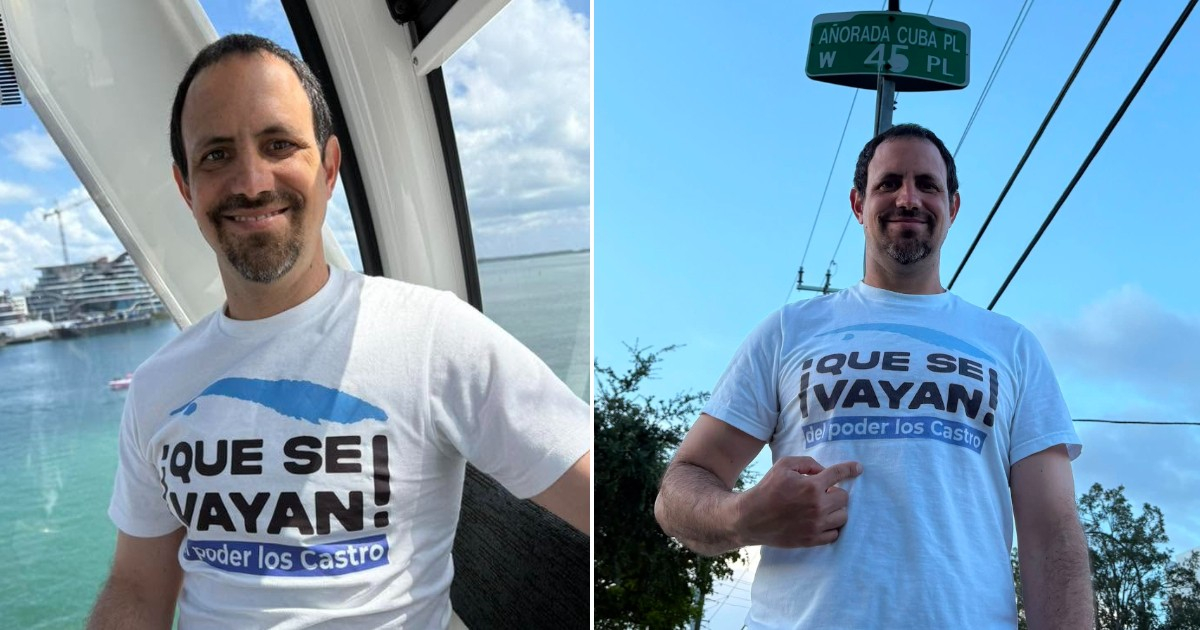
The Cuban activist and biochemist Oscar Casanella commemorated this Monday the fifth anniversary of the protests on July 11, 2021, with a powerful message posted on his Facebook profile, in which he described that date as "the day of Cuba's national rebellion" and called for not abandoning the fight for freedom.
In his text, Casanella draws a parallel between July 11 and the uprising of Carlos Manuel de Céspedes on October 10, 1868, in La Demajagua: "Just as that date marked the beginning of the struggles for independence, July 11, 2021, marked the start of a new phase in the fight of Cubans for freedom and democracy."
The activist, a former Immunology professor at the University of Havana who was forced to leave Cuba in 2022 under threat of imprisonment and currently resides in Miami, emphasizes that July 11 was the first time since 1959 that thousands of citizens spontaneously took to the streets in more than 60 cities and towns, from Pinar del Río to Guantánamo, across all provinces of the country.
"It was demonstrated that the struggle was not just of a few activists, but of an entire nation that desires more freedoms," wrote Casanella, recalling the slogans that resonated that day: "Freedom!", "Homeland and Life!", "Down with the dictatorship!", and "We are not afraid!".
The activist also emphasizes the psychological weight of that day: "For millions of Cubans, both on and off the island, that day held profound moral significance: many realized they were not alone." He compares the geographical reach of 11J with the protests in Belarus in August 2020 and the Tunisian Revolution of 2010-2011, noting that few contemporary mobilizations achieved a comparable territorial extent in a single day.
Casanella acknowledges that the events of July 11 did not lead to an immediate change of regime but rather a massive repression with thousands of arrests and hundreds of sentences. However, he warns that its historical consequences go far beyond the immediate results: "That day changed the perception that Cubans have of themselves and the perception that the world has of Cuba."
The fifth anniversary arrives in a context of acute crisis. As of July 9, 2026, 1,306 political prisoners remain incarcerated in Cuba, a historical record, of which 338 are imprisoned directly for their participation in the 11J. The April 2026 pardon that released 2,010 inmates explicitly excluded those convicted of "crimes against authority," the category the regime uses to criminalize the protesters from the 11J.
In parallel, Secretary of State Marco Rubio demanded on Monday the immediate release of all political prisoners in Cuba. One day after the anniversary, on Sunday, a protest erupted in Old Havana with shouts against the regime's leaders, and residents of Guanabacoa staged a loud cookware protest after more than 33 hours of blackout.
Casanella, who is facing a political asylum process in Miami after being subjected for years to surveillance, threats, and job reprisals by State Security, leaves no room for ambiguity in his message: “Let no one be deceived, the people of Cuba are at war with the totalitarian dictatorship of the Castro family because this Caribbean monarchy is carrying out genocide against Cubans on the island.”
The activist ends his text with a direct appeal to those who share his cause: "As long as there are political prisoners in Cuba and as long as there is a dictatorship that imposes misery and fear of speaking, associating, and participating in politics and decision-making in our country, we must continue to fight."
"We need to have a free homeland where we can live with dignity, in freedom and without fear. We need a free homeland that will welcome and embrace us whenever we wish to return, those of us in exile."
Filed under: