Related videos:
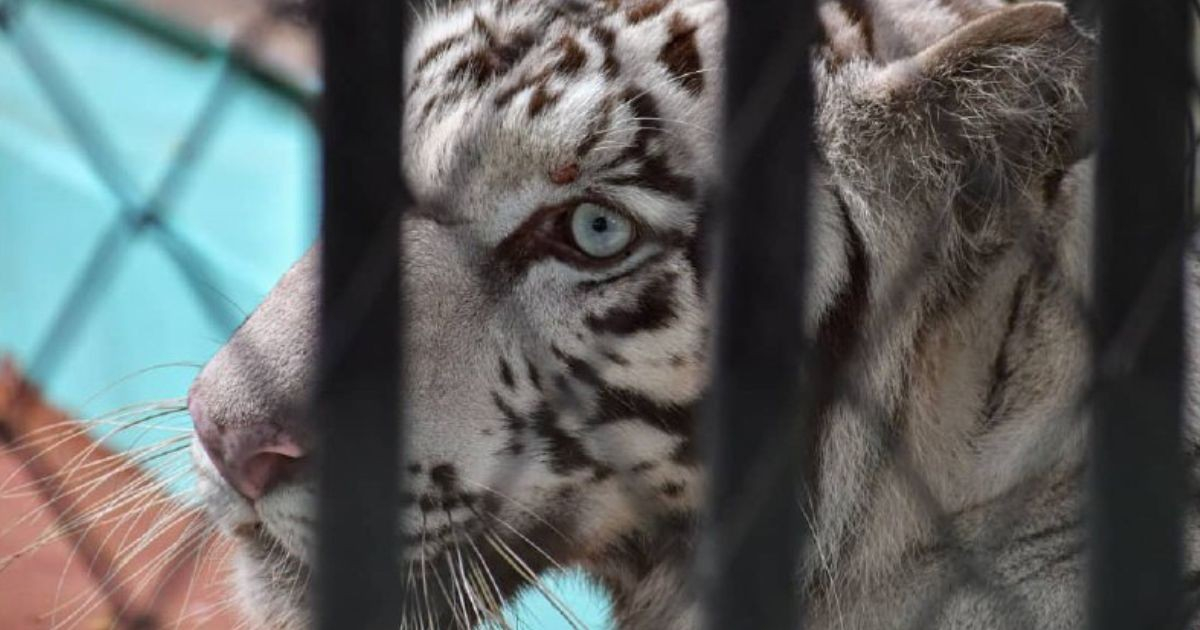
The Ciego de Ávila Zoo introduced to the public this Monday, for the first time, a white Bengal tigress that was recently transferred from the 26 Zoo in Havana.
The six-year-old specimen did not arrive at the Avileño zoo by chance: its arrival signifies the recovery of a species that the institution had lost years ago.
The biologist specialist Zaily Lázara Alfonso Castro explained that the tigress exhibits leucism, a genetic condition that removes the yellow pigment typical of the species without altering its black stripes or the color of its eyes.
The specialist emphasized that the animal should not be confused with an albino specimen: "it has blue eyes and a pink nose, instead of the red eyes associated with albinism."
Leucism suppresses pheomelanin —the orange or yellow pigment— but preserves eumelanin, which is responsible for both the dark stripes and the blue tone of the eyes.
It is estimated that there are fewer than 200 white tigers in the world, almost all of them in captivity and without any known wild populations.
The transfer from Havana was conducted under a strict protocol that began 24 hours before the animal's arrival, including a prior quarantine and constant monitoring during the journey.
The facility that houses her was prepared fifteen days in advance by a team of specialists, veterinary technicians, and park workers, who welcomed the tigress on the night of her arrival.
Ángel Daniel Rojas Ojeda, head of Animal Welfare at the zoo and a veterinarian with 42 years of experience, warned that keeping the animal is not simple: the tigress consumes seven kilograms of meat daily, which forces the institution to rely on support from provincial organizations and the Ministry of Agriculture to ensure her feeding.
During the presentation of the specimen, specialists from the Avileño park also drew attention to the behavior of the public: a Rhesus macaque named Mauro recently experienced an episode of self-aggression triggered by the shouts of visitors, prompting experts to request that families maintain a respectful demeanor towards animals in captivity.
The presentation of the tigress occurs just a week after the National Zoo of Cuba celebrated the birth of four Bengal tiger cubs, including a white specimen, which caretaker Ángel Cordero —with 44 years of experience— described as "a little miracle."
That zoo, however, operates on only 25% of the fuel it needs: it receives five liters of diesel daily instead of the required 20, forcing its workers to transport food using horse-drawn carriages and electric tricycles.
The overall picture of Cuban zoos is one of deep crisis.
In April, the extreme abandonment and severe malnutrition of three lions at the Casino Campestre Zoo in Camagüey was reported, and the National Botanical Garden closed its doors due to lack of fuel.
The 26 Zoo in Havana —the institution that originated the tigress transferred to Ciego de Ávila— has accumulated multiple complaints regarding deterioration, malnutrition, and a drastic reduction of its animal collection.
Filed under: