Related videos:
A former agent of the National Revolutionary Police (PNR), who claims to have been expelled after confronting his superiors and refusing to carry out orders he deemed unjust, made a public appeal this Monday to active police officers to refrain from attacking a population that, he warned, can no longer endure.
Marino Garlobo Reyes shared his story with CubaNet in which he describes how he arrived in Havana 25 years ago from eastern Cuba, drawn by promises of housing and better living conditions that the regime never fulfilled.
"I left the Police because I realized that it was all a deception," he stated.
Garlobo trained at the Valle Grande police academy, where he graduated as sector chief with one of the best records in his class, and was assigned to the Havana neighborhood of Jesús María.
Over time, conflicts with his superiors became unbearable: he openly questioned the repression against citizens and refused to carry out orders that he deemed unjust, including those to detain street vendors, blind individuals, and citizens with disabilities.
“I confronted them and told them the truth, that they repressed people for their own enjoyment,” he stated.
He was finally summoned to a police unit at Lombillo and Boyeros, where he was notified of his dismissal.
Since then, he claims that the stigma of having been expelled from the Ministry of the Interior has closed doors for him in the job market.
His current situation reflects the neglect he reports: he lives in a building with serious structural damage where more than 60 people are at imminent risk of collapse, suffers from transient cerebral ischemia, and cannot obtain the medications he needs.
He was admitted to the Calixto García General University Hospital, but decided to leave due to the deterioration of the facilities and the lack of medications.
"I'm asking the State to take action on these issues, but there's no one to stand up for it. They don't care," he lamented.
The former agent described a systematic pattern of recruitment: young people from rural eastern regions lured in with promises of homes and benefits that seldom materialize, who then spend months away from their families, leading to marital breakdowns and significant personal weariness.
The contrast that Garlobo Reyes draws between the grassroots agents and the regime's elite is devastating: "While they up there have accounts abroad, all their children studying at universities, millionaires, you are here struggling with a problem you did not create."
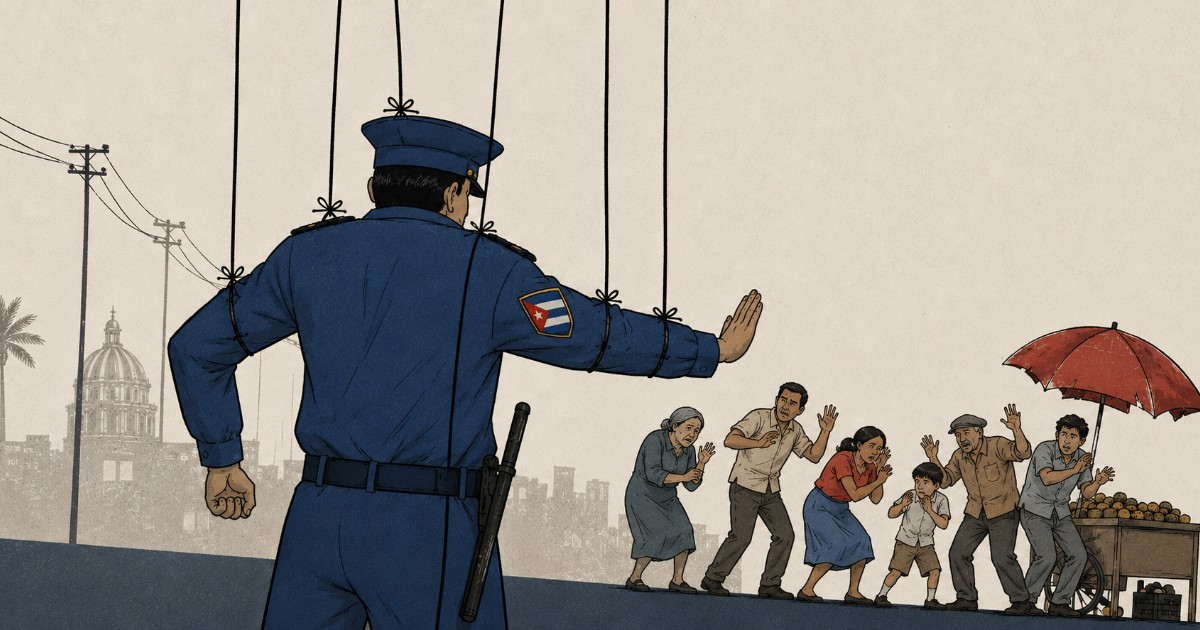
His final message was directed to those still wearing the uniform: "To the police, I say to understand the situation of the people, not to repress them, not to attack them. People can’t take it anymore; they are stressed by the situation, there is no food, there is nothing. Treat your people well, love them. We are the same people."
Finally, for Garlobo, the police officers are as much victims of the system as the rest of the Cubans: "The police officer has no voice or vote. He is an instrument and struggles just like everyone else," he noted.
This diagnosis aligns with what other indicators reveal: the Cuban Citizen Audit Observatorywarned that 20% of police officers have left the force, while MININT has turned to recruiting teenagers in Havana schools through vocational festivals due to the recruitment crisis.
Filed under: