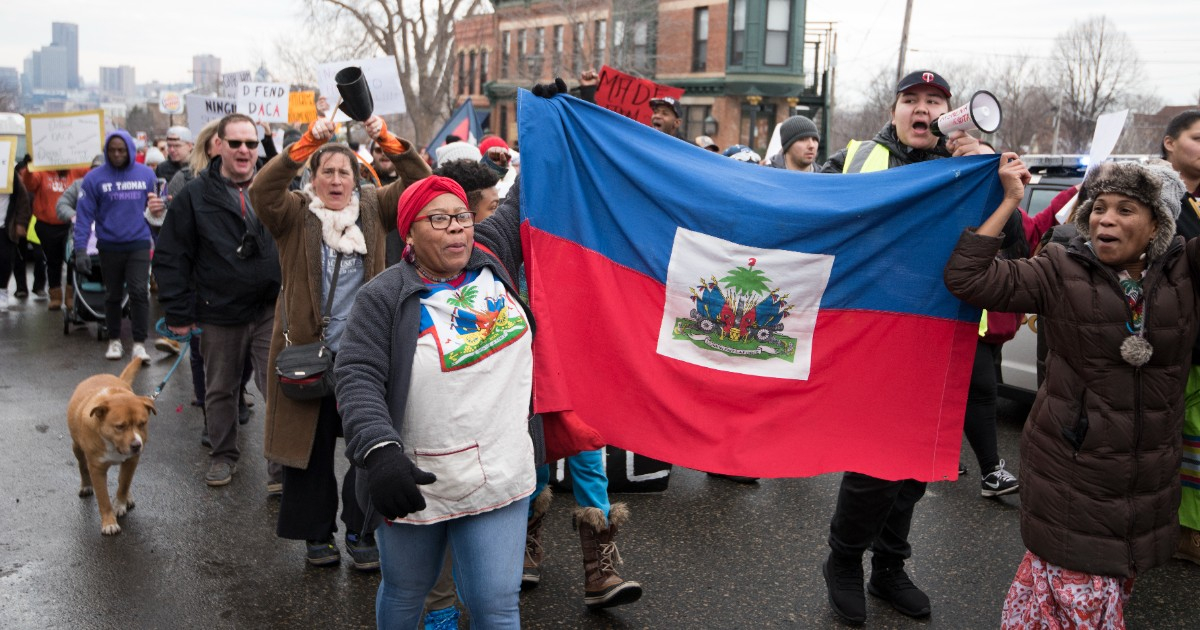
Approximately 330,000 Haitians in the United States, with 158,000 of them in Florida, are facing a distressing countdown: their work permits will expire on July 24 following the end of Temporary Protected Status (TPS), and the threat of deportation looms over families who have spent decades building their lives in the country, according to a report by EFE from Miami.
The trigger was the ruling from the Supreme Court on June 25, which, with six votes in favor and three against, authorized the Trump administration to eliminate the program without the possibility of judicial review, determining that the Department of Homeland Security has full discretion over that decision.
From the Little Haiti Cultural Center in Miami, Carline Paul, a retired teacher known in the community as 'Teacher Carline', summarizes the collective feeling with a deeply poignant phrase: "They forget what we did for them. We played a very important role in the life of the United States. What is happening is ruthless, it is unacceptable, it is inhumane. It is not American."
Carline arrived in the United States at the age of 10, has lived in Florida for 53 years, and has grandchildren with TPS.
Another voice that emerges from the same community center is that of Lilly, an organizer who prefers not to disclose her full last name for fear of reprisals.
"Living in that fear causes a lot of harm; it harms you mentally and emotionally," she says.
Lilly has been helping migrants seek legal options for three years and confesses that she herself wakes up at three or four in the morning with the same nightmare: that she is stopped in the street without reason. "It's not because I am doing something wrong, but because it's me, because of my status," she recounts.
The economic impact of mass deportation would be devastating for Florida. Haitians with TPS contribute $2.6 billion annually to the state’s economy —$1.5 billion just in the Miami area— and work in essential sectors such as healthcare, elder care, construction, and hospitality, according to the organization FWD.us.
Additionally, they pay 300 million in federal taxes and 306 million in state and local taxes each year.
Although the Supreme Court authorized the cancellation, lawyers and immigration groups warn that the effective termination still relies on the conclusion of a process in a district court, leaving beneficiaries and their employers in legal limbo.
The only visible legislative solution is the bill H.R. 1689, approved in April by the House of Representatives with 224 votes in favor and 204 against — with ten Republicans breaking ranks, including Miami Congress members María Elvira Salazar, Carlos Giménez, and Mario Díaz-Balart — which would extend TPS until January 2029. However, the bill remains blocked in the Senate, where Republican leadership has not brought it to a vote.
The context in Haiti intensifies the urgency for any solution. The country recorded over 8,200 murders between January 2025 and March 2026, according to Human Rights Watch, and the gang coalition 'Viv Ansanm' controls approximately 90% of Port-au-Prince, with 1.4 million internally displaced people and nearly six million individuals facing food insecurity.
The TPS for Haitians was established in 2010, following the earthquake that devastated the country, and has been renewed for over a decade.
Carline Paul does not lose hope: "I have hope because I fight and I will not stop fighting. Where there is a will, there is a way." Lilly, for her part, appeals to the most basic truths: "Behind the laws, behind the policies, we are real; there are real families. We are human, we have the right to be human with dignity."
Related videos:
Filed under: