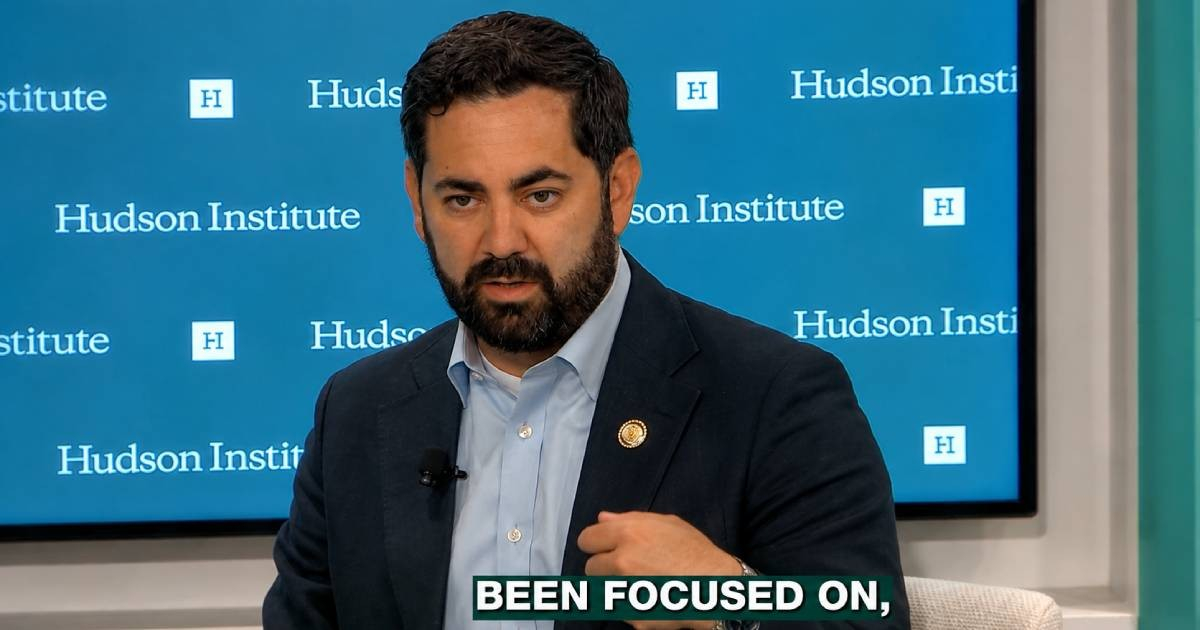
The Republican congressman Mike Lawler included Cuba this Wednesday in an "unholy alliance" that also comprises Iran, China, Russia, Venezuela, and North Korea, and advocated for increasing economic pressure against that bloc during a foreign policy forum organized by the Hudson Institute.
Lawler, chairman of the House Foreign Affairs Subcommittee on the Middle East and North Africa, stated that the main challenges for the United States are closely interconnected and cannot be addressed separately.
"Foreign policy is not conducted in a vacuum or in silos. Almost everything is interconnected. And so, when you look at Iran and the unholy alliance they have with China, Russia, Venezuela, Cuba, and North Korea," the legislator stated.
During his speech, the Republican defended the maximum pressure strategy promoted by the Trump administration and asserted that economic sanctions are a key tool for undermining those governments and limiting their capacity to act.
According to Lawler, reducing Iran's income means diminishing the resources allocated to financing allied armed groups, as well as the development of ballistic missiles, drones, and its nuclear program.
"The more economic pressure we can exert on them, the less funding they will have available to finance their terrorist proxies," he asserted.
The congressman also highlighted the legislative initiatives he has promoted to strengthen sanctions against Tehran. Among them, he mentioned the Iran-China Energy Sanctions Act, included in a foreign aid package approved by the House of Representatives, and the Enhanced Sanctions Against Iran Act, which was approved in March with bipartisan support from 296 co-sponsors and is still awaiting discussion in the Senate.
Lawler compared the current situation to that of the last five years, which he described as a period of "inaction and failure" in foreign policy. In contrast, he credited the Trump administration with a series of strategic advancements, including the bombing of Iranian nuclear facilities, the disruption of oil trade between Iran and China, and Venezuela's exit from that network of alliances.
"Having Venezuela completely cut off from them is positive," he stated, referring to the U.S. operation that concluded with the capture of Nicolás Maduro in January of this year.
The congressman's statements come in a context of increasing pressure from Washington on Havana. Since January 2026, the Trump administration has imposed over 240 sanctions on the Cuban regime and reinstated the island on the list of state sponsors of terrorism.
Meanwhile, high-ranking U.S. officials have emphasized Cuba's strategic ties with some of the countries mentioned by Lawler. The Secretary of State, Marco Rubio, stated before the Senate on June 2 that the island hosts intelligence facilities operated by China and Russia, including at least four Chinese electronic bases and two Russian stations of the GLONASS navigation system. Additionally, Cuba and Iran signed a strategic alliance in 2025 with a duration of ten years.
The Trump administration asserts that these relationships pose a threat to the national security of the United States and has strengthened sanctions through Executive Order 14404, signed on May 1, which increases measures against individuals and entities linked to the Cuban regime and its repressive apparatus. In this context, the legislative offensive driven by Lawler seeks to further tighten the economic blockade on countries that the congressman defines as an "impeccable alliance."
Related videos:
Filed under: