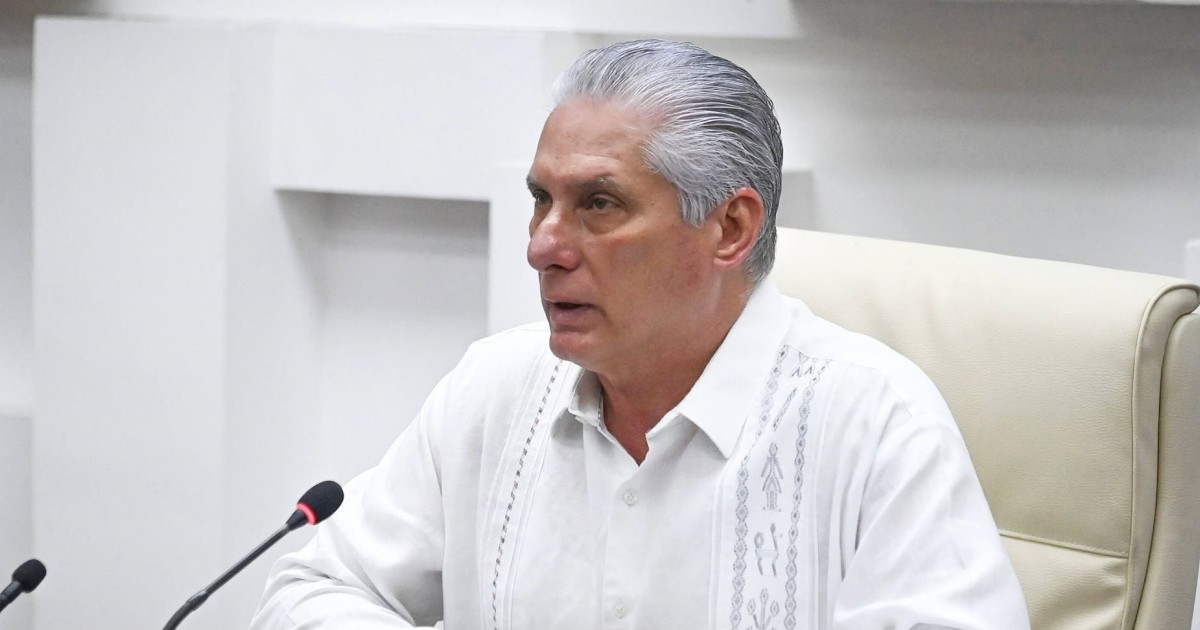
Last Monday, Miguel Díaz-Canel signed Presidential Decree 1251 to declare an official mourning period in Cuba for the passing of the Father Emir of Qatar, Sheikh Hamad bin Khalifa Al-Thani, who died on Sunday at the age of 74 in Doha.
According to a report from Granma, it was ordered that the Cuban flag be flown at half-mast for nearly 48 hours—from 6:00 AM on Monday, July 13 to the last hour of Tuesday, July 14—in all public buildings and military institutions across the Island.
The regime's decision starkly highlights its priorities: while it paid tribute to the Qatari monarch, more than 4,500 people have died in Venezuela due to the double earthquake with magnitudes of 7.2 and 7.5 that ravaged the country on June 24, and Díaz-Canel did not declare a single hour of official mourning for those victims.
The contrast is striking. As of July 14, the Venezuelan government officially confirmed 4,561 deaths, with 71 new fatalities compared to the previous day. The United States Geological Survey (USGS) estimates there is a 42% probability that the actual number could be between 10,000 and 100,000 people. The UN estimates up to 50,000 missing persons and more than 6.76 million people affected in total.
Among the victims are Cubans. Independent media and civic platforms have confirmed at least nine deceased individuals of Cuban nationality, including a family of six found under the rubble of the Oasis Beach and Resjurel buildings in La Guaira. However, the Ministry of Foreign Affairs has only officially recognized two deaths.
The regime's response has faced severe criticism.
On June 27, three days after the tragedy, the Director of Consular Affairs of MINREX, Ana Teresita González Fraga, stated that Cuba "does not have official confirmation of compatriots injured, deceased, or missing," directly contradicting citizen reports with specific names and locations.
Just two days later, the MINREX officially acknowledged the first death -Lupercio Adrian D'Pérez y Pando, a resident of Caraballeda since 2021, and provided contact numbers in Cuba and at the Consulate in Venezuela.
The affected families have reported a lack of consular support and a absence of information regarding the repatriation of the deceased.
The ruler Miguel Díaz-Canel stated on June 28 that he would maintain "permanent contact with Venezuelan authorities," but the regime publicly prioritized the safety of its 12,930 health collaborators, ignoring the situation of Cuban citizens residing in the devastated areas.
The logic of the dictatorship becomes even more revealing when comparing periods of mourning.
The official mourning decreed by Ramiro Valdés Menéndez, historic commander of the revolution and founder of the repressive apparatus of MININT, who passed away on June 21 at the age of 94, lasted less than 24 hours. Díaz-Canel granted the Qatari monarch double the hours of mourning than to one of the pillars of the dictatorship, and none to the thousands of deaths in Venezuela.
The underlying reason is economic. The Cuban Hospital in Dukhan, inaugurated on January 10, 2012, with the presence of Hamad himself, operates with approximately 400 Cuban health professionals whose services Qatar pays to the government of Havana—not directly to the doctors. The regime withholds up to 90% of their salaries.
Medical cooperation between the two countries intensified during the COVID-19 pandemic: Cuba sent 229 health workers to Qatar in April 2020 and a third brigade of 156 specialists in March 2021, while the Henry Reeve brigade cared for over 270,000 patients in that country between 2020 and 2022.
All those shipments of doctors - under labor exploitation conditions - stand in stark contrast to the shortage of staff in Cuban health institutions, which are becoming increasingly precarious.
In November 2025, both governments reaffirmed their commitment to enhance cooperation in biotechnology, the pharmaceutical industry, and medical universities.
The official Granma described Emir Padre as a "dear friend of Cuba" and emphasized his "special affection" for the Island and his friendship with Fidel Castro. Díaz-Canel, for his part, referred to him on his X social media account as a "prominent statesman" and stated that "Cuba shares the sorrow that envelops our friend the Qatari people."
The Cuban people, on the other hand, did not receive the same gesture of official solidarity when their compatriots were buried under the rubble in Venezuela, a country that the regime itself presents as its closest strategic ally and where it maintains a brigade of approximately 12,930 medical collaborators spread across the 24 states of the country.
Related videos:
Filed under: