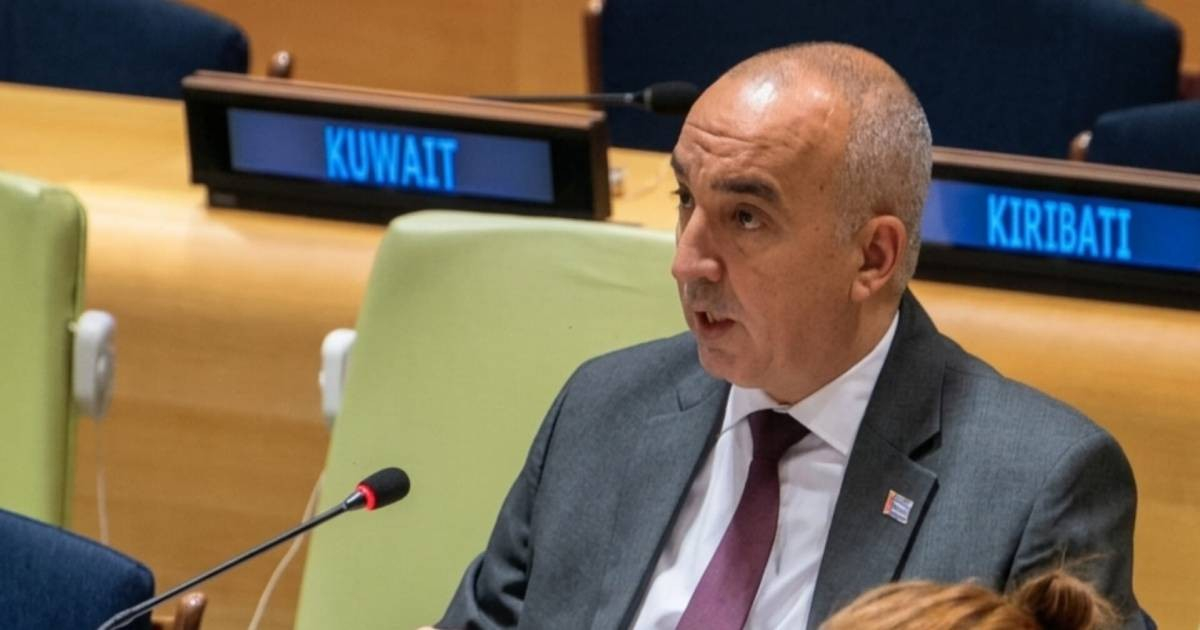
While Cuba remains immersed in a new nationwide blackout, the island's ambassador to the United Nations, Ernesto Soberón Guzmán, was speaking in New York to denounce the U.S. embargo as one of the main obstacles to the country's energy transition and to defend Cuba's right to manage its natural resources sovereignly, reported the Cuban News Agency.
The timing of the occurrence was notable because, while the diplomat was participating in the High-Level Event on Critical Minerals for the Energy Transition, millions of Cubans were left without electricity following the collapse of the National Electroenergetic System (SEN).
The total disconnection of the grid occurred at 11:05 AM on Tuesday, July 14, when the unexpected shutdown of Unit 1 of the Felton thermoelectric plant in Holguín caused the collapse of the electrical system.
This was the fifth nationwide blackout recorded so far in 2026, the third in just ten days, and the tenth collapse of the National Electric System (SEN) in approximately two years, according to data from the Electric Union (UNE).
The service began to gradually restore, and it was not until 07:00 this Wednesday when the system was fully synchronized again, after nearly 20 hours of nationwide interruption.
However, in numerous localities, power cuts continued long after the restoration of the National Electric System. In areas of Matanzas, for example, residents reported having accumulated more than 87 hours without electricity during July, while in several municipalities of Havana, daily outages lasted around 15 hours.
Cuba's speech at the UN
During his address at the United Nations, Soberón argued that developing countries must have equitable access to the resources needed to advance towards clean energy.
"A just energy transition cannot reproduce historical inequalities or deepen the technological dependence of developing countries," he stated.
The diplomat attributed much of the island's energy difficulties to the U.S. embargo.
"The blockade deliberately restricts access to fuel, technology, investment, financing, and even renewable energy projects, directly affecting hospitals, schools, and water supply systems," he stated.
He also emphasized that unilateral coercive measures hinder the development of countries like Cuba.
"There cannot be a truly just energy transition while unilateral coercive measures are used to deny countries the resources they need to develop," he concluded.
A crisis with multiple factors
The Cuban electrical crisis has worsened over the past year due to a combination of several factors.
These include the deterioration of the thermoelectric park, largely made up of plants that have been in operation for several decades; the scarcity of fuel for generation; recurrent breakdowns; and the reduction of oil supply from allied countries.
In May, the Minister of Energy and Mines, Vicente de la O Levy, publicly acknowledged that the country lacked sufficient reserves of fuel oil and diesel to sustain electricity generation.
Days before the collapse on July 14, the generation deficit had reached a peak of 2,341 megawatts, with only 935 MW available against a demand close to 3,100 MW. At that time, 11 of the 16 thermoelectric units in the country were out of service due to breakdowns or maintenance.
As part of its strategy to reduce dependence on fossil fuels, the Cuban government is promoting a solar park program with support from China. Authorities anticipate increasing the share of renewable energy to 24% of electricity generation by 2030 and to 40% by 2035.
Cuba and Strategic Minerals
Cuba's participation in the UN forum also reflects its interest in the international market for critical minerals.
The island has significant reserves of nickel and cobalt, two raw materials deemed essential for the production of electric vehicle batteries and other technologies related to the energy transition.
That potential was one of the arguments put forward by the Cuban delegation during the meeting, which took place while the country was experiencing one of the most severe episodes of electrical instability in recent years.
Related videos:
Filed under: