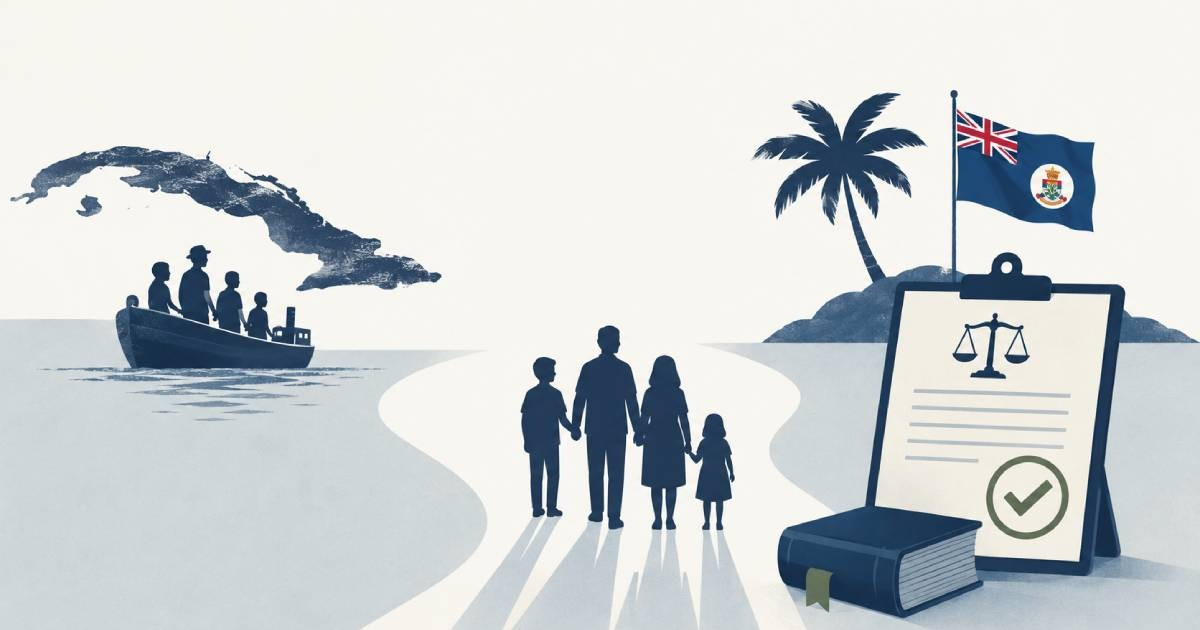
The Cayman Islands Government announced this Thursday that it will promote specific legislation to regularize the immigration status of the children, grandchildren, and even great-grandchildren of Caymanians who emigrated to Cuba during the last century and returned to the archipelago after the 1959 revolution, reported the media Cayman News Service.
The measure aims to address a situation that affects approximately 300 people, many of whom were born and raised in the Cayman Islands, have established their families there, and have lived for decades without fully regularized immigration status.
The origin of the problem can be traced back to the return of numerous families of Caymanian descent who had emigrated to Cuba, primarily to what was then known as the Isle of Pines (now Isla de la Juventud). Although they received temporary residency permits upon their return, the authorities never informed them about the need to formally apply for permanent status for themselves and their descendants.
The representative Julie Hunter from West Bay West explained in statements to Radio Cayman that many of these individuals always believed they had the right to reside in the territory.
"Many people simply assumed that they had the right to be here, and that previous governments had not made it clear that they needed to apply for a status for themselves and their families," he stated.
Most of those affected reside in the West Bay district in Grand Cayman. From there, MPs Hunter and Rolston Anglin, along with former parliamentarian McKeeva Bush, have promoted the initiative to find a definitive solution.
Anglin emphasized that the project is exclusively aimed at those who already live in the Cayman Islands and found themselves trapped in a legal limbo after returning from Cuba.
"We are talking about those Cuban-Caimanians who fought to leave Cuba after the revolution," he noted, remembering that many families were held back on the island for years and could only leave the country when the regime of Fidel Castro authorized their exit.
As a first step, the ruling National Coalition for the Caimanenses (NCFC) agreed last month to create a working group tasked with identifying the affected families, gathering information, and presenting recommendations to regularize their situation in the quickest and most efficient manner possible.
A story with deep roots in Cuba
The presence of a Caimanian community in Cuba dates back to the early 20th century, when numerous fishermen emigrated to what was then called the Isle of Pines, located about 312 kilometers from Grand Cayman, in search of better economic opportunities.
After Castro's revolution triumph in 1959, many of those families tried to return to their place of origin, but numerous individuals remained trapped on the island for years and could only leave later on.
The announcement from the Cayman Islands government coincides with a growing uncertainty in the Caribbean due to the situation in Cuba. The authorities of the Cayman Islands have been maintaining contingency plans since early 2026 in anticipation of a possible increase in migratory flows coming from Cuba, especially from Isla de la Juventud, where many people of Caymanian descent still reside.
The Cayman Islands have already experienced a similar situation during the 1994 migration crisis when they received over a thousand Cuban rafters. According to official figures, by March 2026, the territory had deported 20 Cuban migrants and was holding another 24 in immigration custody.
Related videos:
Filed under: