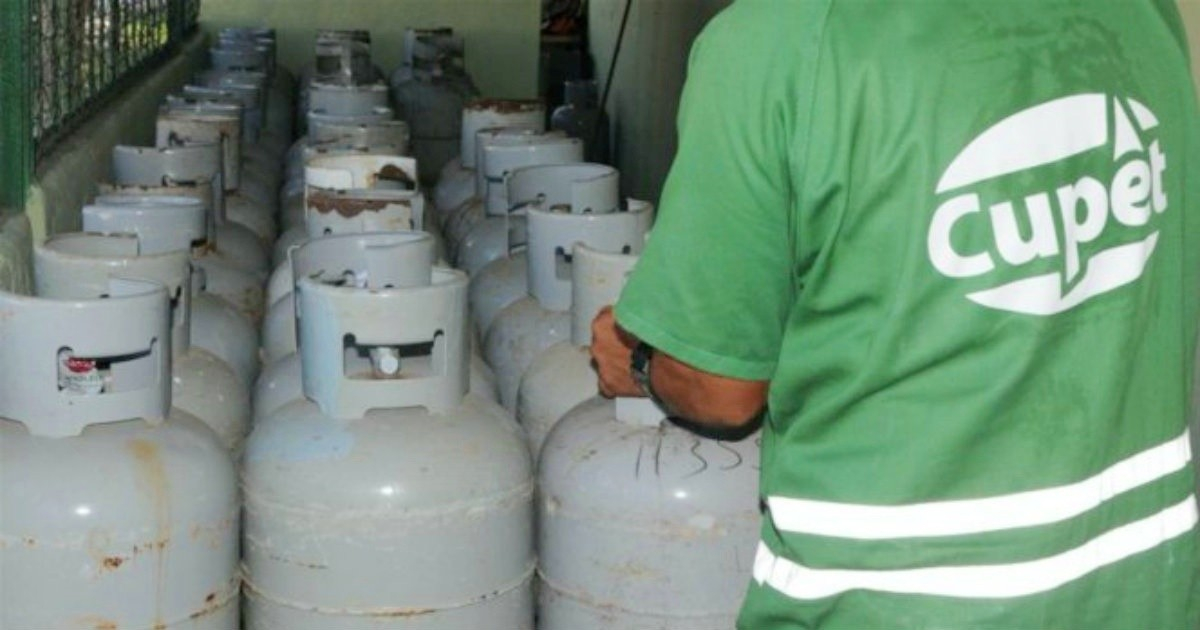
The Cuban regime set this Thursday the official price of liquefied gas at 350 pesos (CUP) for a ten-kilogram cylinder, equivalent to 35 CUP per kilogram, a measure that has sparked a wave of sarcasm and outrage among Cubans on social media, who pointed out the central paradox: the government raises the price of a product that has practically disappeared from the state market.
The announcement, which also sets the price of manufactured gas at 4.97 CUP per cubic meter, represents a 55% increase over the previous price of 225 CUP, effective since March 2024, when it was argued that this rise would serve to "eliminate the subsidy."
Now, without that justification available, the value begins to rise again.
The reaction on social media was immediate and overwhelming. "That doesn't exist, it doesn't matter," summarized one user in the post by CiberCuba on Facebook, reflecting the general sentiment. Another simply wrote: "What gas? Ha ha ha." A third was more direct: "The big joke of the moment. Prices are going up, but where is the product?"
Several comments highlighted the historical contradiction of the successive increases. "When they raised it to 180 CUP, they said that the subsidy would be eliminated with that price. What is the justification for raising it further now?" asked a user. Another questioned whether the official price would have any real application: "The question is, will they sell it at that price, or will it be a symbolic price and in practice be in USD?"
The doubt is not unfounded. Digital platforms like Supermarket23, Katapulk, and KMCERO sell gas canisters for dollars, ranging from 24 to 29 USD -equivalent to more than 15,000 CUP at the unofficial exchange rate-, with exclusive delivery in Havana and a requirement to provide an empty cylinder.
In the informal market, the price of a ball ranges between 10,000 and 50,000 CUP depending on the province.
A user also reported a practice that has become common: "I was given the link to buy it, and when I entered, it said the page was under repair; however, they continued selling. For some, that's a business of reselling."
"What we need is for them to be put up for sale once and for all, because we are going to run out of forests making charcoal or cooking with firewood," another warned.
The spiral of liquefied gas prices illustrates the structural crisis of the Cuban economy: from 110 CUP before 2021, the price rose to 180 CUP in March of that year, then to 225 CUP in March 2024, and now stands at 350 CUP.
"That's what happens when salaries are increased without productive backing. What rises is inflation, not purchasing power," noted a user with economic insight.
Another person summed it up bitterly: "Raising it isn't the problem; it's the same old issue— they raise it, just like they've raised everything else, and then it disappears and there's never any to be found. I know that story by heart."
The scarcity has concrete and devastating dimensions. In April, 834,000 of the 1.7 million liquefied gas customers in Cuba were unable to purchase the product from state distributions.
The company CUPET has indefinitely suspended the distribution in Santiago de Cuba and all eastern provinces since January, following the cut of Venezuelan shipments that occurred after the capture of Nicolás Maduro.
In the absence of gas, millions of Cuban families have returned to cooking with firewood and charcoal, a reality that Díaz-Canel described as "creative resistance."
The energy context in which the announcement is made further exacerbates the perception of governmental cynicism.
On July 14, a day before the new gas prices were set, Cuba experienced its fifth total collapse of the electrical system this year. On July 8, the largest energy deficit in the country's history was recorded: 2,341 MW, which affected 73% of the population. The Minister of Energy, Vicente de La O Levy, admitted in May that Cuba has no reserves of fuel oil or diesel.
Related videos:
Filed under: