
Related videos:
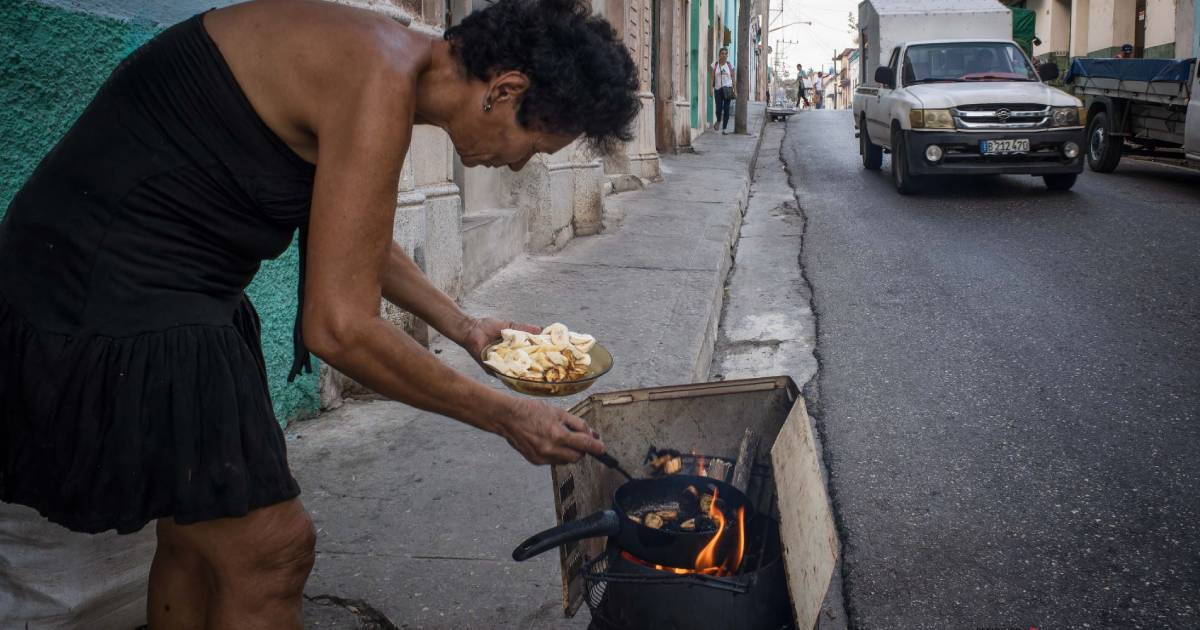
Miguel Díaz-Canel requested this Friday, during the eleventh National Defense Day in the municipality of East Havana, that materials for cooking, from charcoal to firewood, be ensured, a phrase he had already stated in May 2025 during a visit to Villa Clara, and which, upon being repeated, ceases to be a slip and becomes an explicit public policy.
For a head of state to normalize charcoal and firewood as cooking solutions in 2026 represents a break from the energy modernization narrative that the regime itself has upheld for decades.
In the Special Period of the nineties, the return to pre-industrial fuels was a spontaneous popular response to the Soviet collapse. In 2026, it is a government directive.
The difference is significant: it implies publicly acknowledging that the Cuban State cannot ensure the supply of liquefied gas or electricity for cooking to its own population.
The immediate trigger of the current crisis was the capture of Nicolás Maduro by U.S. forces on January 3 of 2026, which cut off Venezuelan supplies of between 25,000 and 35,000 barrels of crude oil daily. Mexico also suspended its shipments that same month, depriving Cuba of 44% of its crude oil imports.
Cuba produces only 40,000 barrels daily when it needs 110,000, and its fuel reserves were just 15 to 20 days in February and March of 2026.
But the economist Mauricio de Miranda Parrondo warns that the economy was already on the verge of collapse before the capture of Maduro, as a result of decades of structural economic failure.
The collapse of 2026 is, in fact, the third episode of the same pattern: Cuba built its energy model on external subsidies, never on self-sufficiency.
First was the Soviet Union, which between 1960 and 1991 supplied up to 260,000 barrels of oil per day and contributed subsidies equivalent to 21.2% of Cuba's gross national product. When that flow was cut off, GDP contracted by approximately 35% between 1991 and 1993.
Venezuela replaced the USSR starting in the year 2000: between 1999 and January 2026, it sent Cuba approximately 63.8 billion dollars in oil, covering 60 to 70% of its needs with deferred payments over 25 years. Maximum shipments reached 90,000 to 100,000 barrels per day between 2012 and 2016, and fell to less than 15,000 in 2026.
The Economist Intelligence Unit projects a contraction of the Cuban GDP of 7.2% for 2026, which adds to a decline of 5% in 2025. De Miranda Parrondo estimates that the cumulative drop since 2019 would reach 23%.
The impact on daily life is devastating. As of March 25, Cuba had an electricity availability of just 1,145 MW against a demand of 3,000 MW. 64% of the territory was experiencing blackouts lasting over 20 hours a day in inland provinces. More than 100,000 homes in Matanzas have been without regular liquefied gas supply since January 2025.
The sacks of charcoal cost between 2,000 and 3,000 pesos in the informal market, in a country where the average state salary is not enough to cover basic needs.
The 2026 crisis is structurally deeper than the Special Period because there is no new external ally on the horizon, the electrical infrastructure has lacked adequate investment for decades, and the massive emigration of 2.5 million people between 2022 and 2024 has reduced the population from 11 million to approximately 8.5 million.
The 80% of Cubans perceive the current crisis as worse than the Special Period, according to a survey by the Foundation for Private Media from 2026.
Francisco Pichón, the UN resident coordinator in Cuba, summarized the seriousness of the situation by launching an emergency plan of 94.1 million dollars in March: we fear a rapid deterioration, with the possible loss of lives.
Filed under: