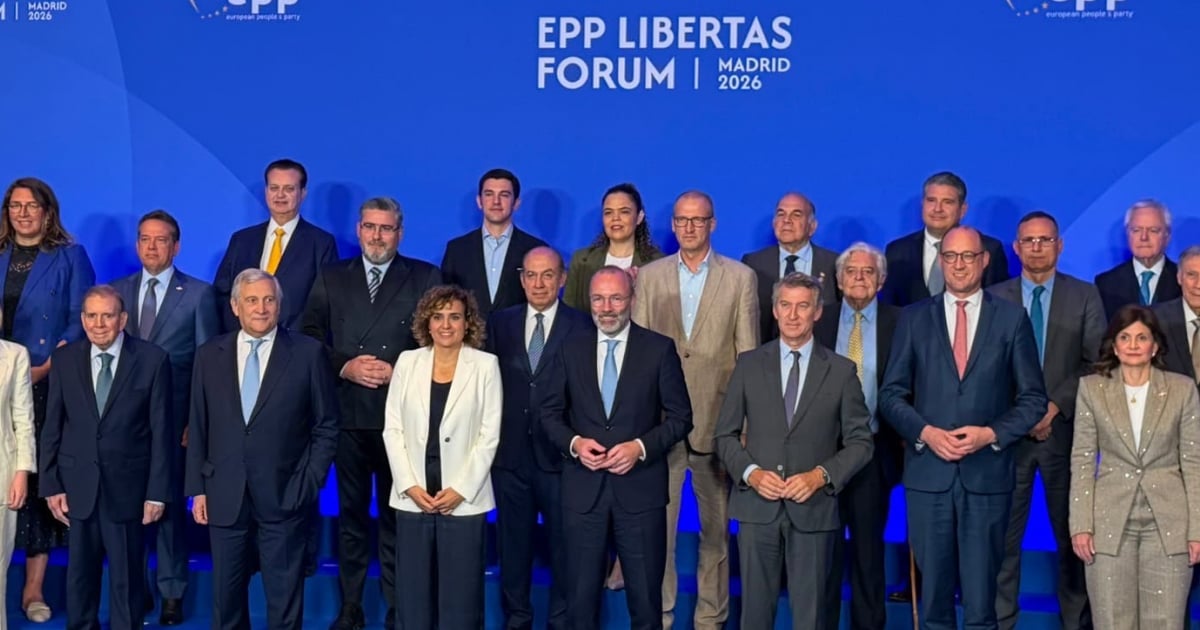
In an era marked by wars, geopolitical uncertainty, and a troubling regression of fundamental freedoms in numerous regions of the world, the Libertas Forum of the European People's Party, held in Madrid, has represented much more than a gathering of political leaders. It has been a moral and political reaffirmation of the principles that made the construction of democratic Europe possible after the tragedies of the 20th century and a reminder that freedom can never be taken for granted.
During two days of intense debate, European leaders, heads of government, MEPs, academics, human rights advocates, and representatives of the democratic resistance against various authoritarian regimes converged on a fundamental message: liberal democracy remains the system that best protects human dignity, and its defense requires determination, coherence, and international solidarity. This was, in essence, the true spirit of Libertas.
The meeting made it clear that the threats to open societies no longer arise solely from terrorism or economic crises. Today, democracy faces a much broader challenge: the strengthening of an authoritarian axis composed of states that concentrate power, restrict individual freedoms, subordinate justice to political authority, persecute opposition, and use propaganda and disinformation as permanent tools of domination.
In this context, the references to Russian aggression against Ukraine, the growing strategic weight of China, governed by the Communist Party, and the dictatorships of Cuba, Venezuela, and Nicaragua were not isolated mentions. They formed part of a broader reflection on the necessity for democracies to act decisively against those who seek to undermine the international order based on respect for law, freedom, and the sovereignty of peoples.
The interventions of Alberto Núñez Feijóo, Antonio Tajani, the Vice President of the Italian Government and Minister of Foreign Affairs, Dolors Montserrat, former President José María Aznar, MEP Antonio López-Istúriz, and numerous European leaders reflected a shared conviction: Europe cannot afford to be indifferent to those suffering imprisonment, persecution, and exile for defending democratic principles.
It was not just about condemning dictatorships. It was about claiming what distinguishes them from democracies: the rule of law, the separation of powers, free elections, political pluralism, religious freedom, freedom of expression, property rights, private initiative, and a market economy as tools for generating prosperity and citizen autonomy in the face of state power.
In response to those who believe that these principles are merely theoretical concepts, the Forum recalled a fundamental truth: where judicial independence and economic freedom disappear, political freedoms also vanish sooner or later.
Especially significant was the intervention of Venezuelan jurist Tamara Sujú, whose track record in documenting human rights violations has made her voice an international reference. Her call to accompany, raise awareness, and advocate for political prisoners reminded us that behind each judicial record fabricated by a dictatorship lies a person arbitrarily deprived of their freedom, a shattered family, and a society that is intended to be governed through fear.
Democracies cannot limit themselves to expressing occasional solidarity. They must transform that solidarity into a permanent policy of support, denunciation, and backing for those who pay the highest price for defending freedom.
This human dimension gained special significance during the panel "A Common Horizon for Freedom," where, alongside Rosa María Payá, we presented the tragedy that our homeland is experiencing. We conveyed to the heart of the Forum the daily reality of Cubans who continue to face repression, hunger, power outages, poverty, and the absence of fundamental rights under a political system that does not allow electoral competition, free press, or legal opposition.
The welcome we received demonstrated that the cause of Cuba's freedom continues to hold an important place in the European democratic conscience. But it also highlighted something even more significant: the struggle of Cubans is part of a much broader battle for the universal defense of human dignity.
The same goes for the leadership of María Corina Machado and many Venezuelan democrats who are fighting for the return of democracy to their country; with Juan Sebastián Chamorro and those who peacefully resist the dictatorship of Daniel Ortega and Rosario Murillo in Nicaragua; and with thousands of anonymous citizens who, from different parts of the world, continue to believe that no tyranny can be eternal.
The Libertas Forum also recalled that the defense of freedom is not only an ethical obligation but also a strategic necessity for Western democracies. Each dictatorship that consolidates its power strengthens international networks of influence, corruption, disinformation, and repressive cooperation that ultimately affect the security and stability of democratic societies themselves.
Therefore, supporting those who peacefully fight against authoritarianism does not mean intervening in the internal affairs of other countries. It means upholding the values that underpin international coexistence and protecting an order based on respect for fundamental rights.
Democratic Europe was born from the decision to place the individual at the center of political life. This legacy, deeply influenced by Christian humanism and the liberal democratic tradition, serves as the best antidote against totalitarian projects that subordinate the individual to the State, the single party, or the leader.
That legacy was fully reflected in Madrid. At the conclusion of the Libertas Forum, those of us from Cuba, Venezuela, and Nicaragua renewed our hopes. We left with the certainty that our struggle is gaining increasing solidarity.
It is a reality that dictatorships thrive when the free world remains silent, but they retreat when democracies speak with a single voice, stand by the victims, and turn solidarity into political action.
We owe a sincere acknowledgment to the President of the PPE Manfred Weber, Alberto Núñez Feijóo, Antonio Tajani, Dolors Montserrat, and all the leaders, parliamentarians, experts, and participants who made this meeting possible. We also extend our gratitude to those who, in various capacities, reaffirmed that the defense of freedom is a shared responsibility of all democracies.
In Madrid, the Libertas Forum demonstrated that Europe is still willing to take action. And that message, for millions of people who still live deprived of freedom, represents the hope that the democratic world has not given up its duty to defend liberty wherever it is most needed.
Related videos:
Filed under:
Opinion article: Las declaraciones y opiniones expresadas en este artículo son de exclusiva responsabilidad de su autor y no representan necesariamente el punto de vista de CiberCuba.