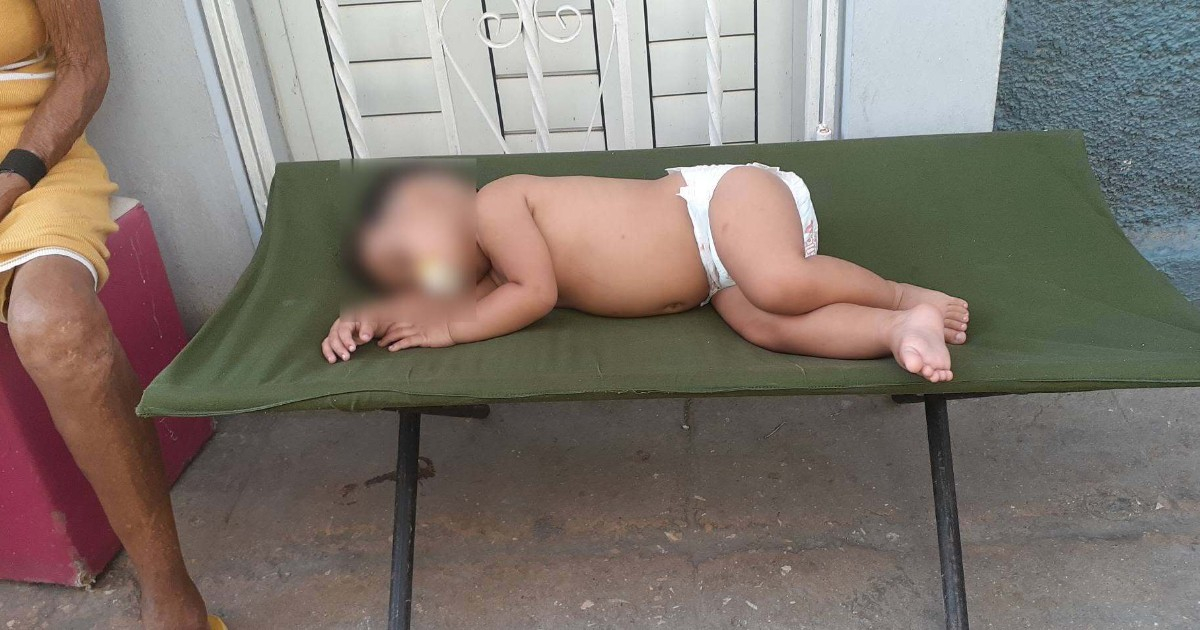
A Cuban mother identified as María Acuña Cruz published a heartbreaking message about her 1-year-old son who is forced to sleep outside the house because the power outages make the heat inside unbearable.
"I feel ashamed to make this post, but this is becoming unbearable," wrote the woman, who accompanied her words with photos of the baby sleeping face down, in a diaper, on a folding cot placed in what appears to be a porch with a cement floor.
The mother describes a humanitarian crisis that accumulates layer upon layer: without electricity to keep cool, the child is exposed to the mosquitoes that thrive in streets that, according to her, are "full of garbage and contaminated."
Additionally, the baby is suffering from a diarrhea virus, and there is not enough water to wash or bathe him as often as his condition requires.
At the end of her post, María Acuña Cruz directed a straightforward question to President Miguel Díaz-Canel: "Do you ever think about the Cuban people that are in your hands, about the children, the elderly, the parents who have to come up with ways to put food on the table?"
The testimony adds to a wave of similar complaints that Cuban mothers have been sharing on social media since May 2026. On July 10, another mother, Dayany Sol Lopez, published an open letter to Díaz-Canel along with a photo of her seven-month-old baby sleeping on a cot in the yard after 48 hours without electricity: "Mr. President, my son does not know what it means to endure, and my son does not understand the mess of a country he lives in."
A family in Matanzas has been sleeping on the rooftop for over a week in search of some fresh air, while other mothers reported heat rashes on their children and babies who have been unable to sleep for more than three nights.
The context surrounding these testimonies is that of the worst electrical crisis in recent Cuban history. The system operates with barely around 1,100 MW compared to a demand of more than 3,100 MW, and the record deficit reached 2,341 MW on July 10.
Cuba has experienced at least five total blackouts so far in 2026, marking the tenth collapse of the National Electric System in 24 months, with outages exceeding 20 hours daily in Havana and lasting up to 87 consecutive hours in Matanzas.
The lack of electricity brings about a shortage of water, as the pumps do not operate without power. Nearly 2.7 million Cubans lack regular access to drinking water, and 43.3% of households receive it every three days or less.
The garbage collection system has also collapsed: in Havana, only 44 out of 106 available trucks are in operation due to fuel shortages, resulting in mountains of waste in streets and neighborhoods and encouraging the proliferation of the Aedes aegypti mosquito, with active outbreaks of dengue and chikungunya in 134 municipalities.
Díaz-Canel himself acknowledged before the Communist Party on June 12 that "resistance alone is not enough," without presenting concrete solutions for the millions of Cubans who, like María Acuña Cruz's baby, face the heat, mosquitoes, and darkness every night.
Related videos:
Filed under: