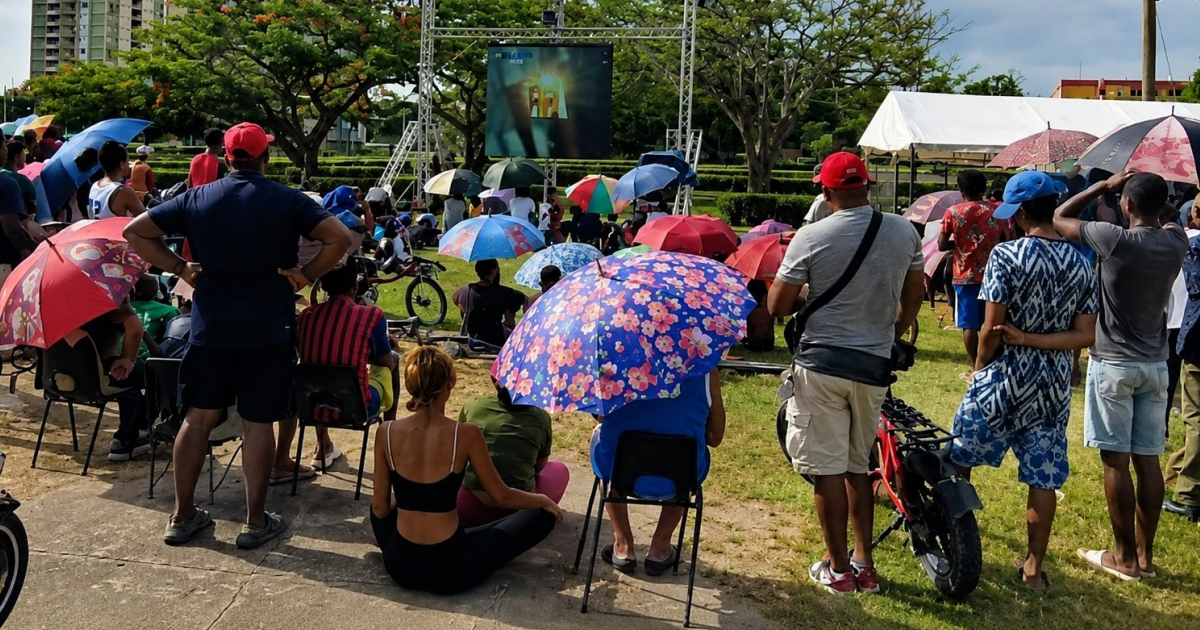
A Cuban identified as LaSai Dela Vida posted on Facebook a text that has generated significant resonance, in which she questions the paradox that Cuba is experiencing during the World Cup: while the country suffers from devastating blackouts and shortages of water, food, and fuel, many men in Havana gather to cheer for Argentina and celebrate goals, ignoring the misery that surrounds them.
"Havana has been shaken for days by the cries of men who see a bulb in their homes light up every two days from the electricity they pay for as if it would never go out, men who do not receive water, who find it difficult to get gasoline, food, money, and most see their children sleeping on rooftops or in doorways, but they do not cry out for that, but for Argentina, for a goal... and I feel more and more ashamed," he wrote.
The text, titled "Happy and Prosperous Misery," has multiple critical layers: it denounces the crisis of basic services, highlights the structural machismo that places the domestic burden on women, and points to the political passivity of those who celebrate a goal while ignoring the collapse of the country.
LaSai Dela Vida describes how many people seek places with electricity to watch the matches while they stay awake all night, swatting mosquitoes and monitoring the water supply to be able to cook the next day.
The author also critiques what she refers to as the "new man"—an ironic reference to Che Guevara's revolutionary ideal—and questions those whose priority is "to meet daily, at a certain time, in a place with electricity to drink beer and shout for football."
The most political point of the text directly highlights the collective inaction in the face of the dictatorship: "War has always been led by men, but in this country, the men who have tried to wage it have been imprisoned, because other men, for the most part, have left them alone; these new men have prioritized other things, shouting for football..."
The background that gives meaning to this complaint is the worst electrical crisis in recent Cuban history: the National Electroenergetic System (SEN) has collapsed at least five times this year, marking the tenth collapse in 24 months.
As of July 13, 106 distributed generation plants remained offline due to lack of fuel, and 11 of the country's 16 thermoelectric plants were out of service.
The regime has attributed the crisis to the oil blockade and the U.S. embargo, without announcing effective structural measures.
Meanwhile, the state channel Tele Rebelde was announcing the semifinals of the World Cup as usual, provoking ironic comments: "The blackout is the champion," "My favorites are Apagonia and Signalonia," and "Hopefully SEN can come to an agreement with FIFA".
LaSai Dela Vida is not a new voice in this debate: in June, after 20 hours without electricity, they publicly asked if it is normal to "spend the day swatting flies, go to bed sweating without water, or shout at a child asking for food."
The final of the 2026 World Cup, in which Argentina will face Spain on July 19 at MetLife Stadium in New Jersey, promises to repeat the same paradox for millions of Cubans who will try to watch the match amidst blackouts that the regime has neither been able to—nor seems willing to—resolve.
Related videos:
Filed under: