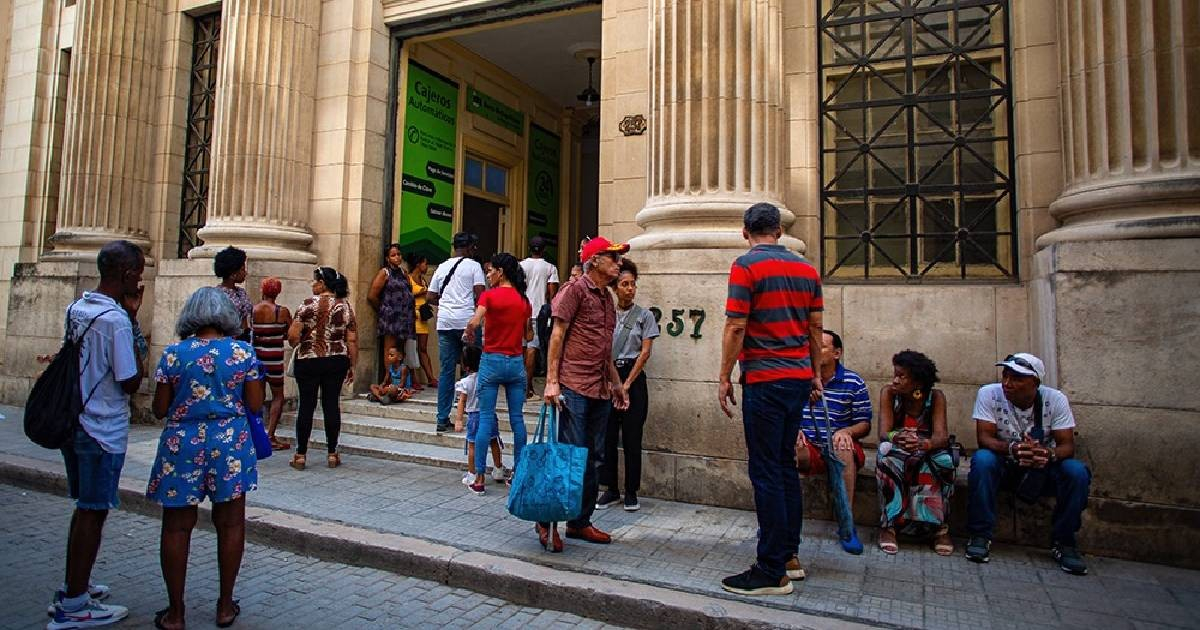
The new measures from the Central Bank of Cuba (BCC) to encourage digital payments and extend pension payments through local businesses sparked a wave of skepticism and dark humor on social media this Saturday.
Cubans pointed out the central paradox that summarizes the country's critical economic situation: cash transaction limits are lifted, but there is no cash available in the banks.
The BCC announced a radical shift in its banking policy through Resolution 74/2026, which indefinitely suspends the limit of 5,000 Cuban pesos for cash payments and receipts among economic actors, in effect since August 2023.
The regulation, signed on July 10 by the president of the Central Bank of Cuba, Juana Lilia Delgado Portal, will come into effect on Monday, July 20.
The package includes immediate payment accreditation within the same bank starting August 1, a reduction in the commission for businesses from 1.5% to 0.8%, bonuses of 4% for consumers and 2% for businesses for Online Payments, the elimination of the commission for cash deposits, and a fee of 0.2% for cash withdrawals.
The citizens' reaction was immediate and forceful
"Now there are no limits on cash withdrawals, the problem is that there is no cash in the banks," wrote a citizen. Another was more direct: "Cuban banks have no money." A third summarized with sarcasm: "Well, that's a good joke by the government, but seriously, where can I withdraw cash?"
Critics также pointed to the infrastructure that would make any mass digitization unfeasible.
"Yes, payment by transfer will be very good where there is electricity, connectivity, and especially a bank, because I want them to tell me how people in the countryside will be able to do it," questioned a user on Facebook.
Another asked outright, "With what electricity and internet?" A third comment summarized it this way: "Transfers without power and connection. In this government, they are clueless."
Skepticism was not diminished by the announcement that local businesses will take on the responsibility of paying pensions in their area using the cash from their daily sales.
"The finishing blow to totalitarianism is here. The private entrepreneur is now in charge of the pension system," wrote a user on the social network X.
Another person pointed out: "The official says they would be covering 'part' of that payment to retirees, but we know it will be the entire amount."
A third party warned about the political consequences of the scheme: "Now they can blame the small and medium-sized business owners for the economic and social disaster in Cuba, and people will go knock down their doors instead of going to the Communist Party if there are no payments."
The failure of three years of mandatory banking
In 2026, only 3.77% of transactions in Cuba are digital, less than 10% of private businesses regularly accept transfers, and more than 50% of ATMs in Havana were out of service in May.
The regime imposed 15,240 fines and ordered 269 closures of establishments without reversing the trend of businesses refusing to accept transfers.
In parallel, the informal market for converting transfers to cash saw its commissions rise from 15% in September 2025 to 40% documented in Santiago de Cuba on July 16, where transferring 1,000 pesos only resulted in receiving 600 in physical bills.
Cuba has more than 1.7 million retirees with a minimum pension of 4,000 pesos per month —less than seven dollars at the informal exchange rate— while the basic food basket exceeds 30,000 pesos.
"Regarding the effectiveness of these economic measures, let's say like the characters from Elpidio Valdés: ‘That remains to be seen, buddy!’ The Cuban economy is a vicious circle," concluded a user on Facebook.
Related videos:
Filed under: