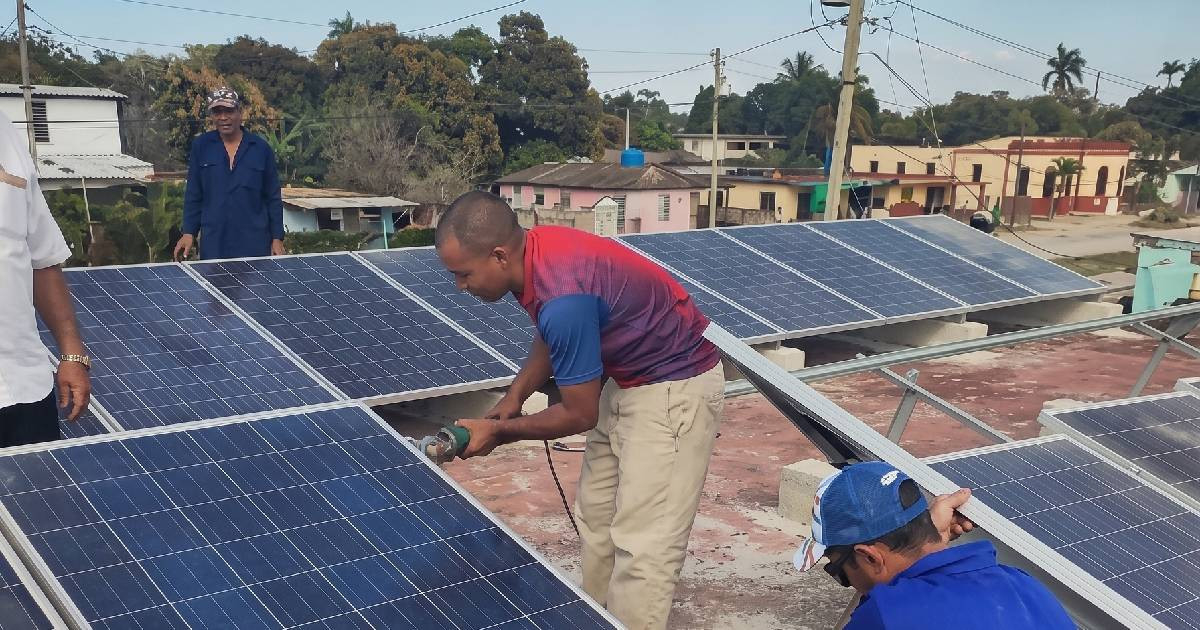
Prolonged blackouts have turned solar panels into a symbol of status and survival, as millions of Cubans continue to rely on a collapsed electrical system or revert to ways of living from another century.
There are times when a society is divided by ideologies, religions, or political parties. In today's Cuba, marked by almost constant blackouts, the new line of separation runs through the roofs of homes. On one side are those who have managed to install solar panels; on the other, those who still light a match to cook or endure hours in the dark, reflected this Friday through his Facebook profile, the writer José Poveda Cruz.
Far from being a luxury, photovoltaic systems have become a survival tool for families who can afford them, whether through support from relatives abroad, income from the private sector, or their own resources.
The problem does not lie with those who manage to escape the blackouts, but rather in the fact that this possibility depends on a crisis that affects the rest of the population, he pointed out.
The scarcity has turned these devices into one of the most sought-after products on the market. Prices are rising as the electrical crisis worsens, and uncertainty fuels demand.
In practice, the ability to keep a fan running, charge a phone, or preserve food increasingly depends on the purchasing power of each family, he added.
The contrast is evident in many neighborhoods. While some homes illuminate the night with inverters, batteries, and solar panels, others resort to firewood for cooking. Two realities coexist just a few meters apart, one supported by technology and the other forced to revert to methods that seemed obsolete generations ago.
Poveda agreed that the small lights powered by batteries or makeshift solar systems, standing out among the darkened homes, are signs of resilience in the face of the collapse of the National Electric System (SEN). However, they also reflect a growing gap between those who can ensure a minimum of energy autonomy and those who are entirely reliant on a public service that is unable to provide stability.
Citizens' comments reveal the depth of the social wound. "There is no longer just a gap of socioeconomic inequality; now there is also the privilege of having electricity in a country that is dark," wrote one.
Another pointed out that "a directly proportional relationship has been created between the number of panels the beneficiary possesses and the way they look at and treat those of us who have nothing."
A third voice summed up the collective exhaustion: "They have divided us. To the point that everyone is thinking of escaping in whatever way they can, from such terrible misery."
The fracture also affects those who believed in education as a social elevator. "Perhaps the greatest irony falls on professionals," writes Poveda Cruz, "those men and women who for decades believed that a university degree was a passport to a better life. They now discover that the diploma shines less than a lithium battery."
The conclusion of your reflection encapsulates what the energy crisis has done to Cuban society: "In Cuba, where blackouts prevail, electricity has ceased to be a service; it has become the most visible form of inequality."
The crisis fueling this break is unprecedented, with a collapsed SEN that has already experienced total disconnections at least eight times in 18 months.
In some areas of Matanzas, power outages have accumulated for up to 87 consecutive hours; in Havana, the average ranged from 15 to 24 hours daily without electricity.
In that context, accessing a solar panel amounts to an unattainable luxury for most. In the informal market, an individual panel costs between 990 and 1,000 dollars, which is more than two years of the average state salary, which hovers around 17.5 dollars per month.
A complete residential kit ranges between $2,750 and $5,200. Resellers and inflation worsen this situation, as items that used to cost less than $100 are now priced between $200 and $300.
Only those who receive remittances from abroad, have private businesses, or access to foreign currency can afford that investment. The panel has ceased to be technology and has turned into a privilege.
The irony of the regime is hard to ignore. On July 8, just two days after the total blackout, the leader Miguel Díaz-Canel toured a solar panel factory in Havana to showcase "innovative energy solutions," according to the official newspaper Granma.
The official statement revealed, unintentionally, that the factory had to install panels on its own roof to "become independent from the National Electric System and not halt production."
Related videos:
Filed under: