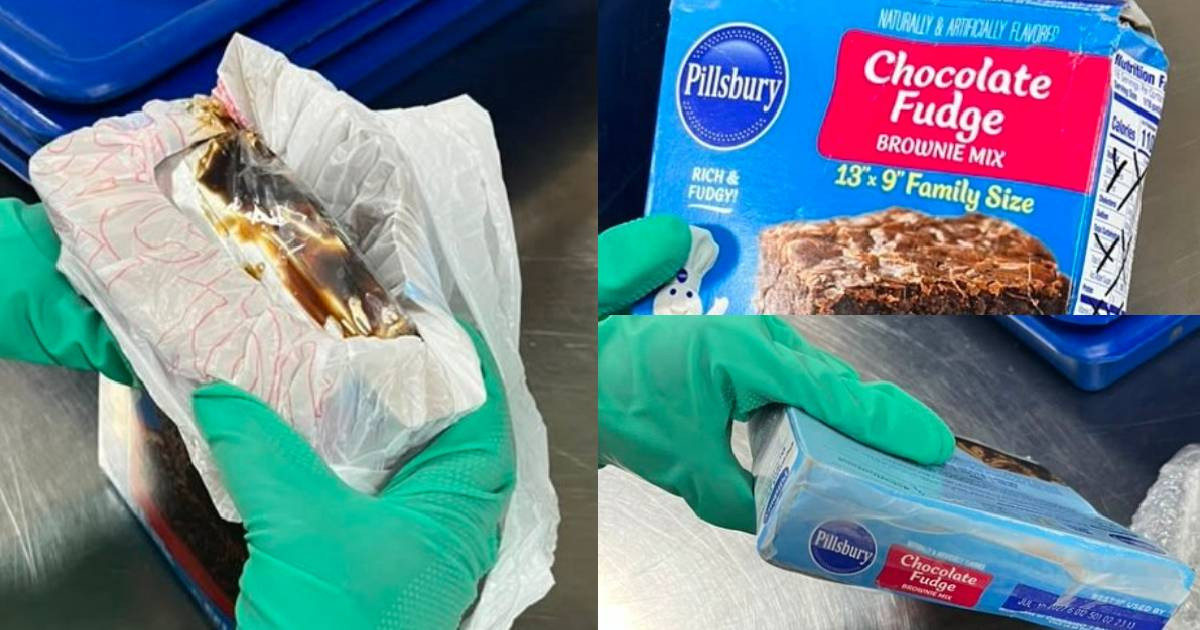
The Customs of Cuba intercepted synthetic cannabinoids, the drug known as "chemical," disguised in two boxes of food from the United States at the José Martí International Airport in Havana, reported this Friday Wiliam Pérez González, Deputy Chief of the General Customs of the Republic.
The images published by the official through his account on X show inspectors wearing green latex gloves handling packages on a metal surface.
One of the boxes used for camouflage was a family-sized 521-gram brownie mix from the Pillsbury brand, which appeared to be an ordinary food product sent from the United States.
The operation was carried out jointly by Customs and the anti-drug agency of the Ministry of the Interior as part of the border surveillance program that both institutions maintain at the country's main airport, it emphasized.
In a recent operation, Customs discovered over 12 kilograms of gold, valued at more than $1,589,160, hidden inside nine handmade figures painted black that two passengers were attempting to illegally smuggle out of the capital's airport terminal. The case was reported to the National Revolutionary Police.
In April, the same Customs-anti-drug duo detected 19 sheets soaked with "chemical" hidden in a box of Cocoa Puffs cereal sent from the United States, which could have allowed for the distribution of 22,800 doses.
Previously, in May, methamphetamine was seized hidden in popcorn packages, and in January, Customs discovered marijuana concealed in cereals and instant drinks, all originating from the same source.
The "químico," also known as "papelillo" or "kimiko," is a synthetic cannabinoid that is 50 to 100 times more powerful than marijuana. Since May 2025, a version that is even more lethal has been circulating in Cuba that contains fentanyl, formaldehyde, benzodiazepines, phenobarbital, and veterinary anesthetics.
On the island, at least 40 variants of synthetic cannabinoids are circulating, with a higher prevalence in Holguín and Havana. Furthermore, 90% of those who try them end up in a state of addiction, according to official Cuban sources.
The ease of camouflaging it explains its proliferation: from a piece of paper the size of an identity card, up to 300 doses can be extracted, and its price ranges from 150 to 300 Cuban pesos per unit, making it one of the cheapest and most accessible substances on the illegal market.
In response to the escalation of synthetic drug trafficking, the Supreme People's Court approved Opinion 476 in August 2025, which increased penalties.
In March, two individuals were sentenced to 15 years in prison for trafficking only 1.74 grams of synthetic cannabinoid in the province of Artemisa.
Related videos:
Filed under: