
Related videos:
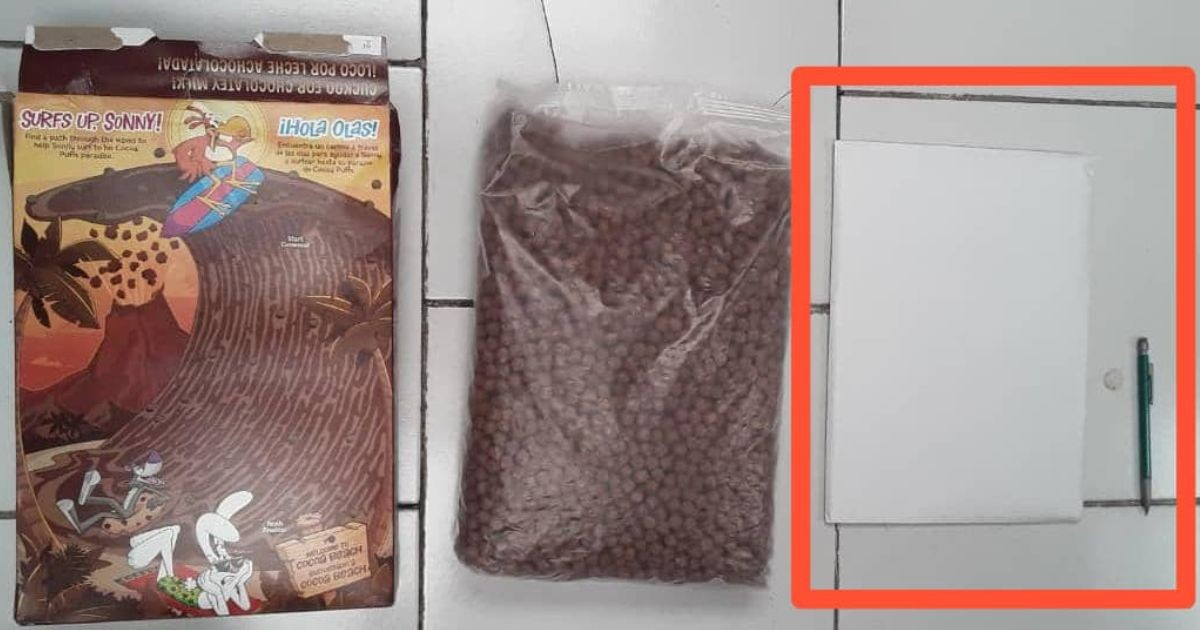
The Cuban Customs and the Anti-Drug Agency of the Ministry of the Interior detected this Tuesday 19 sheets infused with synthetic cannabinoids —the drug known as "the chemical"— hidden inside a box of Cocoa Puffs cereal sent from the United States.
The discovery was announced by William Pérez González, first deputy chief of the General Customs of the Republic, through his official account on X.
"19 sheets soaked with synthetic cannabinoids, referred to as 'chemical', were found hidden in a cereal box in a shipment from the US, the main source of this drug. The consumption of 22,800 doses was prevented thanks to the efforts of the Customs of Cuba and the drug control agency," wrote the official.
The published images show the cereal box, the contents extracted into a clear plastic bag, and the leaves soaked in the substance, with a coin included for size reference.
The seizure occurs just one day after authorities detected methamphetamine hidden in a package of Verde Valle rice in a passenger's suitcase, highlighting a ongoing pattern of drug trafficking disguised in food shipped from the U.S. to Cuba.
In January 2026, Cuban Customs had already seized marijuana hidden in packages of cereal and instant drinks at the José Martí International Airport in Havana.
The "chemical" is a synthetic cannabinoid that is 50 to 100 times more potent than marijuana, also known as "paper" or "kimiko." Its price in Cuba ranges from 150 to 250 Cuban pesos per dose, making it cheaper than many staple foods on the island.
Since May 2025, a version even more lethal than contains fentanyl, formaldehyde, benzodiazepines, phenobarbital, and veterinary anesthetics has been circulating in Cuba.
Cuban authorities have identified at least 40 variants of synthetic cannabinoids circulating in the country, with a higher incidence in Holguín and Havana. According to official sources, 90% of those who try the substance end up in a state of addiction.
The camouflage in everyday foods is due to the fact that a dose occupies just 0.5 cubic centimeters on an impregnated paper, making it easy to conceal in containers of all types. Documented methods include yogurt, gelatin, dietary supplements, medications, diapers, and aromatic plants.
Between 2024 and December 2025, Cuban authorities prevented 72 operations involving synthetic cannabinoids and other drugs from 11 different countries.
In light of the escalation, the People's Supreme Court approved Ruling 476 in August 2025, tightening penalties: from one to three years of imprisonment or fines of up to 1,000 quotas for possession or distribution.
In March of last year, two individuals were sentenced to 15 years in prison for trafficking just 1.74 grams of 5-fluor ADB in the province of Artemisa.
Filed under: