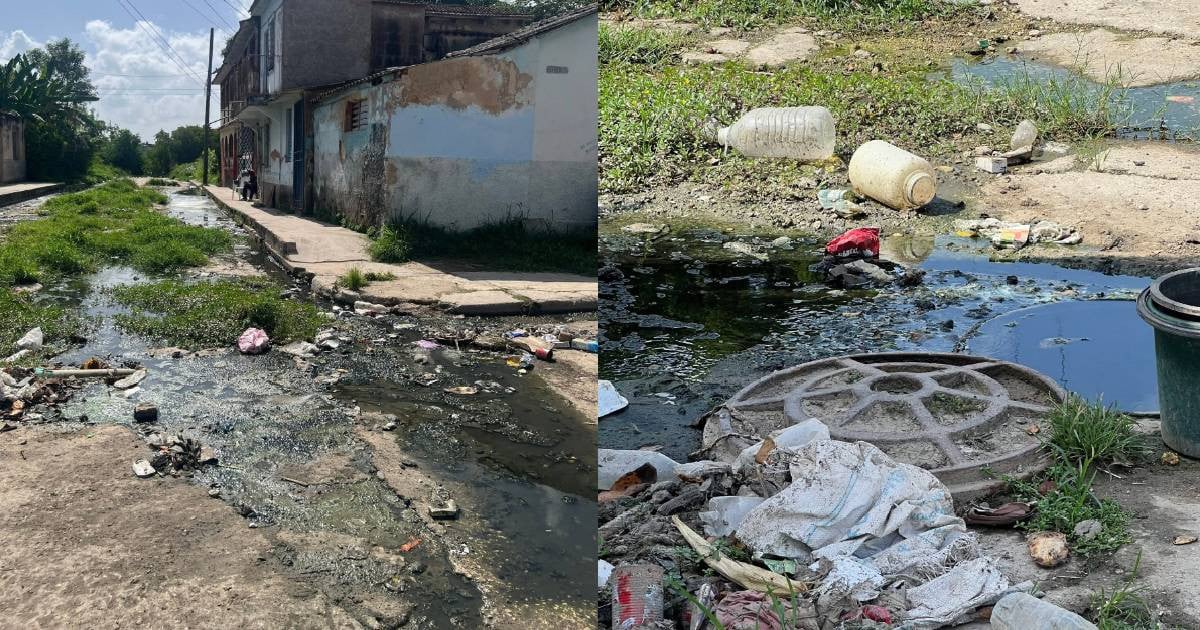
The La Marina neighborhood in Matanzas is experiencing a health crisis that its own residents describe as unsustainable, with streets flooded by black water, uncontrolled micro-dumps, and sewer systems that have become receptacles for wastewater.
A report published on Facebook by resident Leydis Martínez Ramos displayed completely flooded streets with stagnant water and solid waste -plastic bags, bottles, debris-, buildings in severe disrepair, and a record from Etecsa that the neighbors themselves have had to use to divert their sewage due to the lack of functional sanitation infrastructure.
A resident clarifies in the comments that what is photographed "is not a pit, it is a record from Etecsa that the neighbors diverted their wastewater," illustrating the extent to which desperation has led to makeshift solutions with serious health consequences.
The corner of Velarde and Santa Teresa is noted as one of the most critical points, where the accumulation of garbage and water hinders the passage of vehicles.
The citizens' voice in the publication reflects decades of accumulated frustration. "For a lifetime, this place has been completely marginalized for the past 100 years; there has never been a drop of concern for this area," wrote a resident.
Another commentator directly pointed to the responsibility of the State: "There is a governor who gets paid to oversee this, there is a municipal office of Popular Power whose president is also paid... Why should the citizens do that work for free?"
A 62-year-old resident living in the neighborhood reported that the neighbors have had to divert the sewage waters into the street "because there is no systematic maintenance work," and they are tired of cleaning without institutional support.
He added a revealing fact about the historical invisibility of the neighborhood: "This was the only neighborhood that wasn't mentioned positively or negatively on July 11, so what are we talking about?"
Martínez succinctly summarized the citizens' complaint: "Living among garbage and sewage should not be an acceptable reality for any resident of Matanzas."
The crisis in La Marina is not an isolated phenomenon, but rather the most acute expression of a healthcare collapse affecting the entire province since early 2026.
The Municipal Communal Company of Matanzas is operating with only 11 of its 24 waste collection trucks available, paralyzed due to a shortage of diesel fuel.
The daily allocation ranges from 300 to 550 liters, far below the more than 2,700 liters that would be needed to cover all the routes. Of a workforce of approximately 1,400 employees, only 930 are active.
This deficit has caused overloaded landfills throughout the city, illegal burning with toxic smoke, and small dumps in neighborhoods such as Versalles, Embarcadero, and La Marina.
In early June, health authorities confirmed an outbreak of hepatitis A with seven new positive cases of hepatitis and 49 suspected cases in just one week, according to the epidemiological report presented by the Provincial Center for Hygiene, Epidemiology, and Microbiology.
More than 300,000 residents of the province lack a stable supply of drinking water, which further exacerbates the epidemiological situation.
The newspaper Girón, the official organ of the Communist Party in Matanzas, warned in May that "what is at stake is no longer just the image of Matanzas, but the health and future of those who live there," an unusually direct acknowledgment of the extent of the crisis.
Related videos:
Filed under: