The official portal Cubadebate echoed an article this Saturday that reports workers in the United States are not guaranteed even a single day of sick leave, using the hospitalization of Republican senator Mitch McConnell as a hook to criticize labor conditions in the United States.
The text, taken from the progressive American media Truthout and signed by Sharon Zhang, states that McConnell has been hospitalized since June 14, following a fall that briefly left him unconscious and a mild pneumonia, and that he did not explain his absence from the Senate until July 12.
The irony highlighted in the article is real: the Republican senator from Kentucky enjoyed weeks of unpaid leave while blocking for years the legislation that would have extended that same right to ordinary workers.
In 2020, as the Senate majority leader, McConnell prevented the expansion of federal family and medical leave benefits from being included in the second pandemic relief package for COVID.
In 2022, he voted against granting seven days of sick leave to railway workers, amid a conflict between freight companies and unions that were threatening a national strike.
According to the article, the United States is the only wealthy country in the world without a federal guarantee of paid sick leave for all its workers, a significant and documented shortcoming.
However, the question that the Cuban regime avoids asking itself is the most obvious one: what rights do workers have in Cuba?
The response is devastating. The new Cuban Labor Code presented in June 2026 does not recognize the right to strike nor allows independent unions, maintaining the monopoly of labor representation in the hands of the Workers' Central Union of Cuba (CTC), a compliant arm of the Communist Party since 1961.
It's not the first time that Cubadebate has turned to this manual. In May, the portal and the program Mesa Redonda from television broadcast a documentary about poor workers in the United States that sparked a wave of mockery and criticism from Cubans both inside and outside the island, fed up with the regime's hypocrisy.
While Cubadebate points the finger at Washington, the minimum wage in Cuba is 3,210 pesos per month, which is equivalent to less than four percent of the 96,000 pesos that independent economists estimate as the minimum needed to cover basic necessities.
The average state salary is around 6,930 pesos, approximately 13 dollars at the informal exchange rate, and 89% of Cubans live in extreme poverty, according to independent studies.
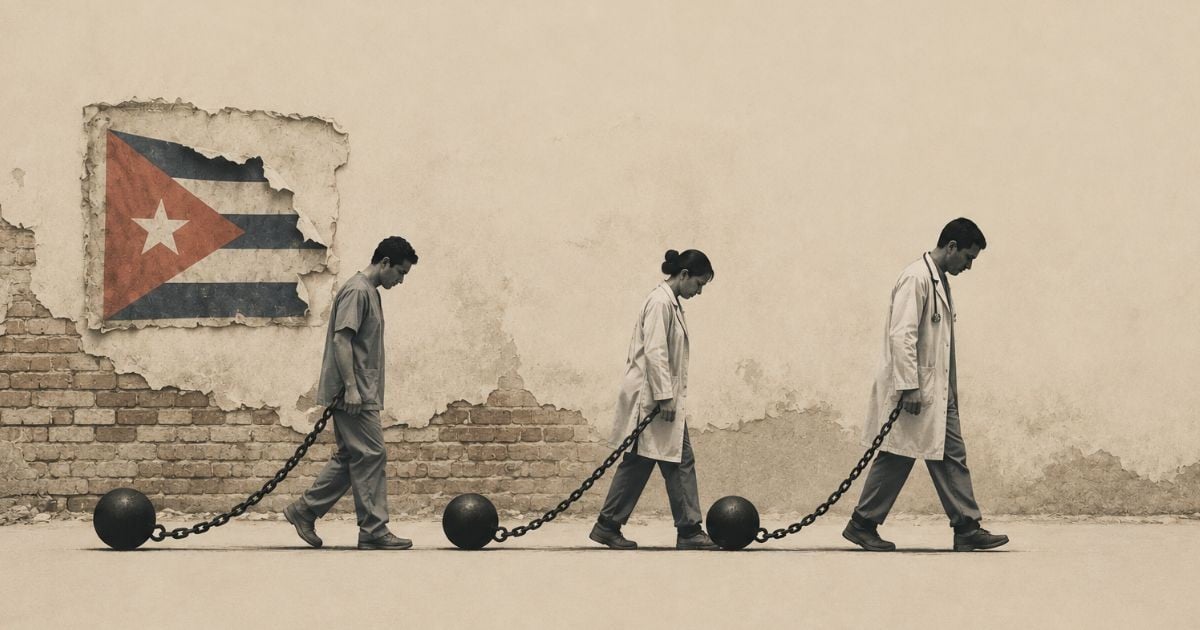
On the other hand, the United States government has pointed out that the medical brigades program, which the Cuban regime prides itself on, constitutes a "form of human trafficking."
On April 7, the Inter-American Commission on Human Rights (CIDH) published a 199-page report that concludes that the program operates under serious indicators of forced labor, human trafficking, and modern slavery, and recommended that all countries on the continent withdraw from it.
The report, based on testimonies from 71 professionals on missions in 109 countries, documented that the Cuban state retains between 60% and 97.5% of the salary paid by the host countries: in Mexico, the government paid about 3,750 dollars per month for a Cuban doctor, while the professional received only 200 dollars.
In addition to that salary retention, there are passport confiscations, academic document seizures, political surveillance, and reprisals against those who leave the mission.
Article 135 of the Cuban Penal Code penalizes abandonment with a prison sentence of three to eight years, and Decree-Law 306 of 2012 allows for a prohibition on returning to Cuba for eight years.
In September 2025, Cuban doctors who broke away from the mission in Italy described the situation with a phrase: "They blackmail you with your credentials."
In 2019, defecting doctors had already told the AFP agency that the program constituted a "system of modern slavery." One of them, identified as Orazal Sánchez, was straightforward: "The sad thing is that we remain slaves. We think we are free, but as long as we have family in Cuba, we continue to work for that system."
In April 2025, the European Parliament approved Amendment 311, which characterizes Cuban medical brigades as "modern slavery" and "forced labor" in the central document of European foreign policy.
Related videos:
Filed under: