
Related videos:
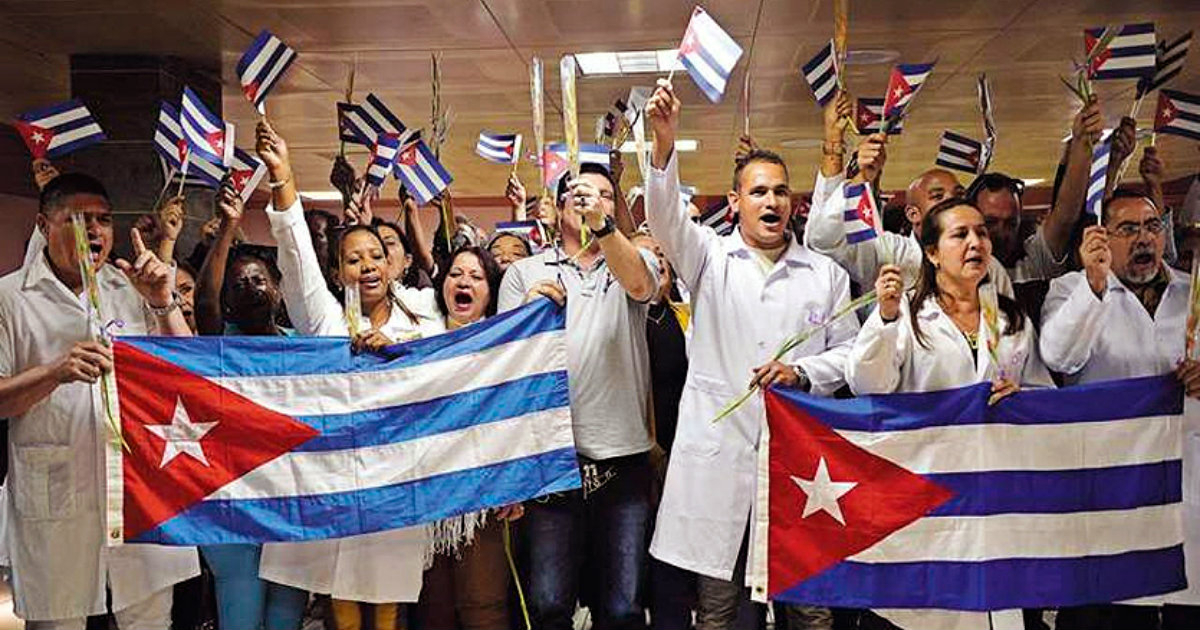
The Inter-American Commission on Human Rights (CIDH) called yesterday on all countries in the continent to withdraw from the Cuban Medical Missions Program.
The organization published a report of 199 pages concluding that the program operates as a machinery for generating foreign currency for the Cuban regime, with serious indications of forced labor, human trafficking, and modern slavery. The news was widely covered by international media such as El País.
The document, prepared in collaboration with the Special Rapporteur on Economic, Social, Cultural, and Environmental Rights, is based on testimonies from 71 professionals on missions deployed in 109 countries and details a systematic pattern of violations that the regime in Havana has denied, labeling them as a smear campaign.
Among the most serious conclusions is the wage retention: the Cuban state retains between 60% and 97.5% of what the receiving countries pay for each doctor.
The case of Mexico illustrates the magnitude of the scheme: that country paid about 3,750 dollars per month for each doctor, while the Cuban professional received barely 200 dollars. In Italy, for example, the country paid 4,700 dollars and the doctor received only 1,200 dollars.
According to official figures from the National Office of Statistics and Information of the regime (ONEI), health services generated $4.882 billion in 2022, making the missions the main source of revenue for the Cuban state, even surpassing tourism.
The IACHR documented situations consistent with contemporary forms of slavery or forced labor, including practices such as contract fraud, retention of identity documents, wage confiscation, and surveillance of private life.
The reprisals against those who abandon the mission are severe: prohibition from returning to Cuba for up to eight years, loss of housing, frozen bank accounts, and pressure on family members who remain on the island.
The Cuban Penal Code, in its article 135, penalizes mission abandonment with a prison sentence of three to eight years.
The president of the IACHR was emphatic in an interview with NTN24: "We must eradicate any practices, including this one, that constitute a systematic violation of human rights."
The report arrives at a time when several countries have already taken action in that direction. In the early months of 2026, Guatemala, Honduras, Jamaica, Guyana, Antigua and Barbuda, the Bahamas, Dominica, and Grenada canceled or did not renew their agreements with the program.
Even Nicaragua, a historical ally of the Cuban regime under Daniel Ortega, canceled its contracts. Mexico and Venezuela remain the primary destinations for missions in the region.
What began in 1963 with the deployment of a first permanent brigade to Algeria has mobilized, over six decades, more than 600,000 Cuban health professionals to at least 165 countries.
The IACHR now demands that the Cuban state and receiving countries ensure the voluntary nature of participation, the full and direct payment of fair wages, freedom of movement, and the elimination of any form of forced labor, in addition to establishing independent inspection mechanisms aligned with international human rights standards.
Human Rights Watch, which in July 2020 classified the working conditions of Cuban doctors on missions as "draconian", thus joins a long list of international organizations that have denounced the scheme, including the UN, which in 2024 requested explanations from Cuba regarding accusations of labor slavery.
Filed under: