
Related videos:
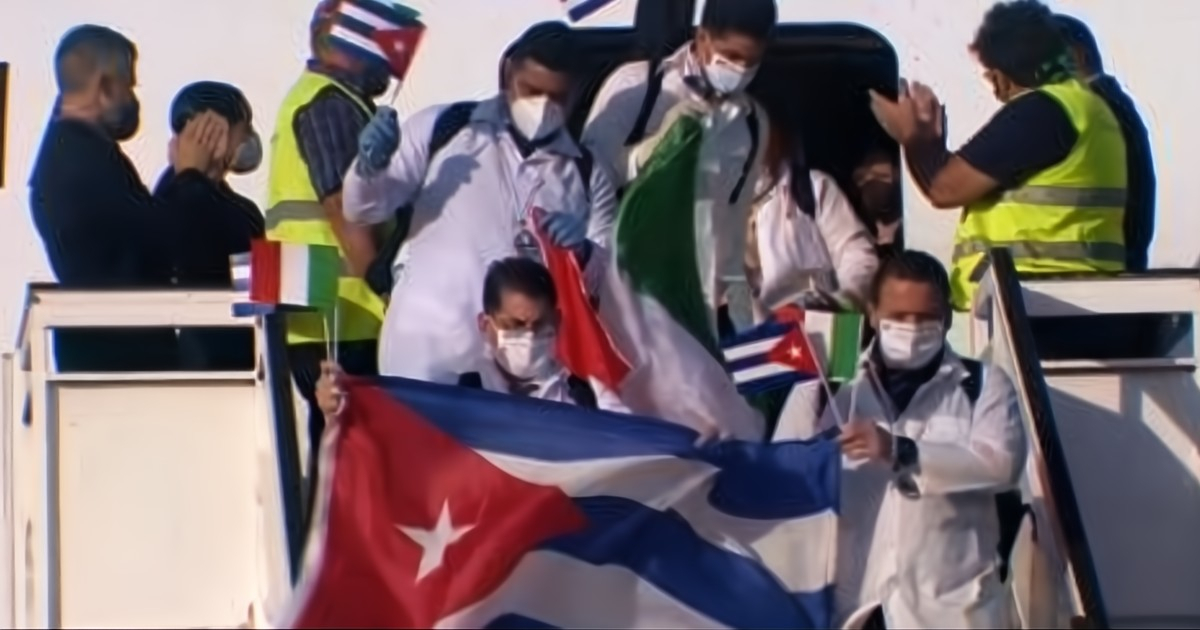
The lives of dozens of Cuban doctors participating in the official mission in Italy are marked by fear, surveillance, and the real possibility of being labeled "defectors" if they choose to disengage from state control.
In addition to job threats and institutional reprisals, one of the harshest penalties is the inability to return to Cuba for eight years.
According to reports gathered by the news portal CubaNet, at least 12 doctors have severed ties with the state company Comercializadora de Servicios Médicos Cubanos S.A. (CSMC), the entity that manages and oversees the medical brigades sent to Italy. Of these, five disassociated themselves from the mission in the last week.
Some opted to switch to the private healthcare system in Italy, others traveled to Spain, and several ceased to transfer the mandatory portion of their salary to the Cuban company, which was enough for them to be labeled as traitors by the island's authorities.
Behind these decisions lies a pattern of systematic abuse. Doctors interviewed by the media reported that upon separating from the official mission, they lose all access to their professional documents: diplomas, certifications, and degrees, which are essential elements for practicing their profession legally in Europe.
"They blackmail you with your degrees," confessed one of the doctors, and without these documents, they cannot validate their training or formally integrate into the Italian healthcare system.
The retention of these documents is part of an institutional policy aimed at preventing dropouts.
According to CubaNet, since 2017 a circular from the National Organization of Collective Law Firms (ONBC) prohibited the legalization of academic documents for professionals who abandon missions abroad, leaving doctors in a legal and professional limbo.
The documented cases in Calabria, an Italian region where several Cuban brigades currently operate, reveal a scheme of surveillance and control.
Two doctors who are still part of the mission reported that they do not feel free even to talk on the phone.
They claim to have received explicit warnings from the leadership of the medical mission, led by Luis Enrique Pérez Ulloa, who also represents the CSMC in Italy.
"They told us they have ways to identify those who report," stated one of the interviewed professionals.
The fear of reprisals is so great that some avoided giving their names out of concern that their contracts would be canceled and they would be sent back to Cuba.
But repression is not limited to those who have already been disconnected; even those who remain in the mission face severe restrictions: internal surveillance, limitations on family reunification, an inability to unionize, and contractual clauses that contradict Italian labor law.
Although the formal contract is signed between the doctor and the Calabria region, in practice, it is Havana that has the real control.
If the Cuban official declares that a professional is "not suitable," local authorities must revoke the contract, according to testimonies.
Even in cases where doctors try to legalize their degrees through official channels in Italy, they face obstacles imposed by the mission.
"I can't go to the Azienda (local health institution) to ask for anything, because they immediately inform the mission head, and you risk having your contract canceled," said a doctor from Reggio Calabria.
Meanwhile, media outlets like The Objective, based in Madrid and cited by CubaNet, have reported that emigrated Cuban doctors have also faced obstacles in obtaining accreditation, in a strategy that extends beyond Italy and points to a regional pattern of state control over healthcare personnel in exile.
From a legal standpoint, this policy is supported by Decree-Law 306 of 2012, which was later incorporated into the new Cuban Migration Law, emphasized the cited news portal.
This regulation allows the State to deny entry to the country for eight years to those who unauthorizedly disengage from official missions, under the argument of preserving the “highly skilled workforce.”
This type of punishment amounts, in practice, to a forced exile that affects not only the doctor but also their family ties and their right to free movement.
One of the most poignant testimonies comes from a doctor who, after breaking away from the mission, stated that she found peace in her decision, even though she knows she will not be able to return to her country for eight years.
"Freedom comes at a cost: for some, it has cost blood; I will pay with eight years of not entering my country. And you know what? I feel at peace," he emphasized.
The situation has begun to generate reactions at various levels. Organizations like "No Somos Desertores" have denounced this system as a violation of human and professional rights.
Meanwhile, in Italy, the Committee for the Defense of Health in Polistena issued a statement on social media following the departure of a Cuban doctor from the local hospital, describing the treatment received as "humiliating" and "exploitation disguised as cooperation."
“Dignity and independence prevailed over duty,” wrote Marisa Valensise, president of the committee, in a post that also questions the role of the regional president of Calabria, Roberto Occhiuto, one of the main advocates of the medical collaboration program with Cuba.
As medical missions continue to expand to other regions such as Molise and Veneto, despite the complaints, political and media pressure is increasing.
Since June, the report "From Havana to Calabria: The Perfect Scam Against Cuban Doctors" by CubaNet has sparked parliamentary inquiries in Italy, calls for transparency, and at least one police investigation.
However, for Cuban doctors, the reality remains the same: if they leave the mission, they risk losing everything, including the right to return home.
“Who is more imprisoned: the one who sleeps on the mission under surveillance, or the one who escapes knowing they can never return?” one of the doctors wondered.
The answer, for now, seems buried among withheld passports, opaque contracts, and a constant fear that accompanies them beyond any border.
In July, the Department of Health and Welfare of the Italian region of Calabria officially denied that Cuban doctors providing services there are legally required to transfer part of their salaries to the CSMC, the state-owned enterprise of the regime that acts as an intermediary between Havana and the recipient countries of healthcare personnel.
In an institutional response dated July 4, signed by doctors Teresa Celestino and Francesco Lucia, the Calabrian authorities assured CubaNet that the doctors contracted from the island sign individual contracts directly with the regional healthcare system, and that salaries are deposited in full and directly into Italian bank accounts in the professionals' names, as required by the labor laws of the European country.
The statement, issued in response to a request for information from the media CubaNet, thereby dismantles the supposed legal authority that the CSMC claims to have in requiring Cuban professionals to hand over the majority of their salary.
However, in August, the president of Molise, Francesco Roberti, confirmed that the region reached an agreement with the ambassador of Cuba in Italy, Mirta Granda Averhoff, regarding the arrival of doctors from various specialties, although he did not specify the exact number or arrival date, reported the agency EFE.
According to Roberti, at least 100 professionals are needed, especially in rural areas and in emergency services.
This pact comes at a time when Washington has intensified sanctions and warnings against governments and entities that hire Cuban medical brigades, which it accuses of being a form of labor trafficking.
The Cuban government confirmed in July that over 24,000 health sector workers are currently providing services abroad as part of its modern slavery system, disguised as an international cooperation policy.
Frequently Asked Questions about Cuban Medical Missions in Italy
Why can't Cuban doctors who leave their missions return to Cuba?
Cuban doctors who leave their missions face a penalty of eight years without being able to return to Cuba. This is due to a state policy supported by Decree-Law 306 of 2012, which aims to prevent the "desertion" of professionals considered as "highly skilled workforce." This measure acts as a forced exile, affecting both the doctor and their family ties as well as their right to free movement.
How does the retention of professional documents affect Cuban doctors in Italy?
The retention of professional documents, such as diplomas and certifications, prevents Cuban doctors who leave the mission from validating their education and practicing legally in Europe. Without these documents, they find themselves in a legal and professional limbo, which restricts their ability to integrate into the healthcare system in Italy or other European countries.
What portion of the salary do Cuban doctors receive for missions in Italy?
Cuban doctors receive only between 22% and 46% of the salary paid for their services in Italy. The rest is withheld by the Cuban Medical Services Marketing Company S.A. (CSMC), under the pretext of tax deductions that are not actually legally supported. This salary withholding scheme is part of a dual hiring system that maintains control over doctors and confiscates a large portion of their income.
What kind of surveillance and control do Cuban doctors face during missions in Italy?
Cuban doctors in missions in Italy face internal surveillance and severe restrictions, such as limitations on family reunification, the inability to unionize, and contractual clauses that contradict Italian labor rights. Additionally, they are subject to warnings and threats of reprisals from the leadership of the medical mission, creating a constant atmosphere of fear among the professionals.
Filed under: