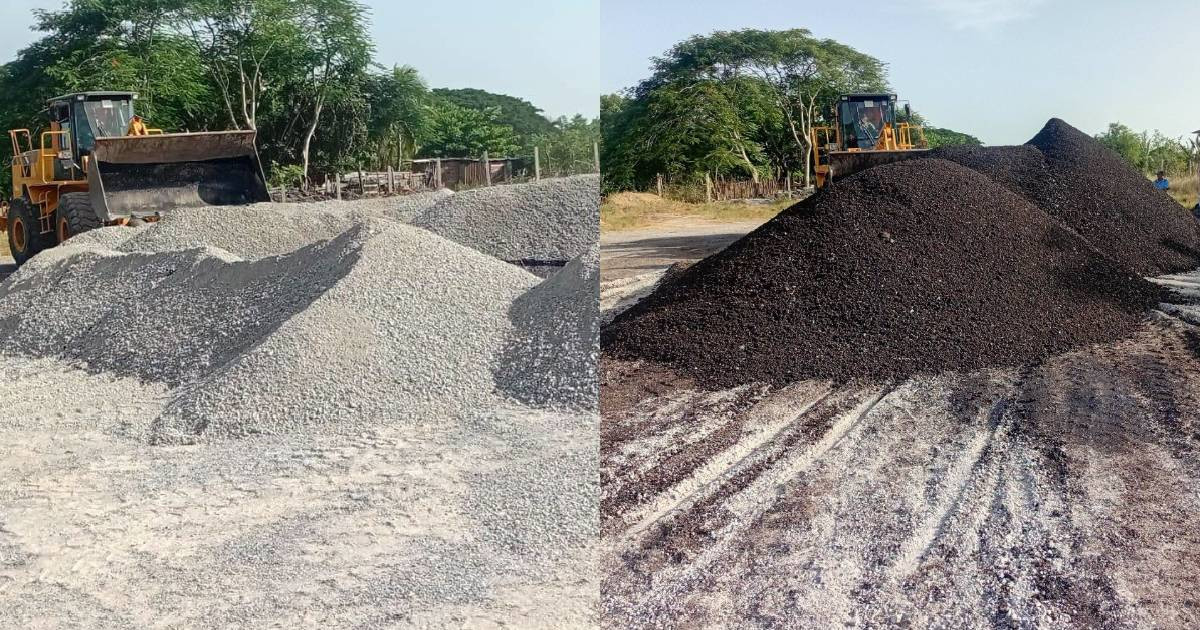
The state-owned Construction and Assembly Company of Las Tunas (Conalza) recently signed cooperative production contracts with two private micro, small, and medium-sized enterprises (mipymes) to manufacture cold asphalt and vinyl paint, products that are in high demand in the Las Tunas area and are currently scarce due to the construction materials crisis.
The first partnership is with the AsfalTunas Commercial Society, with which Conalza will begin the joint production of the first 100 tons of cold asphalt. The second is with the mipyme Construnes Tristá, with which it signed a contract for the future production of vinyl paint, the entity highlighted on July 12 through its Facebook profile.
Under the agreed framework, both parties will exchange financing, construction equipment, infrastructure, and qualified personnel, as well as jointly manage the necessary raw materials.
The company itself acknowledged that the partnership is a response to a critical situation. "Both small and medium enterprises are entering into a cooperative relationship to produce asphalt and paints, at a time when the lack of building materials has hindered the fulfillment of the production plan," it emphasized.
The products obtained will be used for road repairs and maintenance, as well as for the construction of housing in Las Tunas, two areas where scarcity has been particularly severe.
Conalza described the initiative as a "gradual adaptation to the new reality" of the hybrid model between the state and private sectors, a formula that the regime promotes in light of the state-owned enterprise's inability to operate independently.
The legal framework that enables these types of agreements is the Decree-Law 114/2025, which authorizes alliances between state-owned enterprises and non-state actors through economic association contracts, effective from April 2nd.
In June, the government also approved a package of 176 measures that removed the limit of 100 workers for small and medium-sized enterprises and the restriction of owning only one company, thereby expanding the scope of action for the private sector.
Cuban authorities have acknowledged that small and medium-sized enterprises (SMEs) are saving part of the national production, and the data supports this: partnerships with private companies increased the processing of raw materials by 19% in the first four months of 2026, resulting in 9,000 tons of finished production.
The context that drives Conalza towards this hybrid scheme is one of accumulated collapse. 75% of Cuban roads are in fair or poor condition, and in 2024, only 22.3% of the planned patching was carried out, with 12 of the country's 25 asphalt plants halted due to mechanical breakdowns.
In terms of housing, the situation is equally dire. The 2025 housing construction plan has barely achieved 22% of its target, and the housing deficit exceeds 900,000 units according to estimates.
The Minister of Transport, Eduardo Rodríguez Dávila, acknowledged in January 2025 that "the poor condition of many of our roads directly contributes to accidents and the deterioration of vehicles," an admission that illustrates the accumulated failure of state management in infrastructure.
Related videos:
Filed under: