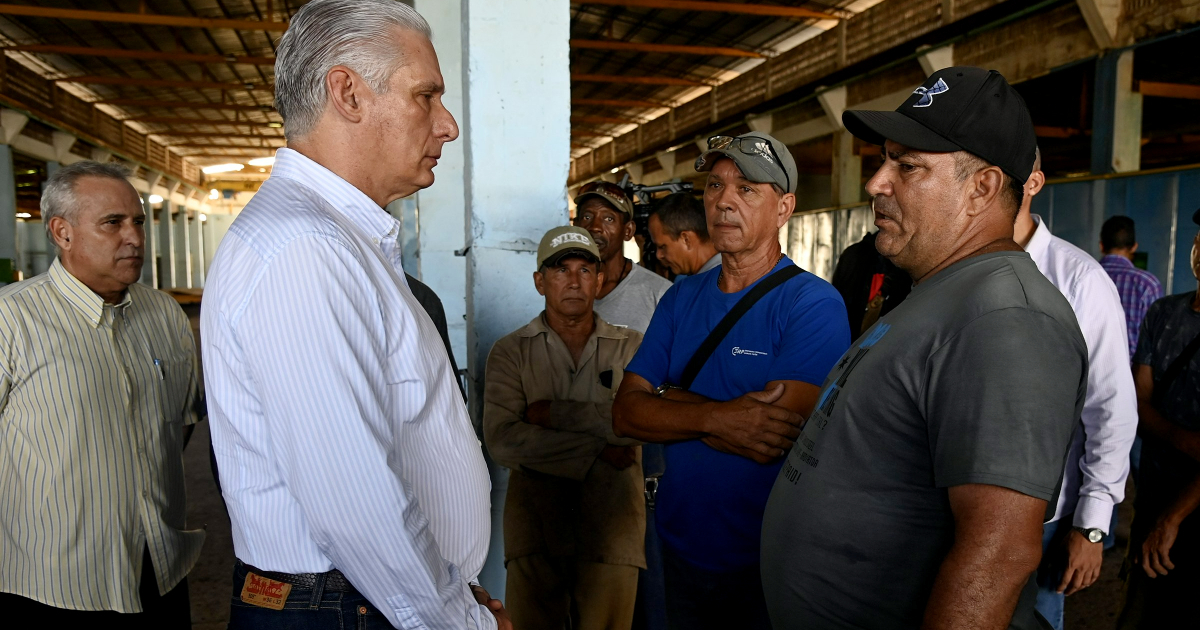
The Cuban leader Miguel Díaz-Canel defended on Tuesday the need to grant greater autonomy to state-owned enterprises during a tour of several industrial entities in the municipality of Havana del Este, where he urged managers to prepare themselves to exercise powers that the government promises to enhance within the new economic transformations.
According to the information published by the Presidencia, the leader emphasized that businesses will need to take on responsibilities such as managing fuels and supplies, conducting import and export operations, handling accounts in foreign currency and distributing profits, responsibilities included in the package of economic reforms presented by the government in an attempt to reactivate an economy affected by resource shortages, low productivity, and the energy crisis.
The statements were made during a visit to the future first public charging station for electric vehicles in the country, built by the Mipyme 5ta. Avenida Motores on the Vía Blanca, as well as to the Guanabo Industrial Base Business Unit, where containers will be assembled mainly to strengthen waste collection in Havana.
Although the state media presented the tour as a demonstration of the progress of various industrial projects, the main political message was focused on the implementation of the economic reforms announced weeks ago, the primary goal of which is to expand the management powers of the state socialist enterprise.
Among the measures announced by the authorities is the possibility for companies to develop new economic activities, manage part of their income in foreign currency, engage with greater flexibility in foreign trade operations, and make decisions that previously depended on central agencies.
The package also includes increased interaction between state enterprises and private actors, along with mechanisms to attract investments and stimulate sectors deemed strategic. Additionally, the government proposes to introduce procedures for bankruptcy, liquidation, and restructuring for state enterprises with sustained losses.
The reform of the state enterprise system also includes the elimination of subsidies, greater management autonomy, the transformation of companies into commercial entities, and the gradual opening to private and individual shareholder participation. However, the government has reiterated that these modifications do not imply a change in the economic model, but rather an update of its operation.
Experts have noted that the extent of these reforms will depend on the regulations that still need to be approved and the actual decision-making freedom that companies ultimately have. Previous experiences of decentralization ended up being constrained by administrative controls and the continued concentration of decision-making within the state apparatus.
Díaz-Canel's visit also revealed some of the contradictions the country is facing. While authorities are promoting projects to expand electric mobility through solar-powered charging stations, Cuba remains deeply enmeshed in a crisis of its electrical system, characterized by ongoing blackouts and difficulties in ensuring energy generation.
At the same time, the government prioritized the assembly of new containers for garbage collection in Havana, a service that has been impacted for years by a lack of fuel, the deterioration of the vehicle fleet, and a scarcity of material resources.
More than announcing new measures, the statements from the ruling authority aim to reinforce one of the pillars of the economic reform program. The challenge will be to verify whether the promised autonomy translates into effective changes for state-owned enterprises or if it remains once again conditioned by the high degree of centralization that characterizes the Cuban economic system.
Related videos:
Filed under: