Every dictatorship requires police, subservient courts, and intelligence apparatuses. However, none of these instruments alone is sufficient to ensure its permanence. There is a much more effective resource: the complicity of those who, without being part of the power, ultimately become its defenders or justifiers. This is one of the great tragedies of contemporary Cuba.
It is easy to understand why the leaders remain loyal to the system. Power provides privileges, immunity, access to goods that the rest of the population will never see, and a position that would vanish with the arrival of freedom. The defense of the regime, in many cases, is a matter of convenience.
What is truly perplexing happens outside of that elite. How can one explain to the citizen who survives on a salary that cannot support their family and yet continues to defend the very system that impoverished them?
How can one understand someone who spends hours waiting in line to get a little food, endures daily blackouts, sees their children leave for exile, and still recites official slogans as if they were undeniable truths? I'm not talking about a theory.
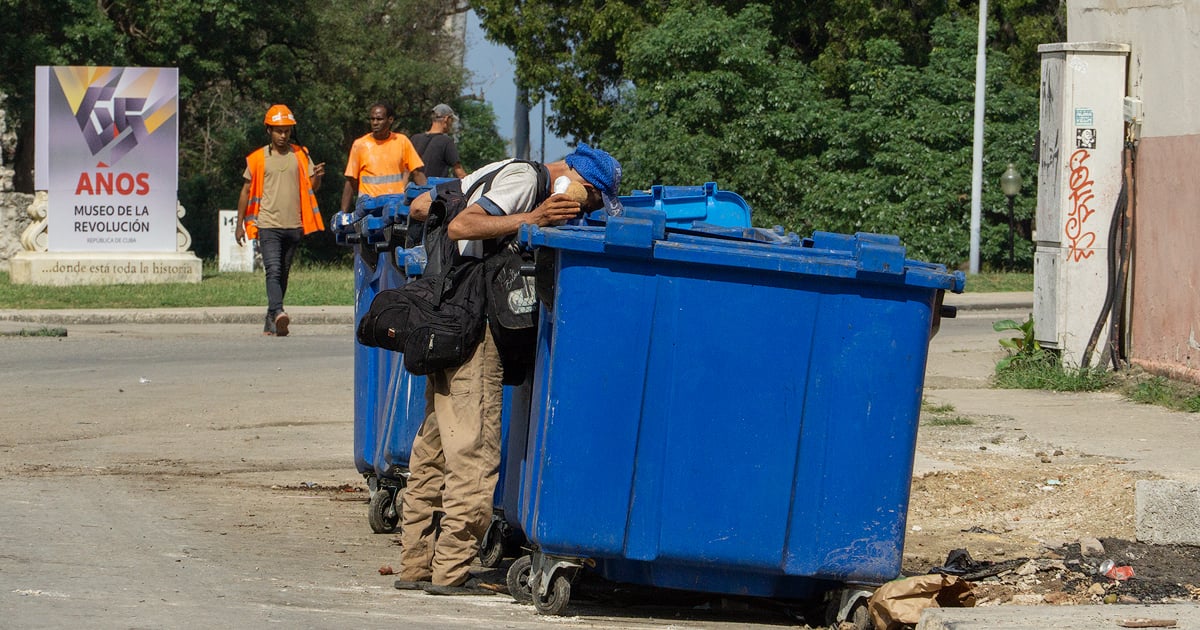
Some time ago, I saw a man searching for food among the trash in a garbage container. He was dressed in worn clothing, could barely stand, and his hunger was evident even before hearing his voice.
Without stopping to rummage through the waste, he said to me: "Fidel was the greatest politician of the 20th century." Those words impressed me far more than the material misery that lay before me. I then realized that the greatest victory of totalitarianism does not lie in controlling institutions. It consists in conquering the minds of a portion of its victims.
For over six decades, the Cuban regime built an immense indoctrination apparatus. Schools, media, mass organizations, and official propaganda disseminated a singular version of history, systematically eliminating any alternatives.
Through repetition, propaganda ceased to seem like propaganda. It ended up becoming, for many, a way of interpreting the world. However, indoctrination does not explain everything.
There is also fear. Not just the fear of prison or physical repression. There is a deeper and quieter fear: the fear of being alone, of losing one’s job, of compromising the future of one’s children, of becoming the object of surveillance or social rejection.
After many years, that fear no longer needs guardians. Each individual ends up monitoring themselves. However, there is an even more uncomfortable component that is rarely discussed: personal responsibility.
Not all complicity arises from terror. There is also the comfort of those who choose not to think, the indifference of those who prefer to look the other way, and the conformity of those who repeat a narrative because it is easier than confronting the truth.
Accepting that one has lived deceived for decades requires immense moral courage. It means recognizing that many sacrifices were in vain, that countless lives were wasted chasing an unfulfilled promise, and that reality ultimately contradicted the official narrative.
Not everyone is willing to take that path. That’s why some continue to cling to the myth even when the evidence has shattered it. History, however, teaches an unchanging lesson. Dictatorships do not fall solely due to the erosion of power. They also vanish when citizens stop cooperating with them, when fear loses its effectiveness, and when conscience regains the place it should never have abandoned.
The Cuba of the future will need to rebuild its economy, its institutions, and its rule of law. However, none of these tasks will be sufficient if civic culture and the sense of individual responsibility are not also restored.
Democracy does not only depend on holding elections. It relies on each citizen understanding that justifying oppression, remaining silent in the face of injustice, or collaborating with abuse also has moral consequences. Because no dictatorship survives solely because of its executioners. It always requires the passivity, silence, or complicity of those who, when they could choose dignity, end up upholding the very system that turned them into victims.
Related videos:
Filed under:
Opinion article: Las declaraciones y opiniones expresadas en este artículo son de exclusiva responsabilidad de su autor y no representan necesariamente el punto de vista de CiberCuba.