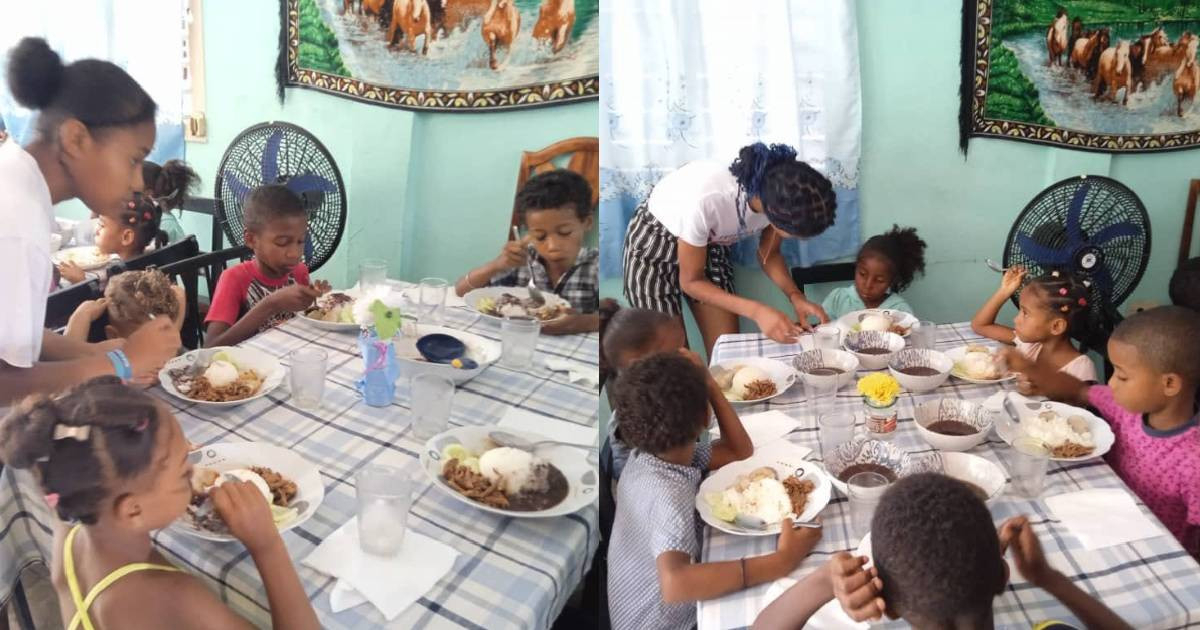
Cáritas Parish of El Cobre, in Santiago de Cuba, inaugurated this week the children's section of its solidarity dining hall, which they named Horizons, with the aim of providing meals to 20 children in vulnerable situations three times a week, the Catholic organization reported this Friday.
The project adds to the dining facilities that the same parish was already operating for elderly individuals, thereby expanding its support network for the most vulnerable sectors of the community.
According to the Archdiocese of Santiago de Cuba, the children receive a full lunch during each visit, attended by volunteers from Cáritas who, according to the organization itself, "ensure a warm welcome and proper hygiene."
The images shared show the children sitting around tables with blue and white checkered tablecloths, eating plates of rice, black beans, and meat, in a space decorated with colorful balloons and attended by volunteers dressed in white.
The parish of the National Sanctuary of Our Lady of Charity of El Cobre is one of the most active religious centers in social assistance within the Archdiocese of Santiago de Cuba.
Manages 14 social projects with over 50 volunteers and serves more than 500 vulnerable individuals, including bedridden elderly people, persons with disabilities, and families affected by migration or incarceration.
After Hurricane Melissa in the fall of 2025, the parish distributed 1,300 daily rations. In January, it facilitated humanitarian aid from the United States for 521 affected families.
The opening of Horizontes occurs at a time of unprecedented food crisis in Cuba. According to data from independent surveys, nearly 97% of the population lacks adequate access to food, one in three families goes hungry, and 29% of Cubans eat only two meals a day.
The situation is particularly dire among minors, as more than 100,000 children are not receiving their daily milk and nearly half of the schoolchildren aged six to eleven do not receive food at their educational institutions.
Infant mortality ended 2025 at 9.9 per 1,000 live births, the highest level in more than two decades.
In the face of the collapse of the state assistance system, Cuban churches have become the country's primary food network, although their own leaders acknowledge that demand is overwhelming.
The Archbishop of Santiago de Cuba, Dionisio García Ibáñez, expressed it straightforwardly on July 6: "So many people are asking for help. And the help is not enough."
In that same context, the apostle Mayim Jorge from the Viento Recio Ministry in Las Tunas, who prepares meals for 480 people weekly, summarized the work of these initiatives in this way: "We are not giving food, we are giving life."
Related videos:
Filed under: