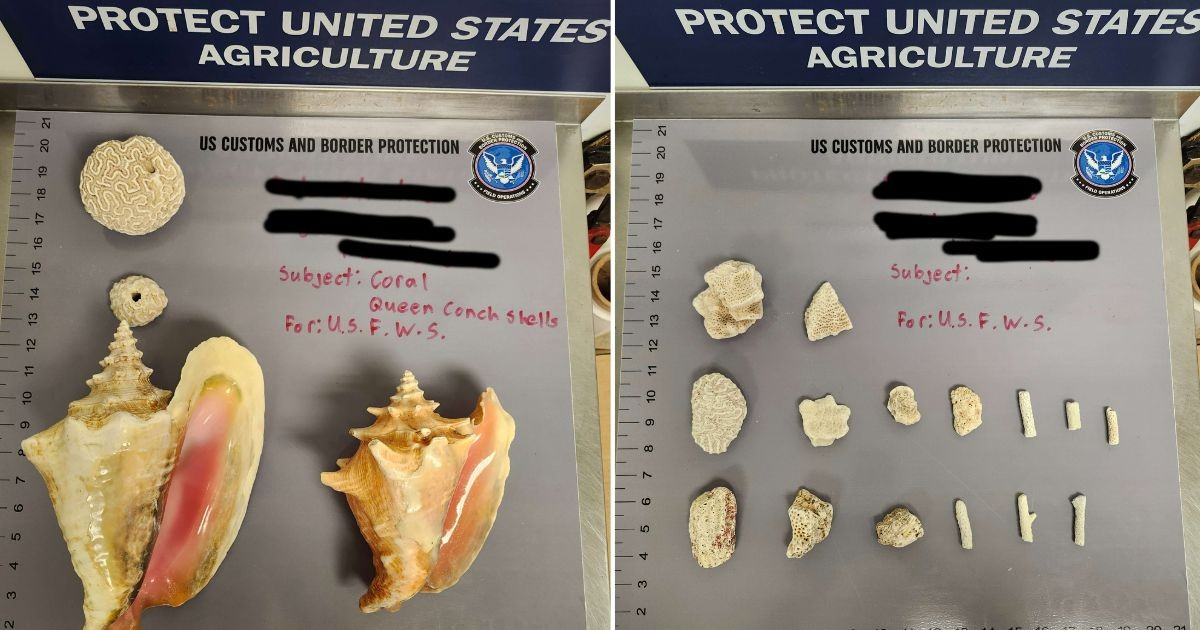
U.S. Customs and Border Protection (CBP) confiscated coral fragments and queen conch shells from passengers arriving at Jacksonville airport from Cuba on Saturday, and transferred the items to the U.S. Fish and Wildlife Service (USFWS) because they are protected species under international law.
The CBP Field Operations Office in Florida posted images of the seizure on X along with a direct message: "We love seashells, but it is illegal to import or export wildlife without a permit, and all these items confiscated from passengers arriving in Jacksonville from Cuba are protected under international law."
Among the seized objects, fragments of coral and several conchs of the queen conch species, scientifically known as Aliger gigas, previously classified as Strombus gigas, can be observed. CBP did not publicly specify the quantity, dimensions, or exact species of the confiscated corals.
Both species are listed in Appendix II of the Convention on International Trade in Endangered Species (CITES), which does not prohibit their trade outright but requires export permits from the country of origin certifying that the extraction was legal and does not harm the species.
Without those permits, importing to the United States constitutes a federal violation.
In the specific case of the cobo, it is considered a critically endangered species in the Caribbean.
Cuba suspended its fishing due to the collapse of fish populations, just like Honduras, the Dominican Republic, and the state of Florida itself, making it practically impossible to obtain a legal export permit from the island. Additionally, coral is protected by the U.S. Endangered Species Act (ESA).
According to the , import and export permits for CITES species are issued by the USFWS Management Authority Office, and the agency recommends consulting with the port of entry before transporting any item covered by the treaty.
No arrests were reported in connection with this seizure; CBP's action was limited to confiscating the items and transferring them to the USFWS for final disposal.
The incident adds to a pattern of similar seizures in recent years. In May, CBP fined a traveler arriving from Cuba $300 at Fort Myers airport for hiding plant cuttings.
Earlier, in January, a couple was arrested at Holguín airport for attempting to take 121 kilograms of meat from protected marine species, including hawksbill turtle, crab, and lobster, out of Cuba.
In December 2021, CBP seized 509 prohibited aquatic items in New Orleans from a couple returning from a cruise in the western Caribbean.
Among them were 68 stony corals, 297 mollusk shells, five queen conch shells, nine sea fans, and 47 marine sponges, as well as sea urchins, mussels, crab remains, and other pieces.
The United States has been identified as the world's leading importer of Queen conch, a demand that increases pressure on populations that have been affected for decades by overfishing and unregulated trade.
Related videos:
Filed under: