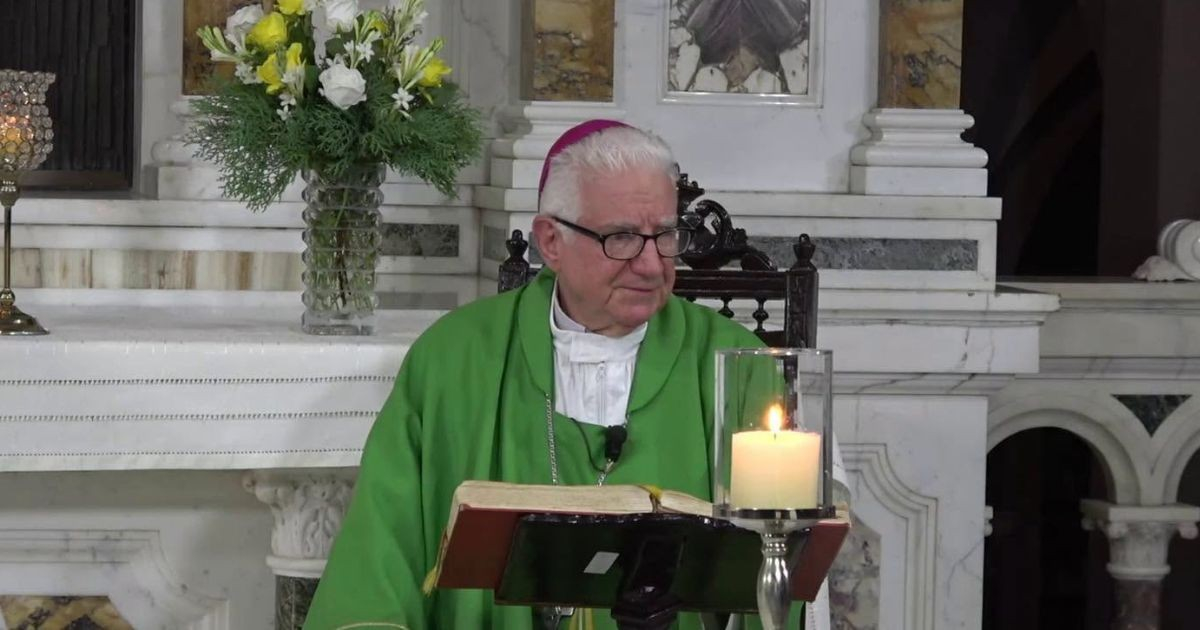
The Archbishop of Santiago de Cuba, Monsignor Dionisio García Ibáñez, expressed his sorrow this Sunday over the exodus of young people from the countryside and cities, and described an island marked by productive decline and the precariousness of a people who survive "day by day."
The statements do not formally correspond to the homily, but to the "Intentions at the beginning of the Eucharist," celebrated on Sunday at the National Shrine Basilica of Our Lady of Charity of El Cobre.
During the opening remarks, the prelate depicted the crisis facing the Cuban people and highlighted youth emigration with a question that encapsulates the demographic and productive drama of the country: “Who cultivates our fields?”.
The archbishop painted a bleak picture of the Cuban agricultural collapse, evoking a land that was once fertile and productive but is now barely recognizable.
"Where are those mills that look like something archaeological? Where is the coffee that we used to enjoy at three in the afternoon, the one we toasted with, an exceptionally high-quality coffee? Where is it? Where are the people who cultivated it?" he asked from the altar.
To that image, he added another equally striking: "Where are the fields that we also saw with the cattle? Where is [...] our typical meat, the pork? Unattainable."
The prelate described the daily precariousness with a phrase that encapsulates the reality of millions of Cubans: "Our people are living day by day. Day by day for food, since we must search for it every day; we cannot store it. Day by day for the water we are going to use, in many regions like this, many. Day by day for the money we are going to spend."
García Ibáñez also spoke about the suffering of retirees, who "have fought all their lives" and watch as their money "slips through their fingers" without being able to meet their basic needs.
The intervention also referred to management errors and the lack of solutions. The archbishop asked the people to "correct what has led us to this situation of scarcity, of not knowing how to manage things," and clarified that the aspiration is not to achieve something extraordinary, "but to at least have what we once had."
During the initial remarks of the Eucharist, the archbishop also called for unity and dialogue: "Let differences of opinion, whether educational, political, philosophical, or of any kind, not signify a break. No. It has never been that way. It should mean that we have different ways of thinking and different solutions to address the country's problems."
The statements about the crisis and the exodus were part of the initial intent of the same Eucharist, in which García Ibáñez later questioned the abuse of power: “When someone does things they shouldn’t or abuses their power, who can confront them about it? Who? Who?”.
Throughout 2026, García Ibáñez has intensified his criticisms from that very setting. In May, he called for concrete changes in Cuba and urged the rulers not to consider themselves "owners of the world"; in June, he warned against those who wield power to do "anything"; and on July 6, he acknowledged the people's distress with a phrase that resonated: "There are so many people asking for help. And the help is not enough."
The prelate's words come in the context of a unprecedented demographic exodus in Cuba: over one million Cubans have left the island by the end of 2024, and 50% of the emigrants are under 35 years old, precisely the age group that should support agricultural production and the economy of the country.
The deterioration of the countryside described by the archbishop is also reflected in the statistics: rice production fell from 304,000 tons in 2018 to 111,000 in 2025.
Root vegetables decreased by 44%, eggs by 43%, and milk by 37.6%, while in 2024 the agricultural sector recorded a 53% drop in its primary productions.
Related videos:
Filed under: