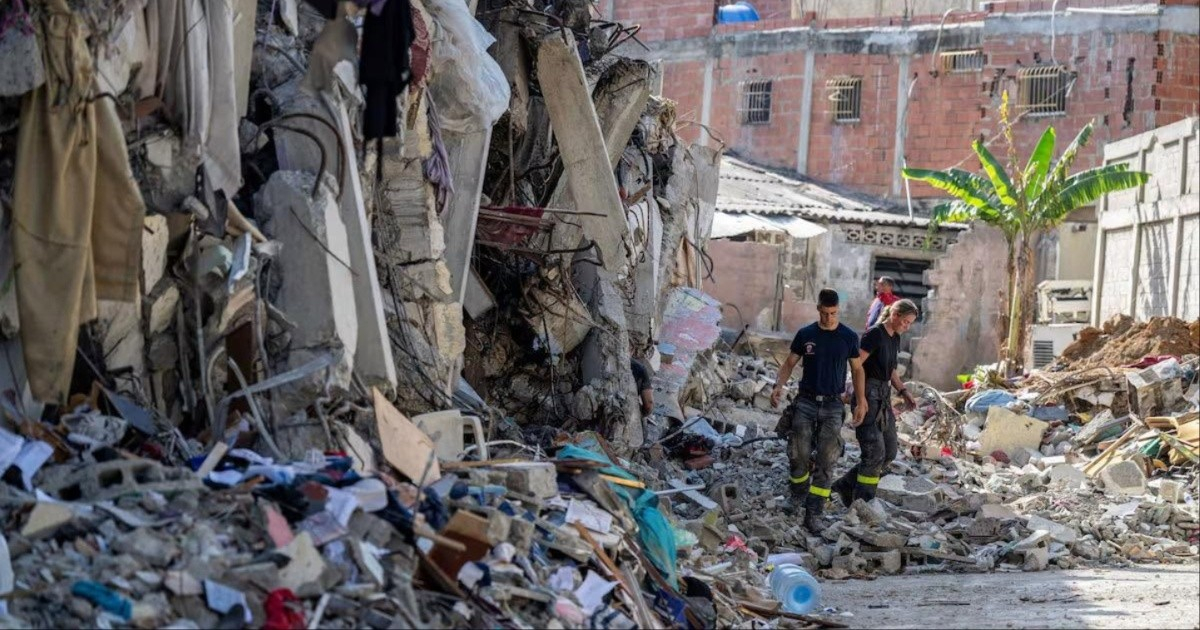
The death toll from the double earthquake that devastated northern Venezuela on June 24 continues to rise. The official report released this Sunday by Jorge Rodríguez, president of the Venezuelan National Assembly, raises the number of deceased to 5,208, 89 more than the report from Saturday, which recorded 5,119 victims.
The same report accounts for 16,740 injured, 6,462 people rescued, 17,907 homeless, and 23,820 housed in 107 temporary camps. The families assisted total 128,324. Since the main earthquake, there have been 1,388 aftershocks.
The magnitude of the emergency response is also reflected in the government report: 2,278 international rescuers, 30,989 personnel deployed, and 31,745 volunteers. Almost 11,000 tons of food and over 35 million liters of water have been distributed, in addition to providing care for 39,935 patients.
The death toll has been steadily rising since the two earthquakes—of magnitudes 7.2 and 7.5, occurring just 39 seconds apart—shook the country at 6:04 PM local time. On June 25, 164 fatalities were reported; by June 30, the number had surpassed 1,900; on July 5, it reached 3,342; by July 12, it climbed to 4,490. The actual number could be much higher: the United States Geological Survey projected a 42% probability that the total could be between 10,000 and 100,000. The UN estimates up to 68,000 missing persons and more than 6.7 million people affected.
The epicenters were located near San Felipe (Yaracuy) and Yumare (Carabobo), within the San Sebastián fault system. The coastal towns of La Guaira state — Caraballeda, Catia La Mar, Macuto, and Naiguatá — experienced the worst damage: over 346 buildings collapsed and approximately 63,000 structures were damaged. NASA confirmed, via the NISAR satellite, that the fault displaced the Earth's surface by up to 60 centimeters near Caracas International Airport.
The disaster also struck the Cuban community residing in Venezuela. At least 32 Cubans have been reported missing, primarily in La Guaira, and at least nine have been confirmed dead; however, an updated official list from the Government of Cuba has not been published. This Sunday, a Cuban woman confirmed the death of her parents and other relatives trapped under the rubble of a building in Naiguatá since June 24. "Today many are asking me how I am. It really was a very, very hard blow. I am still searching for their bodies; it hasn't been easy for me," the woman wrote on her social media.
Another Cuban, a nurse from Camagüey with 27 months of mission in Venezuela, experienced the earthquakes in La Guaira and continued working in clinics and shelters. "People were running, crying, and screaming. I can tell you about it, but you have to live it," she recounted.
Cuba had more than 12,000 health collaborators in Venezuela at the time of the earthquake and sent the Henry Reeve Contingent in two groups —on June 28 and June 30— with surgeons, forensic experts, and search dogs. However, the government's response was criticized: on June 27, the Ministry of Foreign Affairs denied having "official confirmation" of affected Cubans. Even more striking was the double standard of the Díaz-Canel regime: it did not declare any mourning period for the thousands of Venezuelan victims, but signed 48 hours of mourning for the recent death of the Emir Father of Qatar.
This earthquake is considered the deadliest in modern Venezuelan history and the largest seismic event recorded in the country since 1900. Internationally, Venezuela accessed 346 million dollars from its own resources in the International Monetary Fund to finance recovery and reconstruction, while the United States pledged more than 386 million dollars in humanitarian and emergency assistance.
Related videos:
Filed under: