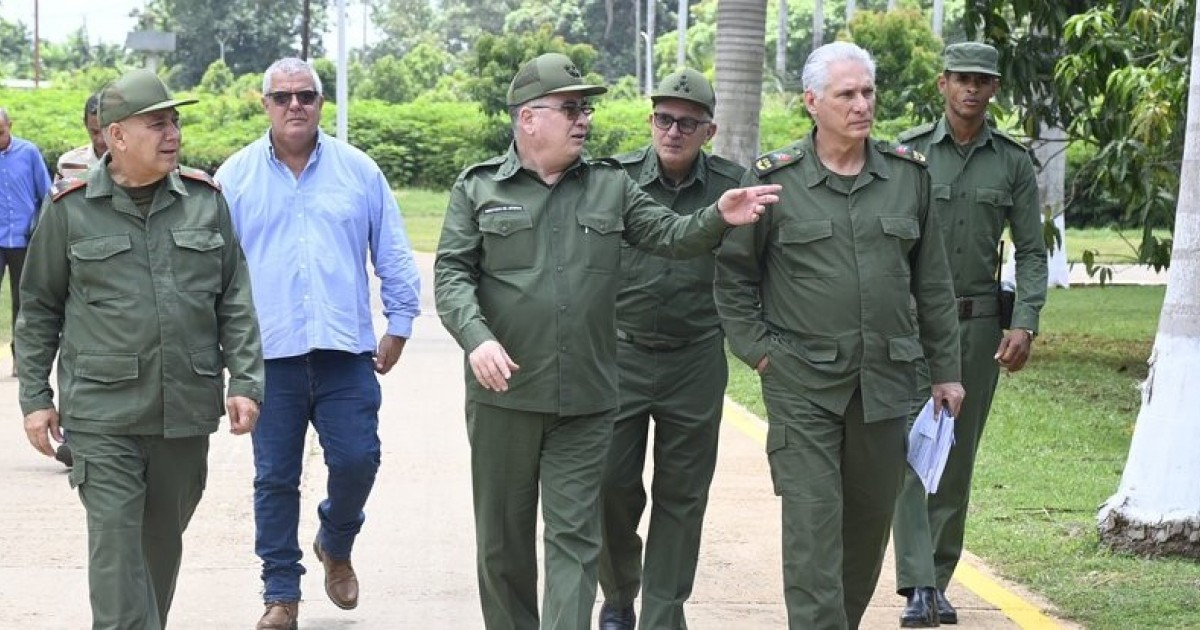
Miguel Díaz-Canel granted an interview to the Russian state channel RT in which he defended the Cuban regime's position to keep the dialogue channel open with Washington, while warning that an armed confrontation would be "a bloodbath that would bring terrible consequences for both nations."
The Cuban leader justified the continuation of the dialogue by appealing to historical tradition, a stance that makes any real progress practically impossible.
"The revolution has always advocated for finding a solution to the bilateral differences between Cuba and the United States through dialogue," he stated, although he conditioned any progress on the conversations taking place "on the basis of respect, equality, where nothing is conditioned."
He also emphasized that issues of political system, self-determination, and independence "are not up for debate."
Díaz-Canel blamed the United States for the current difficulties: “It is very difficult to engage in dialogue under these conditions, when there is a power that constantly assumes the role of aggressor” and “has historically failed to meet its commitments.”
Nevertheless, he insisted that the regime will not abandon the peaceful path, invoking the teachings of Fidel Castro: "Dialogue is the way to achieve peace, and peace is the premise for achieving stability."
The president also rejected the accusation made on July 16 by Secretary of State Marco Rubio, who during a ministerial conference with representatives from more than 70 countries labeled Cuba as the "world capital of radical leftist terrorism" and accused Havana of financing a "platform for political terrorism." Díaz-Canel described it as a "pretext" invented by Washington to justify a potential military aggression.
In the same interview, the leader denounced that the United States is engaging in a "multidimensional aggression" with ideological, cultural, and media components, and accused Washington of promoting a narrative that is "supremacist, capitalist, and imperial, very slanderous, very false."
The choice of RT as the platform for these statements is not coincidental: Díaz-Canel praised the Kremlin channel as a reliable source, claiming that Cuba follows it "when it wants to clarify itself amid so many lies told in the world."
The statements come amid the worst bilateral crisis between Cuba and the United States in decades, with over 240 sanctions imposed by the Trump administration since January and an energy blockade that has left the Island almost without fuel for six months.
The chancellor Bruno Rodríguez had already warned on June 30 that the bilateral conversations "show no progress" and that Washington combines dialogue with threats and coercive measures.
The regime also revealed the extent of the energy crisis affecting the Cuban population. "It has been six months since a fuel ship has arrived; only a Russian ship came," Díaz-Canel admitted, in a confession that contrasts with the official narrative of heroic resistance and underscores the direct impact of sanctions on ordinary Cubans, who endure blackouts lasting more than 24 consecutive hours.
The leader also promised that by the end of July the government would be in a position to implement 121 of the 176 approved economic measures, starting with those aimed at retirees and low-income individuals, although without providing specific guarantees that they will alleviate the structural crisis the Island has been facing after 67 years of dictatorship.
Related videos:
Filed under: