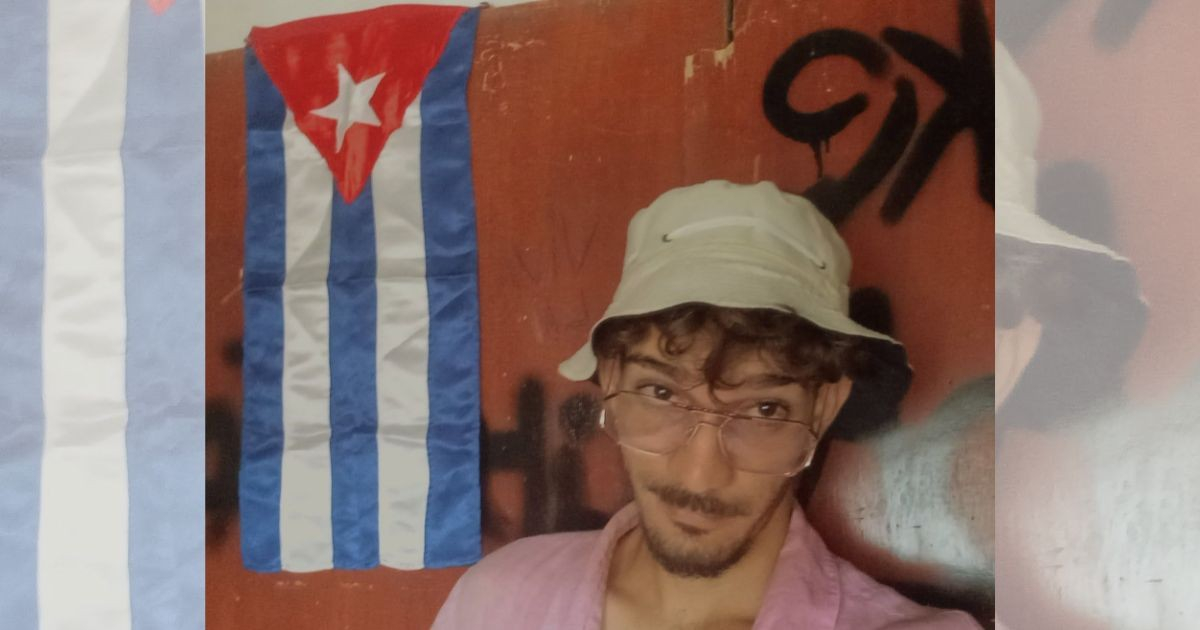
A young resident of Havana reported this Monday that he was fired from his job for exclusively political reasons, without any workplace, accounting, or ethical misconduct involved.
Amel Andrés Alfaro Méndez posted a direct message on his Facebook profile: "I was expelled from my job. Not for accounting or ethical issues. Just for being a confessed anti-communist."
The young man, who describes himself as a "nationalist liberal by choice," asserted that the measure was a response to his public opposition to the Cuban communist system.
"90% of Cubans –according to him– are currently against the system; we have more than enough reasons. But for those of us who choose to express it, it costs us our freedom, peace of mind, or our jobs, as was my case," he wrote.
Alfaro had previously demanded, publicly, the “absolute and immediate” dissolution of the Communist Party of Cuba, as reported by the news portal Árbol Invertido.
The affected individual describes what happened as "unjust and immoral workplace harassment" and interprets it as a tactic to financially suffocate him until he abandons his positions.
However, rather than retreating, he asserted that the outcome was the opposite of what those who ordered his dismissal had anticipated: "It backfired on them. This only confirms that I am on the right side of history and that soon, sooner rather than later, those who have turned Cuba into a concentration camp will pay."
The post generated solidarity, and several followers shared similar experiences, revealing a pattern that recurs across different sectors and times.
Ivan Hernandez recounted that, after the protests on July 11, 2021, someone he knew reported him to Military Counterintelligence: "Everything ended with my dismissal from work despite my contributions as an employee. In the end, that’s how this dictatorship operates to blackmail workers in state-owned companies."
Hernandez was a civilian worker for XETID, a technology company affiliated with the Cuban Armed Forces.
Oto Frometa recalled that in 1994 he was dismissed from a polytechnic for refusing to pay the official union: "Back then, doing that was marking yourself. But I didn't pay... and I survived."
A follower, Dreidy Avila, warned the young man from Havana about what could come: "Now they won't leave you alone until they put you in jail. Take care."
Karelys Suarez summed up the feelings of many in the comments: "And then they fill their mouths saying that there is no repression here, that freedom of expression is respected, all their lies, really."
The case of Alfaro Méndez adds to a series of documented labor reprisals in Cuba during 2025.
In addition, last March, for example, the communicator Ewald Nieves Manduley was dismissed in Guáimaro, Camagüey, for questioning on Facebook the political use of José Martí's figure.
That same month, the professor Abel Tablada was dismissed from the Technological University of Havana (CUJAE) due to critical posts on social media, which sparked student protests.
And between April and May, executives from state-owned companies were pressured under the threat of dismissal to ensure at least 80% participation in the official campaign "My Signature for the Homeland."
In Cuba, state employment remains a significant source of formal income for most workers, making dismissal one of the regime's most effective tools of political repression.
The Cuban Workers' Central (CTC), the only permitted union, operates under state control and does not defend those affected by such reprisals.
Related videos:
Filed under: