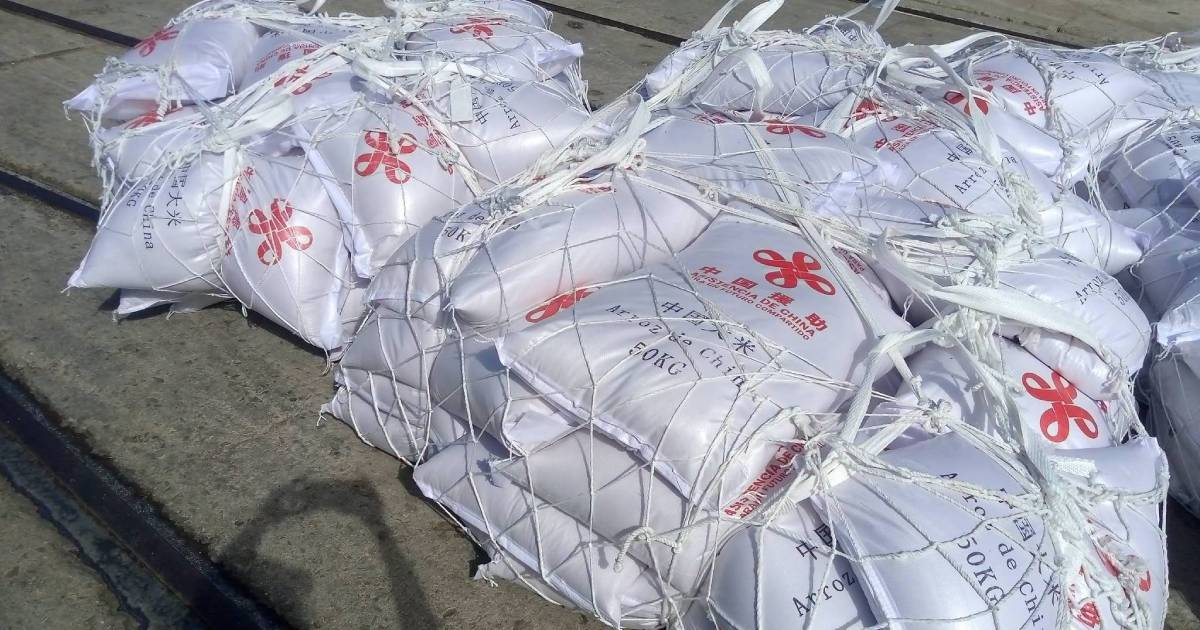
The Ministry of Domestic Trade (MINCIN) announced on Tuesday that residents of Camagüey will receive three pounds of rice donated by China for free, as part of the distribution of the regulated family basket. Rather than generating relief, the announcement prompted a wave of criticism on social media, where many Cubans denounced the ongoing delays in food deliveries and questioned the Government's portrayal of this assistance as an achievement, deeming it insufficient.
The report, published on the social media of MINCIN and shared by the Bodegas Camagüey Telegram channel, acknowledges "limitations and delays in deliveries" and states that the donated rice has yet to arrive in the province.
According to the organization, the distribution of peas is also being completed in the municipalities of Guáimaro, Camagüey, Florida, Carlos Manuel de Céspedes, and Sibanicú, in addition to progressing the delivery of powdered milk for children up to six months and baby food, with Nuevitas as the only municipality still pending.
However, the report itself acknowledges that there is no coverage for basic products like oil, coffee, and sugar, while the distribution of cigarettes remains partial and several municipalities have outstanding quotas.
The reactions came quickly.
"Misery calls for misery," wrote one user. Another internet user expressed the sentiment of many with a striking phrase: "They flaunt their misery."
Several comments pointed out that some of the advertised products are months behind schedule. "You should be ashamed to promote that rice that was supposed to be available in June, and now we are at the end of July and August is approaching," wrote Osmany Toledo Álvarez.
Other users pointed out that the pea whose distribution is now announced by MINCIN actually corresponds to the quota for February.
The amount of rice allocated to Camagüey has also caused discontent. While other provinces will receive a greater share of the Chinese donation —up to eight pounds per person in Las Tunas, Holguín, and Granma, and five in Santiago de Cuba— the people of Camagüey will only receive three pounds.
"Why 3 pounds and in other provinces 5? Is it discrimination?" asked one user. Another stated that the original donation accounted for eight pounds per person and commented ironically, "They stole the other five."
An internet user questioned the official message with a direct criticism of the Government: "Cuba's policy is all about saving face. We know that three pounds aren't enough, we know that giving you February's peas in July is nonsense... In the end, they don't care whether people eat or not; what matters to them is making the announcement and appearing to be the good guys."
The complaints were not limited to Camagüey. From Santiago de Cuba, a user reported that the cigarettes on the ration card "have been noticeably absent for months" and that they can only be found in the informal market, where a pack costs 500 pesos.
The situation reflects the ongoing deterioration of the state distribution system. In May, authorities in Camagüey acknowledged the sale of expired toothpaste in stores and claimed it could be used "without risks." Shortly after, the Minister of Food Industry admitted on state television that in 2026 it has not been possible to ensure the distribution of products such as oil, chicken, and yogurt, while coffee has only made it to Havana once.
The MINCIN attributes the delays to the shortage of fuel for transporting food from the ports and collection centers. Nevertheless, interruptions in the delivery of the basic basket have become a constant issue throughout the country.
Uncertainty increased even further on June 18, when Miguel Díaz-Canel announced that the supply booklet will no longer be universal and will focus on retirees, families with children suffering from chronic illnesses, and individuals deemed vulnerable, a reform that represents the most significant cut to the rationing system since its establishment in 1962.
Related videos:
Filed under: