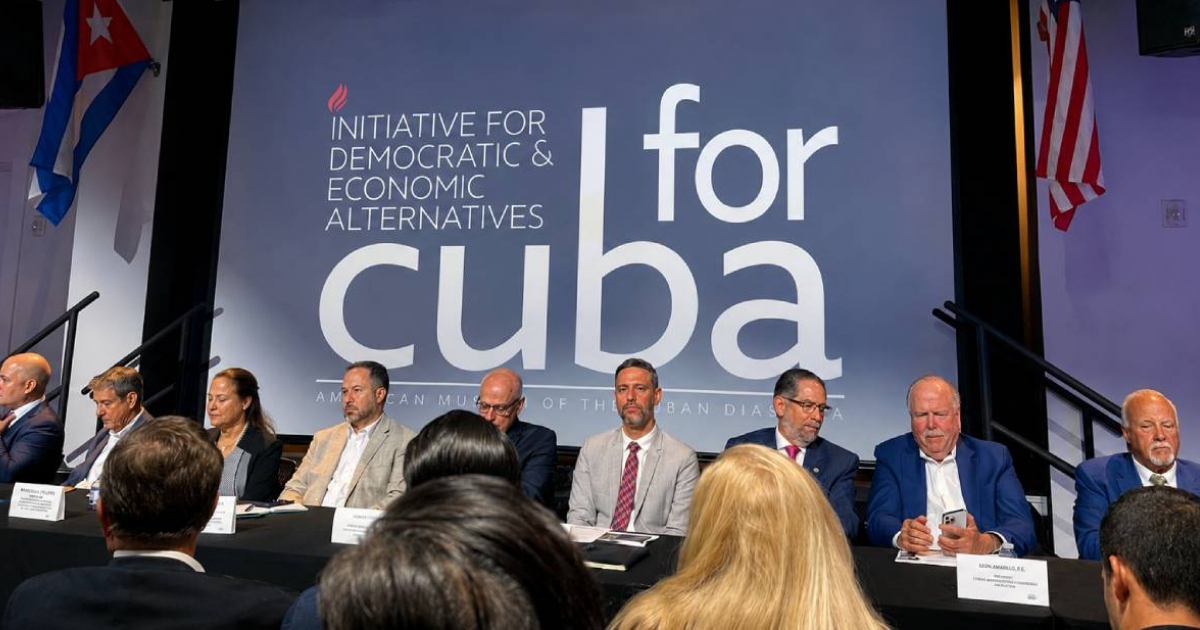
A dozen Cuban specialists in infrastructure, economics, engineering, urban planning, and law are working from Miami on designing a roadmap for the reconstruction of Cuba in the event of a democratic transition.
Far from being limited to a political debate, the initiative seeks to answer a specific question: What needs to be done during the first months and the first years to revive a country marked by the deterioration of its basic services and economy?
That was the focus of the forum "Initiative for a Democratic and Economic Alternative for Cuba", held at the American Museum of the Cuban Diaspora this Wednesday. Experts from various disciplines began presenting sectoral plans with cost estimates, timelines, and priorities.
The initiative brings together the American Museum of the Cuban Diaspora, the Cuban Studies Institute at Florida International University (FIU), the Cuban-American Engineers Association, the Foundation for Human Rights in Cuba, and other organizations, with the aim of preparing technical proposals before a potential political change occurs on the Island.
What do the plans consist of?
TNT24 interviewed several experts participating in the forum. The specialists agreed that Cuba's recovery would not begin with large projects, but with the restoration of essential services and the creation of conditions to attract investments.
"In this forum, we began with the infrastructure, which is the main economic engine for this reconstruction, but there will be other discussions focusing on areas such as housing. The legal system, which is the most important, is scheduled for September because we will have the assistance of prominent legal experts," stated Marcell Felipe, president of the American Museum of the Cuban Diaspora.
Among the main proposals presented are:
- Rebuilding the electrical system, regarded as one of the priorities to put an end to power outages. Researcher Jorge Piñón estimated that the recovery of the sector would cost between 5 billion and 8 billion dollars and would take between three and five years. "The cost of recovering the electrical sector in Cuba would be between 5 billion and 8 billion dollars and is expected to take between three and five years," he stated.
- Recovering drinking water and sewage systems. Engineer Josenrique Cueto estimated that the required investment would be around 8 billion dollars. He explained, "an initial recovery could be feasible in about 24 months. However, having a functioning, stable, and consistent system would take at least between five and ten years."
- Modernizing highways, ports, railways, and cities. During the meeting, it was noted that much of the national infrastructure remains operational, although it has decades of accumulated deterioration, requiring extensive renovations.
- Addressing the housing deficit, estimated at around one million homes, through future specific programs that will be discussed in new conferences.
- Design a new legal framework that guarantees private property, legal security, and investment protection, regarded as an essential requirement to attract capital.
- Fostering a gradual economic recovery. Participants suggested that an initial stage could focus on reactivating tourism and port activities to generate income that would allow for financing other investments.
- Restructuring the energy sector. Among the proposals is to review the future of existing refineries and redesign the strategy for fuel production and supply.
How much would it cost to rebuild Cuba?
The figures presented during the forum reflect the magnitude of the challenge. Rafael Romeu, president of the Association for the Study of the Cuban Economy, estimated that the first 180 days of stabilization would require between 180 and 270 million dollars, primarily financed through private American capital.
The businessman Luis Ajamil, president and CEO of Bermello Ajamil & Partners, stated that there will be several phases after the fall of the regime for the reconstruction of Cuba.
"In the first phase, I believe the most logical step is to start with tourism, by bringing in large ships, because that's already in place, it generates revenue, it attracts investment. Little by little, as the economy begins to recover, the freight segment will come into play," he noted.
Experts estimate that in a second phase, the comprehensive recovery of the country—including energy, infrastructure, housing, agriculture, tourism, and telecommunications—would require between 275 billion and 375 billion dollars over a period of 10 to 15 years.
Why are they creating these plans now?
The organizers assert that a potential transition will require immediate decisions and that waiting for a political change to begin designing them would mean losing valuable time.
Marcell Felipe emphasized that the diaspora has the technical knowledge and the necessary capital to take part in the country's recovery.
"We have the human talent, the capability, and the private capital in exile that is ready to invest immediately to rebuild the country, without the American government participating in those areas, but all of this depends on one essential issue: the change of regime."
Political change, an essential condition
Beyond the figures and technical projects, the consensus of the forum was that none of these proposals could be implemented without a transformation of the Cuban political system and the country's laws.
Regarding the importance of the legal system for Cuba's development, architect and urban planner Willy Bermello stated: "First, there must be a legal framework that protects all types of private investment; otherwise, capital will not flow in. There needs to be the assurance of a democratic balance in Cuba, something that does not exist today."
The importance of these plans lies in their aim to prevent improvisation in a transitional scenario.
The aim is to have defined diagnoses, projects, and priorities to accelerate the recovery of public services, build trust among investors, and lay the groundwork for long-term economic reconstruction.
Related videos:
Filed under: