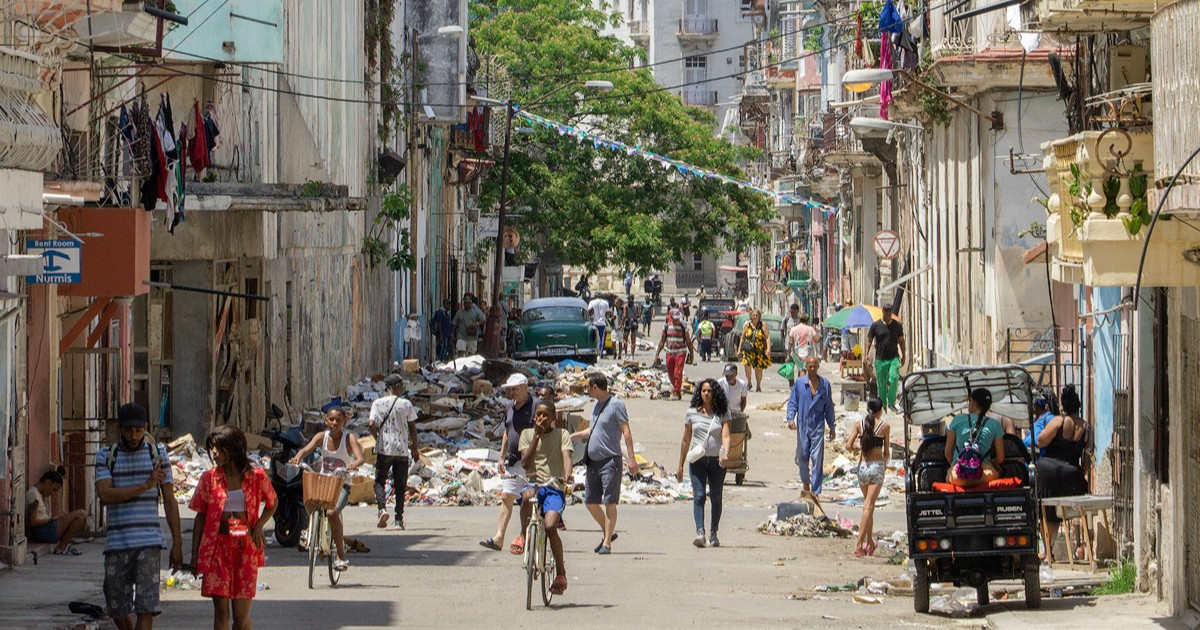
Businessmen, academics, and engineers gathered in Miami estimated on Wednesday that restoring a functional infrastructure in Cuba after decades of deterioration under the Castro dictatorship would require between 275 billion and 375 billion dollars and a timeframe of 10 to 15 years.
The estimates were presented at the forum “Initiative for a Democratic and Economic Alternative for Cuba,” held at the American Museum of the Cuban Diaspora.
More than a dozen specialists in energy, engineering, urban planning, and economics participated in the event to answer a specific question: how much money and how much time would it take to rebuild the country in the event of a democratic transition.
Rafael Romeu, president of the Association for the Study of the Cuban Economy, estimated that the first 180 days of stabilization would require between 180 and 270 million dollars, financed mainly by private U.S. capital, not by government aid.
The energy sector was the focus of much of the debate. Jorge Piñón, a researcher at the Energy Institute of the University of Texas, warned that restoring the Cuban electrical system would cost between 5 billion and 8 billion dollars and would take between three and five years.
"These plants are worn out, they are broken, poor technology; they are burning Cuban oil, which is the vicious cycle that increasingly deteriorates the power generation system on the island. So it will take time," Piñón noted, recalling that more than a dozen generating units have accumulated over 40 years of operation.
The expert also warned that any agreement with suppliers of floating plants would be contingent upon a future democratic government settling reported debts exceeding 100 million dollars and providing financial guarantees to investors.
The water and sewer system would pose a similarly significant challenge. Josenrique Cueto, former interim director of the Miami-Dade County Water and Sewer Department, estimated that expense to be around 8 billion dollars.
"An initial recovery could be feasible in about 24 months. However, having a functioning, stable, and consistent system would take at least between 5 and 10 years," he clarified.
In terms of road infrastructure, Carlos A. Penín, president of CAP Engineering, emphasized that private capital will not participate without guaranteed return mechanisms. "The government needs a plan where they allocate funds every year for the roads. The private sector will not get involved unless there are tolls, as that is how they recoup their investment," he explained.
Participants agreed that sectors such as tourism, telecommunications, and the cruise industry could progress more rapidly and generate the necessary revenue to fund later stages of reconstruction.
The forum took place on the same day that Secretary of State Marco Rubio stated from the Philippines that Cuba "has a direct impact on national security" of the United States, described it as a "failed state," and reiterated that Washington seeks a prosperous Cuba, although he declined to discuss timelines or concrete actions beyond the current pressure.
On July 11, Rubio revealed that the U.S. officially offered aid for reconstruction, contingent upon genuine political and economic reforms.
The consensus of the forum was that no plan could be implemented without a change of regime. In this regard, the words of Marcell Felipe, president of the American Museum of the Cuban Diaspora, were clear and direct.
"The future of Cuba can be extremely bright. We have the human talent, the capability, and the private capital in exile that is ready to invest immediately to rebuild the country, without the American government being involved in those areas. However, all of this depends on one essential issue, which is regime change. That will not happen as long as the Castro family and the Díaz-Canel family are leading that system."
This forum is part of a broader initiative that brings together several exile organizations, including the Cuban Studies Institute of FIU, the Cuban-American Engineers Association, and the Foundation for Human Rights in Cuba. A forum on the Cuban legal system is scheduled for September, featuring the participation of legal experts, as part of the same planning agenda.
Related videos:
Filed under: