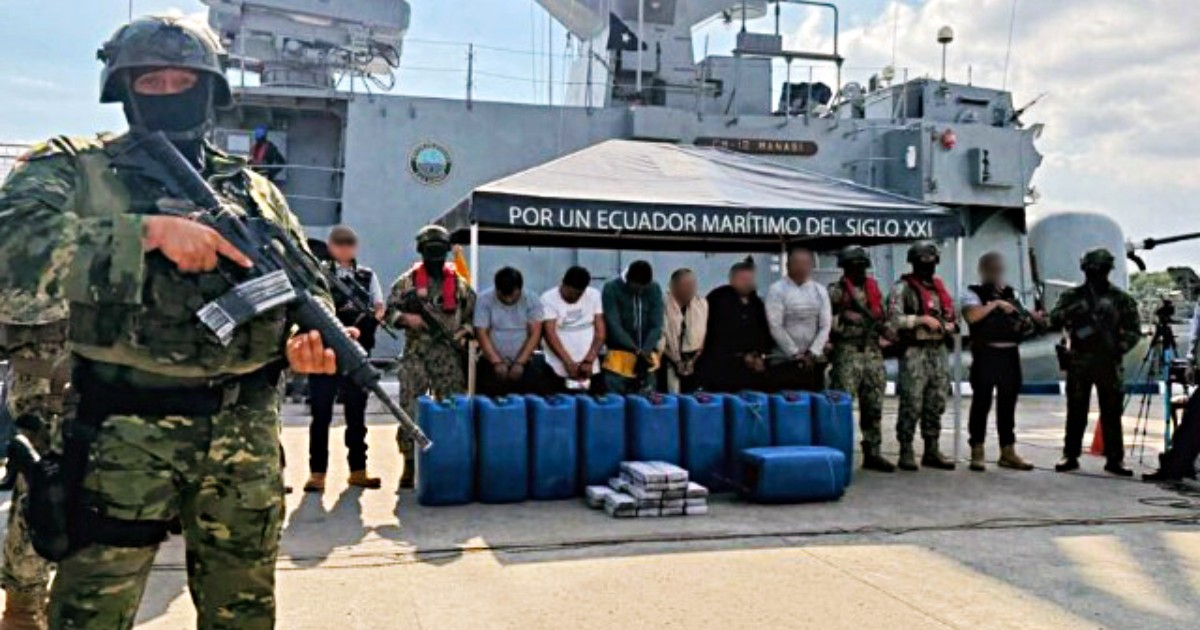
A coalition formed by the Joint Interagency Task Force South (JIATF-S), the Ecuadorian Navy, the Colombian Navy, and the DEA seized 2,728 kilograms of cocaine this Wednesday in the Eastern Pacific, which JIATF-S itself deemed the largest blow to maritime drug trafficking at sea in Ecuador during 2026.
The operation began when a maritime patrol aircraft from the United States Southern Command (SOUTHCOM) detected two fast boats traveling parallel to the south of Colombia, originating from Ecuador and heading to Mexico.
Six traffickers were arrested, all of Ecuadorian nationality.
The aircraft crew tracked the vessels overnight and coordinated in real-time with JIATF-S, which in turn guided the Ecuadorian Navy surface ships to the exact interception point.
During the surveillance, the traffickers encountered a fishing boat to exchange crew members and refuel, a common maneuver on these Pacific routes.
When boarding the vessels, the teams discovered 73 modified fuel barrels with double bottoms designed to conceal the drugs, a hiding technique that is becoming increasingly sophisticated in these operations.
JIATF-S described the operation as a demonstration of what regional cooperation means: "JIATF-S, Ecuador, Colombia, and the DEA joined forces to intercept a massive shipment of cocaine in the Eastern Pacific, delivering the most significant blow to drug trafficking at sea in Ecuador this year."
The agency also emphasized that these efforts, led by the U.S. Department of Defense, "cut off funding to transnational crime, strengthen regional security, and protect our homeland."
The operation is part of a phase of cooperation between Ecuador and the United States described as a "total offensive," with multiple maritime interdictions planned throughout 2026 in the Pacific and the Caribbean.
The 2026 World Drug Report by the UNODC, published at the end of June, identified Ecuador as a key logistical platform for global cocaine trafficking, indicating that criminal networks exploit the extensive Pacific coast, port infrastructure, and legitimate maritime trade—including banana exports—to conceal illicit shipments.
In March, the Armed Forces of Ecuador, with U.S. support, bombed a narco camp in the Amazon as part of the "Total Extermination" operation against the Border Command in Sucumbíos.
In the maritime sphere, a joint operation in June had already resulted in the detection of an Ecuadorian narco boat in the Caribbean with the seizure of over 3,900 pounds of marijuana and the arrest of two Ecuadorian nationals.
In July, the Ministry of the Interior of Ecuador reported joint operations with the DEA at sea that resulted in the seizure of more than three tons of drugs and the arrest of 11 individuals, with interdictions carried out 180 nautical miles west of Manta, having an estimated economic impact of over 80 million dollars for the criminal networks.
Related videos:
Filed under: