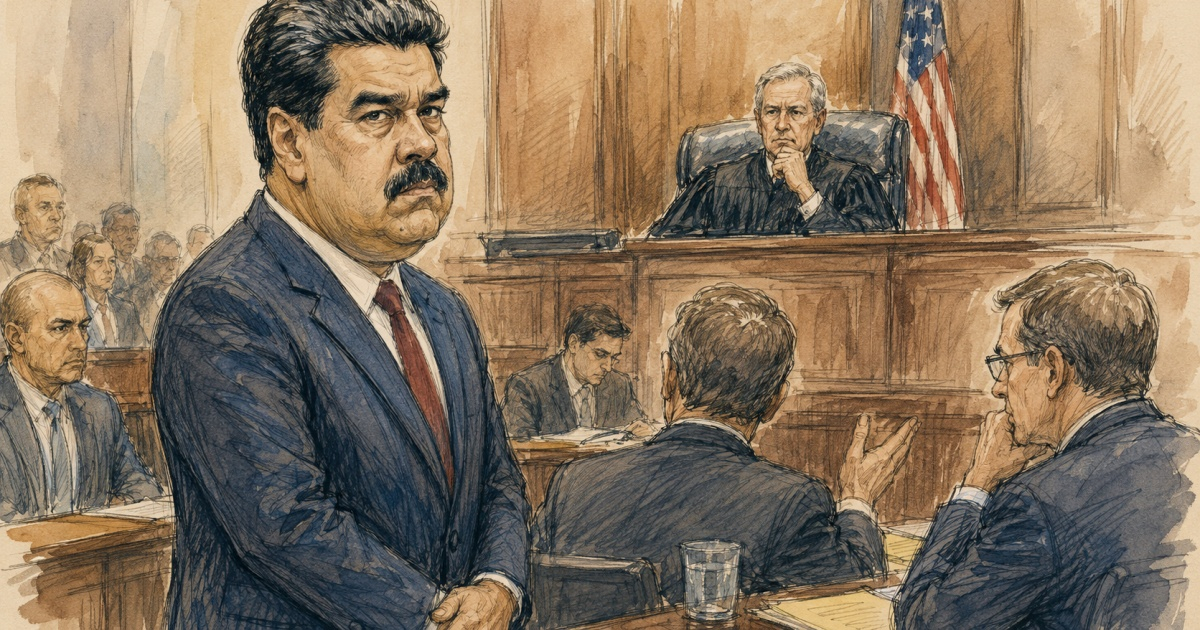
The Southern District of New York Prosecutor's Office filed a court document on Tuesday proposing that the trial against Nicolás Maduro and his wife, Cilia Flores, on charges of narco-terrorism and drug trafficking, begin in the middle of next year.
The Prosecutor's Office has requested that the trial begin in June 2027, as reported by the agency EFE.
The proposal was jointly presented by prosecutors and defense attorneys before Judge Alvin Hellerstein, as confirmed by CNN.
On the other hand, the hearing scheduled for this Wednesday—the third since Maduro's capture on January 3, 2026, in Caracas—does not signify the start of the trial or the issuance of any verdict.
Its purpose is to review the status of the process, the exchange of evidence, and the timeline for pre-trial motions.
The session had been rescheduled from June 30; the Department of Justice justified the change by the need to "avoid logistical and scheduling issues related to the provision of secure transportation and security."
Maduro and Flores have been held at the Brooklyn Metropolitan Detention Center since their arrest, awaiting trial.
The proposed procedural calendar
The court document establishes a roadmap with specific deadlines before the oral trial can commence.
The defense will present its initial arguments in September 2026, while the U.S. government is expected to deliver the majority of the classified materials during November.
Legal teams will have until early 2027 to file new motions, after which the court will set the trial date definitively.
Maduro faces charges of conspiracy for narco-terrorism, conspiracy to import cocaine into the United States, and possession of weapons of war, all of which carry sentences of up to life imprisonment.
In their first appearance on January 5, both pleaded not guilty.
Maduro then stated: "I am a prisoner of war" and "I am still the president of Venezuela."
The defense strategy
The attorneys Barry Pollack -who represents Maduro- and Mark Donnelly -defender of Flores- are preparing a legal offensive to try to nullify the proceedings, questioning the jurisdiction of U.S. courts, claiming head of state immunity, and challenging the legality of the arrest.
A key legal element is the bilateral extradition treaty of 1922 between the United States and Venezuela, whose clause states that "all differences between the contracting parties, relating to the interpretation or execution of this treaty, will be decided by arbitration."
According to a column published by The New York Times on Tuesday, if the Venezuelan government activates that clause, U.S. courts may lack the authority to continue the process.
The legal expert David Sloss noted that “it would not be particularly surprising if the dispute were temporarily withdrawn from the courts and submitted to arbitration.”
The judge Hellerstein has already rejected previous attempts to dismiss the charges, stating: “I am not going to dismiss the case.”
The diplomatic context complicates the process
The trial is progressing amid a complex diplomatic dynamic between Washington and Caracas.
In April 2026, the United States modified the sanctions on Venezuela to allow the Venezuelan government to finance the legal defense of the accused.
This Tuesday, the Trump administration also requested that judicial immunity be granted to the interim president Delcy Rodríguez in a civil lawsuit filed in Florida.
The Secretary of State, Marco Rubio, confirmed on Monday the start of transition talks in Venezuela for August 2026, adding a significant political dimension to the judicial process.
If the proposed schedule holds, the trial against Maduro and Flores would not begin before the summer of 2027, more than a year and a half after their arrest in Caracas.
Related videos:
Filed under: